Every Doctor Who Series Ranked
Now that the Whoniverse is on BBC iPlayer, which is the best Doctor Who TV series of all time?

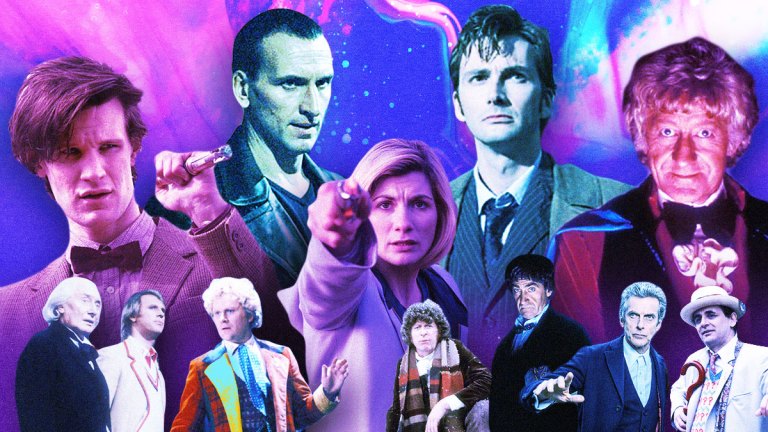
It’s Doctor Who’s 60th anniversary month, which calls for two things: celebration, and admin. Fittingly, here’s an administrative celebration of the BBC show, featuring every season/series that’s aired so far. After a six-tab Excel file and a lot of overthinking, it’s a big ol’ list arranging each of Doctor Who’s individual runs in reverse order of excellence.
(A note on methodology: this list does not include runs of Doctor Who specials or the TV movie, and Christmas specials are included under the entries for their relevant series.)
There’s good stuff everywhere in Doctor Who. Sometimes it can take a bit of digging to find it, but much of the time, you hardly even have to look – it’s just there, posing as the Commissioner from Sirius 4, or asking “Do I have the right?”. What follows is an attempt to arrange each season and series of the show since 1963 in order of how much great stuff they contain, and how well it all works as a whole.
39. Season 19 (Fifth Doctor, 1982)
A time of four script editors: Christopher Bidmead commissioned most of the stories (with producer John Nathan-Turner commissioning ′Earthshock′ and ′Black Orchid′ – the latter a story Bidmead had rejected – and doing some script editing too), Anthony Root came in then got seconded to Juliet Bravo – so Eric Saward got a temporary contract – then Root stayed put and Saward stayed on.
As a result, we get a patchwork of approaches in season 19, exemplified by ′Kinda′ – a story in which Janet Fielding’s Tegan is mentally tortured in her dreams by the evil Mara. ‘Kinda’ was commissioned by Bidmead, and written for Tom Baker’s Doctor with one companion before being retooled for Peter Davison and two (then three) companions, before Saward script-edited the story. Despite so many cooks threatening to spoil this broth, ′Kinda′ was a highlight, though one dismissed by 1982 fandom – a strange reaction seeing as it was surrounded by dull, strangely structured, half-remembered Sixties throwbacks.
The exception to those is ′Earthshock′ – a ludicrous collection of pseudo-dramatic moments held together by brutally efficient direction and everyone – especially Matthew Waterhouse as companion Adric – performing with incredible conviction.
38. Season 22 (Sixth Doctor, 1985)
This season attempts to show the Doctor responding to a violent and complex universe with violence of his own. ′Attack of the Cybermen′ concludes with the Doctor saying he′s never misjudged anyone as badly as he′s misjudged Lytton, who has met him twice and tried to kill him. ′Vengeance on Varos′ pokes gently at the relationship between Doctor Who, horror and its own viewers. ′The Two Doctors′ is either a grim continuation of this violent streak or, as its defenders suggest, a clinical examination of Doctor Who’s flaws.
Season 22 might have ambitions to interrogate the whys and wherefores of Doctor Who but either doesn′t engage beyond superficiality, or the interrogation is so rigorous that it renders the subject comatose.
37. Season 11 (Third Doctor, 1973- 1974)
Season 11 isn’t without its charms but feels untethered after the erosion of a successful formula. Starting again after the departure of Katy Manning’s companion Jo Grant and the death of Master actor Roger Delgado, this season finds the show in transition.
Among the positives are the introduction of Elisabeth Sladen as Sarah-Jane Smith and alien race the Sontarans. Stalwart Malcolm Hulke′s final script for the series, ′Invasion of the Dinosaurs′, is as rounded as you′d expect from him but also has a bitter, jaded quality. ′Death to the Daleks′ is endearing Terry Nation pulp, while ′Monster of Peladon′ lacks so much of what made its predecessor, season nine’s ‘The Curse of Peladon’, work. Finally ′Planet of the Spiders′ is a thematically strong finale, but weighed down by bloated indulgence.
36. Series 12 (Thirteenth Doctor, 2020)
The first 15 minutes of ‘Orphan 55’ are great, ‘Fugitive of the Judoon’s first half is very strong, and nearly all of ‘The Haunting of Villa Diodati’ is superb. ‘Can You Hear Me?’ is solid enough, and together with ‘Orphan 55’ builds towards the departure of Tosin Cole as companion Ryan. ‘Spyfall Part 1’ demonstrates Chris Chibnall’s ability to fling everything at the wall and take you along for the ride. However…
Gallifrey’s second destruction is a less potent echo of its first. The series finale ends with the heroine unable to destroy the animated corpses of her entire species, so Joe off of Derry Girls has to do it for her. An entire planet is now a lifeless husk, including over two billion children. It’s a depressing, cynical gambit that’s unsuited to Jodie Whittaker’s most joyful of Doctors.
35. Season 23 (Sixth Doctor, 1986)
Season 23 came about as a reprieve from cancellation, with BBC management offering little beyond an instruction to make the show less violent and ‘y′know, better′. That behind-the-scenes chaos is reflected in its curious story concept, which is essentially A Christmas Carol deal delving into the Doctor’s past, present and future as Colin Baker’s Doctor is put on trial by the High Council of Time Lords for breaking Gallifreyan law.
“The Trial of a Time Lord” isn’t without moments of genius, but lacks clarity as to what is actually going on. It’s muddled and frustrating, especially given the context and the glimpses of potential, and unfortunately, the courtroom scenes are the weakest thing about it.
34. Season 15 (Fourth Doctor, 1977 – 1978)
The most successful stories from this season are echoes or leftovers of the previous production team. Graham Williams and interim Script Editor Anthony Read were in a difficult situation and did well simply to get the show made but – barring opener ′Horror of Fang Rock′ – the results were not anyone′s best work.
Nonetheless, Robert Holmes′ ′The Sun Makers′ is a fun ‘Screw you BBC’ story, and Chris Boucher has his go at the Erich von Daniken-inspired “Aliens actually did human history” with ′Image of the Fendahl′. Other stories have their moments, but suffer from transitional problems that aren’t helped by the previous production team’s overspend, and the UK’s political and financial situation at the time.
33. Series 13/Flux (Thirteenth Doctor, 2021)
This six-episode tale was obviously affected by the Covid-19 pandemic, but that’s not to blame for a level of storytelling inertia so pervasive that it’s almost impressive. In ‘Flux’ the Doctor goes up against a mysterious planet-destroyer, and showrunner Chris Chibnall rapidly emits concepts and situations that go, essentially, nowhere.
Yes, ‘War of the Sontarans’ is the best post-2005 Sontaran story, but exposition here repeatedly stalls momentum and the final two episodes confirm that the Timeless Child arc will likely never have a resolution, which is anticlimactic, and cement the Chibnall era as consistently bleak and destructive; not caring about huge death tolls in favour of colliding legacy monsters together.
32. Season 21 (Fifth Doctor, 1984)
Silurians/Sea Devils serial ′Warriors of the Deep′ is season 19’s ‘Earthshock’, but ordered from Wish. The solidly entertaining VHS boxset of ′The Awakening′ and ′Frontios′ is followed by ′Resurrection of the Daleks′, which throws so many ideas at the wall that some actually stick. ′Planet of Fire′ balances competing demands to produce something quietly effective… And ′The Caves of Androzani′ is a masterpiece that ties together the strands of the Fifth Doctor era so efficiently you′d think it was deliberate. If it was, that’s immediately undone by the Sixth Doctor’s introduction in ‘The Twin Dilemma’, a poorly realised story full of edgelord posturing.
31. Season 24 (Seventh Doctor, 1987)
Given the short notice on going into production – with no lead or script editor – the fact that this series achieves so much is impressive. While ‘Time and the Rani’ is a strange beast, untethered to anything like reality, it isn’t mean-spirited or without positives. ‘Paradise Towers’ – a sort of panto J.G. Ballard – points the way forward. ‘Delta and the Bannermen’ feels like a version of ‘Time and the Rani’ that actually cares about real people, notably featuring the Doctor abandoning his search for an alien princess because he hears someone crying.
‘Dragonfire’ is a handy summary of the season: patchy but occasionally brilliant, drifting from tradition but not escaping it, echoing contemporary life, and being visually very CBBC. It’s scrappy, cartoonish and surprisingly influential for such a maligned season.
30. Series Seven (Eleventh Doctor, 2012 – 2013)
If this is the show running on fumes as Matt Smith’s era draws to an end, then it’s doing well for the most part. ‘Asylum of the Daleks’ is a packed attempt to address Amy′s pregnancy storyline in the midst of a Dalek story while also introducing the next companion. ′Dinosaurs on a Spaceship′ is elevated by Matt Smith. ′The Power of Three′ is let down by its ending changing on-set, and ′The Angels Take Manhattan′ is a happy-sad ending for the Ponds with the Doctor a turbulent, childlike storm of feelings.
The second half of this series is better than its reputation suggests, but compromised by two proper clunkers: ‘Nightmare in Silver’ and ‘Journey to the Centre of the TARDIS’. As Neil Gaiman’s first episode since ‘The Doctor’s Wife’, and a story exploring the TARDIS itself, both were highly anticipated but ultimately frustrating.
The Impossible Girl arc – whereby the Doctor reduces Clara to a mystery to be solved rather than a person (a deliberate choice and one that the show knows is bad) – continues Eleven’s dark trajectory. ‘The Bells of St John’, ‘Hide’ and ‘The Name of the Doctor’ are all perfectly fine and ‘The Rings of Akhaten’ is unfairly maligned.
29. Series 11 (Thirteenth Doctor, 2018)
In which the chief weakness is Chris Chibnall’s desire to boost his co-writers, as exemplified by ‘The Battle of Ranskoor Av-Kolos’ reportedly being a first draft because Chibnall had spent his time working on other people’s scripts. Chibnall’s other stories also suffer from lifelessness, with the exception of ‘The Tsuranga Conundrum’ – a slight money-saver with a great monster (Pting is both fun and dangerous) that clunks along with some clear and recognisable character arcs.
The other writers in Series 11 all produce stories that are memorable (in the case of ‘Kerblam!’ you can admire the ability to manipulate Doctor Who tropes while simultaneously loathing the ending) and suggest potential in the new approach; moving away from London, European history, and returning monsters: all solid foundations to build upon.
28. Season 18 (Fourth Doctor, 1980 – 1981)
In its efforts to be as unlike Season 17 (see below) as possible, Season 18 is equally divisive, but expands the show’s palette and range. A huge aesthetic makeover – courtesy of new script editor Christopher H. Bidmead and producer John Nathan-Turner – starting with a David Fisher script having the fun filed off, and then ′Meglos′ – a story where redemptive readings play the ′knowing parody′ card heavily. Things pick up with ′Full Circle′, then we have ′State of Decay′; a story that is obviously howlingly camp despite Bidmead leaping on its back, grappling it down into a straitjacket while murmuring ′this is not the way Terrence, this is not the way′.
′Logopolis′ is a fan favourite but its emotional power is mostly from Tom Baker′s legacy rather than the story itself, and then we have ′Warriors′ Gate′ and ′The Keeper of Traken′, which also had significant input from Bidmead. Here we can see how his approach could produce something indistinguishable from magic.
27. Season 17 (Fourth Doctor, 1979 – 1980)
With Douglas Adams now in the Script Editor role there′s a tension between ideas and tone. With strike action curtailing the series early, it′s also a series that struggles with its budget and with Tom Baker being more flippant than ever. Sometimes this is a bit much. Sometimes the tonal balance is fine. ‘City of Death’ part two is perfect.
Adams attempted to use harder science-fiction concepts – ′Destiny of the Daleks′ was inspired by Asimov, ′Horns of Nimon′ a sci-fi version of the Minotaur/Labyrinth myth, ′Nightmare of Eden′ echoes ′Cardinal of Monsters′ and starts with a ship emerging from hyperdrive in the same place as another ship. This patchy but promising version of Doctor Who may have solidified after another season, as Anthony Read′s did, but Adams′ increasing success elsewhere meant that this was not to be.
26. Season 20 (Fifth Doctor, 1983)
For the 20th anniversary season, producer John Nathan-Turner asked that every story feature a returning character, and so we open with the return of Omega in ′Arc of Infinity′. Unfortunately though, ′Arc of Infinity′ is pish.
‘The King′s Demons′ is adequate but an unexceptional closer after the planned Dalek story fell through. The middle of Season 20 is a definite improvement on the previous series though. It′s main clunker, ′Terminus′, is at least a bold swing and miss. ′Snakedance′, is an excellent follow-up to ′Kinda′ and more familiar with the conventional structures of Doctor Who; ′Mawdryn Undead′ brings back the Brigadier while avoiding familiar beats; ′Enlightenment′ is simply superb. In the Eighties, Doctor Who′s quality varied much more drastically than in the Seventies, but the highs were higher.
25. Series Six (Eleventh Doctor, 2011)
This was an attempt to change the structure of the show, with a set of seven episodes followed later in the year by another six, and it finds some consistency in its second half.
Steven Moffat, buoyed by the positive response to Series Five′s more serialised approach, linked the stories even more closely. The ongoing storyline is: a pregnant Amy is kidnapped and tortured, her baby is then kidnapped, and she doesn′t realise that her baby grew up alongside her as her best friend who eventually becomes the Doctor′s wife. This is, as they say, a lot, and the damage is only really addressed when Amy kills the person responsible, and it isn′t enough for the complexity of emotions that would ensue from such a bizarre and harrowing series of events. The focus is more on Matt Smith’s increasingly ruthless Doctor.
The provocation of ′A Good Man Goes to War′ and ′Let′s Kill Hitler′ has aged well, suggesting that the Doctor in Oncoming Storm mode isn′t so much awesome as blinkered and dangerous, and that Doctor Who is incapable of tackling subjects like actual Nazis because they′re a real-world danger that cannot simply be solved by throwing the Doctor at them.
24. Season One (First Doctor, 1963 – 1964)
A fascinating group of stories, as the show’s initial concept is both established and almost immediately fatally wounded. Many of us will know that the Daleks, arriving in the second ever serial, were only used because too many other stories fell through or weren’t ready. The educational family show was not meant to feature bug-eyed monsters, but if producer Verity Lambert hadn’t stood her ground and insisted on it then Doctor Who would have most likely been a Sixties curio like Adam Adamant Lives, beloved by dedicated fans but far from popular culture.
The Doctor also changed quickly here. Initially an irascible snob who regarded his companions as beneath him, the character was softened by both hubris and being challenged by Barbara (“Do you realise you stupid old man, that you’d have died in the cave of skulls if Ian hadn’t made fire for you?”). The production team understood very quickly that the no one would actually want to travel with the Doctor if it was a consistently horrible time.
23. Season Five (Second Doctor, 1967 – 1968)
Not being alive in the Sixties, this season has no hold over my childhood, but the Base Under Siege stories that dominate this series (at least five of the seven stories) are beloved by fans who were the right age on broadcast. Cheaper to make, based around one set and a small number of monsters besieging said base, it became a shorthand for the show. However, watching/listening back to it now, the formulaic nature is an issue. While the run of three stories from ‘The Enemy of the World’ through ‘Web of Fear’ to ‘Fury from the Deep’ is strong (and ‘Tomb of the Cybermen’ is an enjoyable B-movie lifted by a few memorable scenes) all the base-under-siege stories suffer when watched in proximity to each other, with their standard suspicious commanders dragging the story out. ‘Web of Fear’ stands out due to the lack of people behaving like idiots in it, but even that has a padded final episode.
Season Five demonstrates that, no matter how well you hone a formula, Doctor Who needs more than one kind of story in its locker.
22. Season Nine (Third Doctor, 1972)
Season Nine starts well – opening with a story that was rewritten to include Daleks (trading on their legacy while focusing on human collaborators), then taking the Doctor and Jo to Peladon for the first time for an enjoyable bit of political intrigue, high-pitched voices and the King′s special shorts. ′The Sea Devils′ is a serving of action-Pertwee with good character work. This is followed up with ′The Mutants′ and ′The Time Monster′, which are strange and ambitious stories but less successfully realised. Here, then, we reach a point where the show could plateau. It needs to take swings to expand what it can do, balancing that against well-made familiarity. That balancing act will be key going forward.
21. Season Six (Second Doctor, 1968 – 1969)
Season Six’s shadow looms large on later Doctor Who. More varied than the previous season and all the better for it, with classics like ‘The Mind Robber’ and ‘The War Games’. ‘The Invasion’ reframes a Cyberman story around the more interesting accomplices in Tobias Vaughn and his incredible henchman Packer, allowing Cybermen to do cool Cyberman things like march around unimpeded and go insane in sewers.
While it isn’t their best work, the season features the writing debuts of Terrance Dicks and Robert Holmes (Dicks rewriting the fun ‘The Seeds of Death’ and Holmes contributing the patchy but promising ‘The Krotons’ and ‘The Space Pirates’). They would go on to define large swathes of Doctor Who, with ‘The War Games’ revealing the Doctor’s backstory and naming his species for the first time, while ‘The Invasion’ acted as a prototype for Season Seven.
20. Season Three (First Doctor, 1965 – 1966)
A fascinating transition but one that proved how hard it would be to constantly bottle lightning: original producer Verity Lambert moved on and in came John Wiles with Donald Tosh as Script Editor, both stuck with a 12-part Dalek epic they didn’t want and an increasingly irascible William Hartnell.
We got a sustained run of stories where the Doctor loses. From ‘The Myth Makers’ – the Trojan war as black comedy – through to ‘The Massacre’ – where Wiles suggested the show should examine religious conflict and Tosh followed this up with ‘Doctor Who in an Exciting Adventure with the Huguenot Massacre’. Past series were deemed too whimsical, and so a more serious and grown-up take on Doctor Who was posited (yep, it only took three series for that take to rear its head). Compelling drama was made of the Doctor continually losing, only for the show to reset itself on a flimsy and nonsensical pretext. The second half of Season Three is patchy and the experiment in Serious Drama was finally doomed when Wiles left after being unable to recast William Hartnell.
19. Series Two (Tenth Doctor, 2006)
With increased boldness and in David Tennant, a lead actor who embraced camp, the show and character moved onwards. Opener ′New Earth′ is a story melded to its time and context; asserting boldly and bluntly the confidence of this Doctor and Rose before ′Tooth and Claw′, a pyrrhic victory that ultimately ensures the star-crossed lovers are torn apart. It′s a self-inflicted heartbreak from this all-consuming relationship, and Rose’s mum Jackie Tyler bears the heavy load.
The return of Sarah-Jane is obviously important for David Tennant′s delivery of the line about Gallifrey: “Everybody else died, Sarah”, and for the legacy of The Sarah-Jane Adventures if not for the story itself. Indeed Series Two was swathed in huge levels of excitement on broadcast but it has an element of comedown from Series One′s cathartic climax and Christopher Eccleston’s exit.
18. Season Eight (Third Doctor, 1971)
The first full series under Barry Letts’ and Terrance Dicks’ control opens by introducing the Doctor’s new and incredibly arch nemesis kidnapping a circus in order to burgle a museum. This would have been absolutely unthinkable in Season Seven. The Master is here, and now there′s no need to devise a new concept to justify story length: just add Delgado. The Master and Doctor′s relationship establishes that attempted murder is their version of texting.
′The Mind of Evil′, by ′Inferno′ writer Don Houghton, is more in-keeping with the previous season, but there′s more variety in tone here. The stories aren′t all successful, but this series established a formula with a small amount of flexibility, one that would consolidate viewers and legacy while allowing the show a holding pattern.
17. Season Four (Second Doctor, 1966 – 1967)
After refocussing the show on the contemporary – with new companions Ben and Polly from present-day London – the show set about doing things only Doctor Who could do. This was helped by the first recasting of the role; William Hartnell’s deteriorating health meant his replacement by Patrick Troughton. Troughton finds his feet throughout Season Four, trying out different levels of whimsy and quiet to see what works.
We now have a delirious sense of daftness in the show, but mostly presented seriously: fish people go on strike and giant evil crabs turn a colony into a sinister Butlins. Troughton balances the ridiculousness and melodrama with a sense of seriousness and purpose. Before Doctor Who settles into formula, presaged here by the first two Cybermen stories, this is another delightful burst of imagination bookended by outstanding Dalek stories.
16. Season 14 (Fourth Doctor, 1976 – 1977)
′The Thing of Bad Thing′ story-title series, barring the philosophical conundrum of ′The Deadly Assassin′. As with Season 13, the quality baseline is good, but the collision of ideas is more confident. Robert Holmes rips off The Manchurian Candidate while simultaneously revising everything we know about the Doctor′s home planet, heightening the purely malicious aspects of the Master and coming up with a version of the Matrix about 23 years before the Wachowskis did. Chris Boucher writes about unwilling gods losing their grips on sanity before doing a pseudo-murder-mystery story rich enough to spark several spin-offs. ′The Masque of the Mandragora′ is visually and conceptually ambitious, a well-researched non-celebrity take on the pseudo-historical genre. ′Talons of Weng-Chieng′, though, is a racist Yellow Peril riff whose memorable dialogue can’t overcome a slight plot spread thinly across six episodes.
15. Series Eight (Twelfth Doctor, 2014)
A patchy first half followed by an incredible second. The point at which Peter Capaldi′s tenure snaps into gear is the end of ′Kill the Moon′, where the Doctor seems to feel timelines flowing through him and announces a miracle has happened that humanity (if not Doctor Who fandom) embraces. ′Mummy on the Orient Express′ through to ′The Witch′s Familiar′ is one of the all-time great runs of stories (yes, including ′In the Forest of the Night′).
It′s clear that Steven Moffat hasn′t lost his ability to provoke fandom either, deliberately broadcasting stories which ask the audience not to take them literally and making the eminently sensible decision to cast Michelle Gomez as the Master, making Clara increasingly Doctor-like, and then finally lobbing ′The Brigadier′s dead body came back to life as a Cyberman′ into Gallifrey Base before walking away whistling nonchalantly.
14. Season Seven (Third Doctor, 1970)
This was hugely influenced by Nigel Kneale’s Quatermass series, to the extent that Kneale thought he should be owed a cheque. The Doctor is exiled to Earth and unable to repair the TARDIS, so works with UNIT to defend the planet. The new production team of Barry Letts and Terrance Dicks agreed with writer Malcolm Hulke that this format limited threats to ‘Mad scientist or invasion’, and worked to circumvent these restrictions.
The result was a version of the show that made the best of the imposed format limitations while seeking to reverse them at the earliest opportunity. Season Seven has its own tone and style, making it an outlier in Doctor Who but a popular one (especially with fans who prefer minimal whimsy). As with most attempts at Doctor Who as Serious Drama the show’s overriding format – the Doctor and friends have adventures together – undermines the major moments of conflict and so we have the Doctor declaring the Brigadier a murderer at the end of ‘Doctor Who and the Silurians’ and then still being part of UNIT in the next story. Viewed as standalone stories, though, this is a strong series.
13. Season Two (First Doctor, 1964 – 1965)
Having got the rough idea of the show down, Season Two decides that instead of honing what it is, it will expand further and try new things out. Some experiments are more successful than others but ‘The Web Planet’ and its giant ant creatures deserves respect for trying something so weird. The show gets bolder with comedy, with ‘The Romans’ an attempt to sustain an increase in jokes across a whole serial, which ‘The Time Meddler’ builds on. ‘The Rescue’ uses the already-present cliché of a man-in-a-rubber-monster-suit to its advantage. ‘The Time Meddler’ almost casually drops another TARDIS and Time Lord into the mix. ‘The Crusades’ finds fresh ground by dabbling with Shakespearean meter and tropes. The Daleks invade Earth in a bleak post-war adventure that confirms their place in pop-culture history and the regular cast changes for the first time: Vicki replaces Susan and is more confident and active in the stories.
Season Two proves that the show can change and adapt: the Daleks are its studio blockbusters that allows the show to do a four-part story about warring insects. At this point it seems like the possibilities for Doctor Who are endless.
12. Season Twelve (Fourth Doctor, 1974 – 1975)
After a ceremonial baton-passing of ′Robot’ we move onto ′The Ark in Space′, where the new Fourth Doctor finds himself in a Hartnell story and then a PG-version of Alien made four years in advance. The new production team commits to intense horror. The last time the show did this was in 1971′s ′Terror of the Autons′, written by Robert Holmes. By sheer coincidence, he′s the new script editor.
While ′Genesis of the Daleks′ is rightly celebrated as one of Terry Nation′s best scripts (alongside Michael Wisher′s performance as Davros) the highlight of this series is ′Ark in Space′, a fantastic mash-up of conflicts and characters, giving Tom Baker′s new Doctor so many facets: a scary, hostile, grumpy alien, he′s impassioned, intense, weird and celebratory. Holmes gives the loss of humanity to the least pleasant character, not simply to muddy the waters but to emphasise what possession takes away. It′s a huge story in a confined location about the human soul and what it′s capable of, but also it′s about bubble-wrap wasps trying to kill everybody and it′s one of the greatest things Doctor Who has ever done.
11. Season 13 (Fourth Doctor, 1975 – 1976)
This series is embedded in the consciousness of most children who watched it. While ′The Android Invasion′ sticks out as a pulpy throwback, there’s a real consistency throughout. This is the series where the mash-ups became apparent: Forbidden Planet, Jekyll and Hyde, Frankenstein, Hammer′s Blood from the Mummy′s Tomb, The Thing from Another World and – as ever – Quatermass. Body Horror is a huge influence. Tom Baker and Lis Sladen provide a contrast. Indeed, after the stunning horror visuals of the first half of ′Terror of the Zygons′, the Doctor spends the second half sending up the Zygons so we have the balance of terrifying monsters seared into the memory and the Doctor indicating that it′s alright, they′re actually kind of daft.
Both Baker and Sladen underplay the intensity of their relationship, and this leads to a superb moment in ′The Brain of Morbius′ where the Doctor matter-of-factly states he′s going to head to almost-certain-death in order to restore Sarah′s sight. While the sense of threat has a lot of weight to it, mostly, it also isn′t grounded in the everyday (contrast this with the Pertwee era where the horror lands differently but there are stories that are recognisably about the world the audience lived in). Instead this series is grounded in the two main characters, with actors at the height of their powers elevating the material.
10. Series Four (Tenth Doctor, 2008)
The show is in a groove now, there′s a familiar pattern to the stories. The Doctor is a lot less spiky in this series, probably as it’d be too repetitive if he always was, but also because Donna is there. Hooray! The first three stories show what a companion can do, the legacy monster returns, and then the second two-parter is the cue for experimenting. Here, Steven Moffat is setting up storylines for the next decade, followed by Russell T. Davies weaponising the Tenth Doctor′s greatest strength against him before taking some of the campest bits of previous series and making them horrifying.
Then, for a real sense of tonal dissonance, we have Doctor Who doing Infinity War ten years early. ′The Stolen Earth′ moves incredibly fast, taking the show stratospheric. ′Journey′s End′ finds itself backed into a corner. Donna′s fate is horrible, of course, Martha goes from rejecting a sci-fi McGuffin as a weapon to embracing one, and Rose is left with a genocidal sex clone and asked to make him better. Davros′ admonishment that the Doctor turns his friends into weapons doesn′t really land given his creations are trying to destroy everything, but being a companion is clearly damaging in other ways.
9. Series Three (Tenth Doctor, 2007)
New companion Martha fancies a Doctor who’s still grieving Rose and oblivious to the damage he causes. After Donna′s “I think you need someone to stop you” note Martha has a subservient relationship to the Doctor (which makes her situation in ′Human Nature/The Family of Blood′ harder to watch). And yet we have the Doctor′s absolute confidence in Martha during ′Last of the Time Lords′.
There′s thematic overlap with Series Two, and the Doctor is an even messier hero. The accompanying stories – outside of the rote Dalek story – build up to an electric finale. The last episode is conceptually great (big fan of Martha saving the world through faith rather than a McGuffin), but overcooked. It′s impossible to deny the excitement of ′Utopia′ and ′The Sound of Drums′ on broadcast, and the run of stories from ′Human Nature′ onwards has such incredible momentum, it′s one of the most fascinating runs of stories in the show′s history.
8. Season 16 (Fourth Doctor, 1978 – 1979)
Imagine opening a series with ′The Ribos Operation′ and ′The Pirate Planet′ and going ′But wait, there′s more!′
I have a soft spot for ′The Power of Kroll′ (scriptwriter Robert Holmes is clearly as indebted to the genre as Terry Nation, which informs some of the most dated aspects of his work). Unfortunately the series′ finale, ′The Armageddon Factor′, is an overlong underwhelm made once the money had run out. It results in the season feeling less impressive than it actually is.
Douglas Adams′ debut script is both ostentatiously silly (with robot parrots and jokes about particle accelerators) and surprisingly angry (there′s a Pythonesque allegory of rapacious empire and its complacent populace in there too). This is followed by David Fisher′s charming ′Stones of Blood′ and ′Androids of Tara′. After an awkward transition, the show has found writers who can give it the appearance of complete whimsy while smuggling in bigger ideas. It′s more abstract than in the Pertwee era, but Doctor Who is dabbling in the real world again.
7. Series 10 (Twelfth Doctor, 2017)
An extremely solid run of stories with a stupendous two-part finale, Series 10 brings new facets to Peter Capaldi’s Twelfth Doctor as seen through by his new companion. Pearl Mackie is fantastic asBill[1] , her presence enough to overcome some lapses in detail (her love interest isn′t sketched out as a character but you want Bill to be happy so let it pass).
Barring ′The Lie of the Land′ there′s no real misstep here, even if the Monk Trilogy is undermined as a result. As this series exists purely because the new showrunner needed time before taking over, Moffat does repeat himself (but then he′s always elaborated on ideas). He′s always bringing that sweet sweet hubris to the fore, often taking the Doctor′s hero moments and puncturing them. Here the Doctor′s desire to believe in the Master′s redemption leads, indirectly, to Bill′s death, but also to the Master′s redemption. There’s no clever plan here, just trying to avert death for as long as possible. This is small scale but all the more powerful for it, with the coda of ′Twice Upon a Time′ being a flawed but pleasantly melancholy tale of a tired, tired man surrounded by death, given the gift of his memories before he goes.
6. Series Five (Eleventh Doctor, 2010)
′The Eleventh Hour′ is a barnstorming reintroduction to the show and ′The Beast Below′ an unfairly maligned fairy tale. The Angels two-parter is both wondrous in places and jarring in others. Vampires of Venice′ is a solid but unexceptional story and reintroduces Rory effectively, ′Victory of the Daleks′ – shorn of the Dalek redesign controversy – is by-the-numbers.
′Amy′s Choice′ is another underrated story while ′The Hungry Earth/Cold Blood′ is largely forgettable. ′Vincent and the Doctor′ is a story that continues to resonate even with its inexplicable use of Athlete on the soundtrack. ′The Lodger′ is clearly Gareth Roberts′ best script. A strong group of stories overall.
Moffat tells the story in and around the individual episodes with the finale as the punchline. This places a lot of weight on the finale in terms of how well the series works. Fortunately the Series Five finale is excellent, a cathartic and satisfying ending highlighting Matt Smith′s ability to feel so much older than he is.
5. Season 25 (Seventh Doctor, 1988 – 1989)
The boldness of the pre-credits sequence for ′Remembrance of the Daleks′ is matched by the following four episodes. It isn′t merely the action and scale, but the number of ideas in these stories that impresses. While ′Remembrance′ is structurally tight, the same can′t be said for ′Greatest Show in the Galaxy′ or ′Silver Nemesis′. However the stories rattle on at a great pace and we haven′t seen a Doctor and companion just straightforwardly enjoy each other′s company since Season 18.
′The Happiness Patrol′ is the post-Newsround version of ′Paradise Towers′, ′Greatest Show in the Galaxy′ has a delirious energy and is saturated with ideas, and ′Remembrance of the Daleks′ is an all-time classic. When your weak point is the story where Cybermen are forced to respond to jazz, you know something′s going right.
4. Season 10 (Third Doctor, 1972 – 1973)
An almost perfect season apart from ′Planet of the Daleks′, which is a Terry Nation greatest hits package beloved by a lot of not-me.
After Season Nine took some swings and missed, all of Season 10′s gambles pay off: Bob Holmes′ meta-pisstake-cum-BBC-sideswipe ′Carnival of Monsters′ is an inventive joy, ′The Three Doctors′ was given to the overambitious Bob Baker and Dave Martin to write, and is accordingly a batshit revisionist creation myth for the Time Lords (where you suspect they probably sent Omega off into a black hole so his voice couldn’t escape). ′Frontier in Space′ is Doctor Who attempting a space opera and is another sign of how far Jo has come as a character since her introduction. It′s fitting that she′s at her best this series just before leaving in ′The Green Death′, a barnstorming combo of cosy romp and environmental polemic paying off character work across the series.
3. Season 26 (Seventh Doctor, 1989)
As with Series One, this functions as a whole.
As with Season 25, there′s an obvious weak point, but ′Battlefield′ is still a story bursting with ideas. ′Ghostlight′ is so witty and fun that understanding it isn’t strictly necessary. ′The Curse of Fenric′ spends three episodes spinning more and more plates before smashing them together to see what happens. It′s superb, but possibly not on first viewing.
Sylvester McCoy‘s Doctor makes Ace confront her fears in this series. This idea is explored in spin-off stories, but resolves itself in Season 26. In ′Fenric′ Ace confronts the Doctor about his behaviour, and there′s a cathartic moment for her at the end of the story. This leads into ′Survival′, where the Doctor asks Ace if she′s willing to put herself in danger, then risks his life to keep her safe. The story concludes – very unlike her comic and prose versions – with her and the Doctor walking off together for further adventures. ′Survival′ wasn′t written as the final story, and this is precisely why it works as one.
2. Series Nine (Twelfth Doctor, 2015)
A series designed to lure fans in with the returns of Davros, Missy and Gallifrey, it kills off Clara and then pulls the rug from under the viewer and saying ‘But have you considered this?’
Which, I concede, can be frustrating. However there′s a fundamental issue with Doctor Who that is hard to reconcile: it′s meant to be this big show that can go anywhere and do anything but there′s a frequent demand to play the hits. And indeed every showrunner since 2005 has done so, to some extent. Note how Russell T. Davies′ series structure seems to assert itself back on the show no matter what anyone tries. It′s difficult enough making one series of fairly traditional Doctor Who stories and making them good without having to expand what the show is capable of every year.
Moffat’s version of looking inward isn’t simply ‘Karn you dig it?’ but to ask bigger questions, with ′Heaven Sent/Hell Bent′ a more laser-focussed ′Good Man Goes to War′. Here the Doctor makes amends before settling down with River. The character grows and learns. They can’t do that if you only play the hits.
1. Series One (Ninth Doctor, 2005)
Here, Doctor Who has a sheen of Proper Drama, in large part due to Christopher Eccleston playing a Doctor haunted by unseen adventures. The series functions as one single story, the final episode of a then-unseen war. It’s written as if this might be the only series Russell T. Davies would get to make.
The weaker stories (the Slitheen two-parter, with its tonal uncertainty, ‘The Long Game’ and ‘Boom Town’) all have really strong scenes in them, with the family drama in ‘Aliens of London/World War Three’ expanding the show’s range. They all ask interesting questions of the series and the title character. They’re not the stories people drift towards from this series but they all contribute significantly to its overall payoff.
It also only really feels serious in contrast to the camper tones – if not content – that followed. The traumatised Doctor dances to Britney, flirts with trees and reads gossip magazines, all of which are novel within the scope of the TV series. Any awkwardness around this works in the context of someone putting on a front.
Companion Rose Tyler is a fantastic creation, the Ian and Barbara of 2005: she also has a significant impact on the Doctor′s behaviour and compassion. The masterstroke is her extended family (Jackie Tyler grows as a character each time we see her). Doctor Who is expanded, it can do more, and even its lesser episodes have something to recommend them. Given the pitches that were around in the preceding years, it′s hard to imagine anybody else bringing it back this successfully.
Doctor Who returns to BBC One on November 25.