Fortnite Is a Good Cinema Supplement, Not a Cinema Replacement
Movies have always pulled weird promotional stunts, long before Fortnite came along.

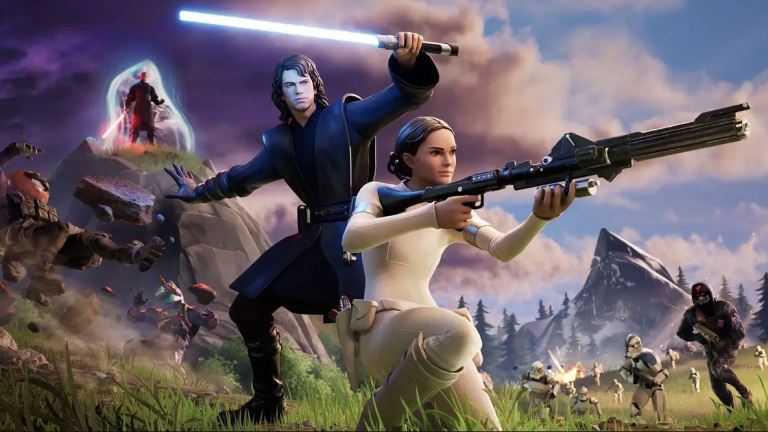
“Somehow, Palpatine returned,” Oscar Isaac’s Poe Dameron famously declared in Star Wars: The Rise of Skywalker. What Damreon didn’t say was how exactly he and the resistance learned that the Emperor had come back. Because all of that happened in 2019’s Star Wars X Fortnite, a four-week series within the massively popular Battle Royale game. Players who completed the event, in which their characters blasted away at one another while collecting Star Wars-style skins and guns, were treated to a recording of Darth Sidious calling for revenge, declaring that the day of the Sith is imminent.
The decision to put such a major plot point in a video game certainly raised eyebrows back in 2019, but it was overshadowed by the many, many, many other problems with The Rise of Skywalker. But more and more studios and even filmmakers are collaborating with Fortnite. Most recently Quentin Tarantino went so far as to make a short film within the game, the Kill Bill spinoff “The Lost Chapter: Yuki’s Revenge.” To some movie fans, the idea of a devoted cinephile like Tarantino making a movie in Fortnite spells the end of the theatrical experience. But as long as Fortnite is just another promotional technique, such fears are unfounded.
A History of Exploitation
American cinema has always been entangled in capitalism, going all the way back to Thomas Edison demanding payment for anyone who used the early film camera and projectors that he and W. K. L. Dickson created. Just as much a product as they are an art, movies must be sold to audiences and distributors and, thus, marketing is heavily involved.
For example, actor-turned-director Emory Johnson promoted his 1922 pro-police melodrama In the Name of the Law by inviting local law enforcement to attend for free and handing out plastic badges and whistles to youngsters. Twenty years later, Howard Hughes pushed back against Hays Code enforcer Joseph Breen’s demands to downplay the emphasis on star Jane Russell’s chest in his movie The Outlaw by hiring a skywriter to display the film title in the sky, accompanied by two huge circles. In 1960, theaters filled their lobbies with standees of Alfred Hitchcock informing audiences that they will not be permitted entrance to Psycho after the film had begun, which only increased interest in the early slasher. It’s no wonder that studios used the word “exploitation” instead of “promotion” to describe their marketing techniques.
The wording may have changed since then, but the basic practice has not. In 1999, The Blair Witch Project‘s producers posted missing posters for its supposedly doomed documentarians, Joaquin Phoenix pretended to be stoned during a David Letterman interview for his mockumentary 2009 I’m Still Here, and just this year, Tom Cruise posted videos of himself eating popcorn like a madman to drum up interest in Mission: Impossible – The Final Reckoning. One of the more famous recent examples came from Christopher Nolan, who released the first image of Heath Ledger‘s Joker in The Dark Knight via a cross-country scavenger hunt.
Why So Serious?
It’s not hard to draw a straight line from Nolan promoting The Dark Knight through an alternate reality game and the way he released a trailer for his 2020 movie Tenet. The first people who got to see the teaser for that Bond-influenced sci-fi flick were those playing Fortnite, where the trailer played in an online theater.
Nolan’s participation in the Fortnite promotion helps put the current craze into perspective. Few filmmakers are as devoted to the theatrical experience as Nolan. Not only does he remain committed to film over digital and not only has he pioneered the use of IMAX cameras for narrative movies, but he held back Tenet to prevent it from going to streaming before theaters during the pandemic. Clearly, he knows how to use Fortnite to get attention for his movies while still upholding the sanctity of the movie theater.
That said, one can sympathize with moviegoers worried about Fortnite‘s effects on cinema as an art. It’s quite unnerving to see how the game uses skins based on famous characters and figures from all over pop culture, including the movies. Any given game may feature David Corenswet’s Superman shooting Zendaya‘s Chani from Dune in the face while dodging sniper fire from Art the Clown from Terrifer, who happens to be controlled by a six-year-old who has no business watching those movies. Whatever genuine feelings these respective movies invoke seem cheapened when they become stuff kids can buy for a game.
And yet, when Chani shows up in Denis Villeneuve‘s Dune 3 next year, none of us are going to be wondering how she escaped the clutches of Superman and Art. The situations in Fortnite are so ridiculous that they stand apart on their own, completely divorced from the narratives that spawned them.
The Theatrical Standard
No question, it is strange that you can only watch “Yuki’s Revenge” in Fortnite, which is a huge bummer for cinephiles who don’t care about video games. And there is the fact films such as Inception did stream for a while within Fortnite, attempting to undo the division between the actual film and the video game.
As of yet, the movie-watching experience within Fortnite is pretty substandard, which means that even the biggest gamer understands the theater to be superior to whatever Epic Games has constructed. And as long as we keep movies within Fortnite to a minimum, then the promotions and goofy skins can continue without worrying film fans. Fortnite isn’t a threat to cinema; it’s its own weird thing.
But if Palpatine’s return taught us anything, it’s that you can never keep a bad idea down. So we’re sure that, somehow, the idea of movies within Fortnite will return. Until then, we’ll keep watching movies in theaters and using King Kong to shoot Poe Dameron with a laser rifle.