A Mighty Wind Was Catherine O’Hara at Her Sweet, Silly Best
Catherine O'Hara left behind a multitude of great performances, none better than that of a conflicted former folk singer.

The news of Catherine O’Hara’s death at age 71 is sure to prompt fond remembrances of her work. Some will recall the outrageous characters she portrayed on the groundbreaking Canadian sketch series SCTV. Others will mention her playing tacky artist Delia Deetz in Beetlejuice or the formerly rich Moira Rose in Schitt’s Creek, both women adjusting (poorly) to new, more humble circumstances. And probably most people will remember her as the forgetful but loving and determined mother from Home Alone.
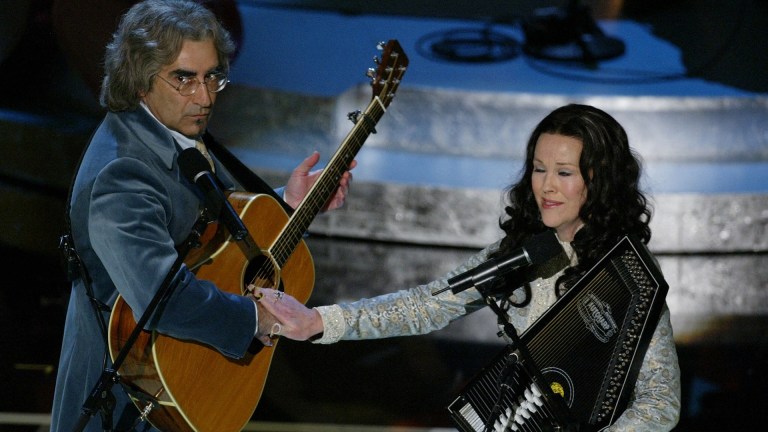
But O’Hara’s best and most complicated performance might also be one of her less remembered ones. In the 2003 mockumentary A Mighty Wind, O’Hara reunited with actor/director Christopher Guest and fellow SCTV/future Schitt’s Creek co-star Eugene Levy to play Mickey Crabbe, one half of a famed folk duo. While A Mighty Wind has plenty of the dry humor and absurdism that made Guest’s comedies such classics, O’Hara also brought pathos to Mickey, showing off the actress’s silly side and her sweet side.
Folk in A
Like Guest’s previous mockumentaries Waiting for Guffman (1996) and Best in Show (2000), both of which featured O’Hara, A Mighty Wind examined the idiosyncrasies of an overlooked subculture, namely the 1960s folk music scene. A Mighty Wind follows the children of a famed record producer as they try to reunite the acts from their father’s heyday for a tribute concert. The bickering Folksmen Trio—consisting of This is Spinal Tap‘s Guest, Michael McKean, and Harry Shearer—pose problems for the organizers, as do the sprawling members of the New Main Street Singers, which include an old hand played by Paul Dooley and newcomers portrayed by Parker Posey, Jane Lynch, and John Michael Higgins.
But the greatest hurdle involves Mickey Crabbe and Mitch Cohen (Levy), who recorded under the name Mitch & Mickey. Both romantic and creative partners, Mitch & Mickey were the sweethearts of the folk world, their love memorialized by the song “A Kiss at the End of the Rainbow.” At the climax of each performance, the two would pause the number to share a tiny kiss before playing the final chords. However, they had an awful break-up and went in radically different ways, Mickey to marriage and a suburban home and Mitch into madness, making a reunion unlikely.
When we first meet Mickey in the movie’s first act, O’Hara plays her much like the other folkie goofballs in the film. The first half of A Mighty Wind pokes fun at the intense sincerity of ’60s folk music, with its sweater-wearing players and its wholesomeness. But then, the film uncovers surprising lasciviousness among the players, such as the insults that the Folksmen shoot at each other or the New Main Street Players’ embrace of pagan rituals.
Mitch & Mickey Revisited
Mickey continues in that vein by sitting in her comfy living room and, in a Minnesotan accent that would be right at home in Fargo, sharing winsome memories about her time with Mitch. O’Hara sneaks panic into Mickey’s calm demeanor when she realizes that she’s agreed to perform the song without securing a commitment from Mitch, and that Mitch is unlikely to join. Stumbling over her words, taking quick sharp breaths to maintain her composure, Mickey starts muttering to herself about dark times around their break-up.
What follows is a series of talking heads describing Mitch’s post-break-up spiral, complete with images of album covers that show Mitch standing in a grave and looking like Charles Manson. Levy plays Mitch as a complete weirdo, who speaks his lines with tense discomfort and who constantly darts his eyes around the room.
Between the two, Levy gets the bigger and more attention-grabbing part. However, his character doesn’t work without O’Hara setting him up, preparing us for a genius and giving room for Levy to get weird. That’s true throughout the film, as when Mitch visits Mickey’s home and the two reunite for the first time in years. These moments let Levy do funny things like stare with confusion at the model trains constructed by Mickey’s husband Leonard (Jim Piddock), or ramble incoherently when trying to recall the duo’s first meeting.
Rather than simply stand aside, O’Hara finds more subtle and equally strange notes to play while portraying the “normal” one. O’Hara goes through a litany of grunts and facial tics when trying to get Leonard to stop talking about his company’s work with spastic bladders over dinner, finally declaring, in a calming mom voice, “Maybe that’s dessert talk.” She gets the punchline at the end of the first meeting story, describing in detail how Mitch stood up and strode across a concert venue to confront a rude heckler, only to end it by saying, “and he got pummeled.”
A Click At the End of the Rainbow
As much as O’Hara shows off her comedy chops with Mickey, she never stops treating the character like a real person. There’s genuine longing in her eyes when she watches Mitch tell stories about their past, and real fear as the tribute concert draws near.
That complexity all comes together during “A Kiss at the End of the Rainbow,” an Academy Award-nominated number written by McKean and his wife, actress Annette O’Toole. Not only does O’Hara sing the track with Levy, layering warm harmonies over his more simple, almost spoken-word delivery, but she also relays Mickey’s hesitance as they get closer to the kiss during the tribute costume.
While Levy emphasizes Mitch’s fear that Mickey won’t want to do the kiss, O’Hara underscores her character’s sadness. She lets her head fall to the side and wears a forlorn expression when they reach the pause. Right before Mickey leans in to touch Mitch’s lips, she lets out a quiet click of the tongue.
Does the click acknowledge everything that she and Mitch could have had and let slip away? Does it underscore the false premise of the entire performance, recognizing that the two of them were never the Mitch & Mickey that people loved? Does it show a reluctance for even participating in the show, a desire to return to her quiet, normal life with her husband?
The movie doesn’t tell us, and O’Hara provides no answer. She just lets it sit there right before the kiss, adding complexity to what could have been a simple moment of catharsis.
Not Just Joking
When people remember Catherine O’Hara over the next few days, they’re sure to talk about her incredible comic timing and her constant presence on our screens.
But anyone who watches her play Mickey Crabbe in A Mighty Wind will know that O’Hara wasn’t just a hilarious comedian and a proper movie star. She was also an accomplished dramatic actor, someone who could bring layers to characters that others would play as just a joke.