Every Saw Movie Ranked from Worst to Best
Do you want to play a game? Good! Let's rank the grisly movies of the Saw franchise.

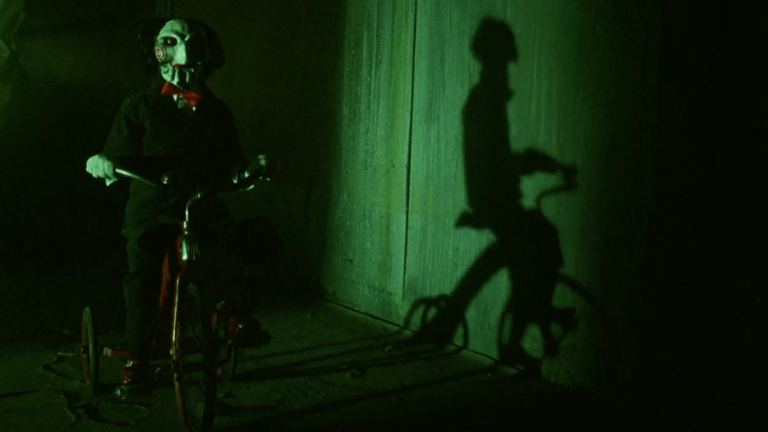
In 2004, James Wan’s debut feature film Saw arrived amongst a slew of splatter and slasher movies dismissed as “torture porn.” The film having little in common with the likes of Hostel and Wolf Creek didn’t seem to matter, and would go on to matter even less as the Saw sequels upped the gore factor.
Despite being lumped in with that corner of the horror genre at the time, Saw would outlive it by blossoming into a 10-movie franchise that almost always cleaned up at the box office, and when the Jigsaw story seemed to be running out of juice, attempts were made to reinvigorate the franchise before it finally put original star Tobin Bell front and center in 2023’s smash hit, Saw X.
While we wait for an 11th installment, let’s take a look back at all the Saw movies so far and decide which ones are the gleaming reverse bear traps, and which are the rusty blades of the franchise.
10. Saw V
Saw V picks up immediately after the events of Saw IV, as FBI agent Peter Strahm (Scott Patterson) manages to escape his watery death via an ingenious tracheotomy and sets out to expose Jigsaw’s new successor, Mark Hoffman (Costas Mandylor). He doesn’t quite manage it, unfortunately, so RIP to a real one.
The lore-heavy Saw V has ended up at the bottom of this ranking for many reasons. The group trap is an interesting concept (dang it gang! just work together!) and it’s fun to finally see Hoffman emerge from the shadows to be positioned as an insidious villain, but the movie feels utterly weighed down by its backstory as the more visceral stuff you’d expect from the franchise takes a backseat. Interminable chatter slows the film’s pace to a crawl, while the necessary flashbacks pile up into a mountain of homework.
The closing “gotcha!” moment is truly ridiculous, too. At no point would Hoffman have known that the man about to expose him wouldn’t listen to the entire final tape! At this stage in Saw’s evolution, Jigsaw himself was also starting to feel like an afterthought. This was perhaps the first installment to really expose itself as annual Saw churn.
9. Saw IV
Saw IV manages to alter the structure of the franchise, and I’ll give it props for that. The Saw movies couldn’t just keep relying on being grisly torture porn with a fun twist at the end; they needed something new, and Saw IV found the answer: make the continuing story a crime saga.
This franchise entry plays with the audience’s notion of exactly when all these events take place, as we learn that John Kramer (Tobin Bell) planned his eventual demise and left a trail of clues to draw those investigating his crimes to their own deaths. A casual Saw viewer would get whiplash from this one, as the story takes place at the same time as Saw III, pre-dating Kramer’s autopsy, which the film begins with.
The final moments reveal that Detective Hoffman, present at the autopsy, was never in any danger; he was Jigsaw’s accomplice all along, and also that the real test for our hero, Officer Rigg (Lyriq Bent), was not to try to save everyone in the past. And also dispose of Eric Matthews (Donnie Wahlberg). And also frame Agent Strahm. And also… I’m mentally exhausted just trying to write this out so it makes sense, and that’s why I can’t really rank Saw IV any higher. It’s probably the twistiest Saw of all, which could be considered a bonus, but it’s also a lot. Too much!
8. Spiral: From the Book of Saw
In 2021, Lionsgate and Twisted Pictures decided that the Saw franchise needed a spinoff. An intriguing concept; Spiral is more of a police procedural in which Detective Ezekiel Banks (Chris Rock) tries to track down a Jigsaw copycat killer.
Disposing of the industrial-grime aesthetic the Saw movies are known for, Spiral is a slick, tightly paced cat-and-mouse thriller, but it just doesn’t quite work. It doesn’t feel enough like a Saw movie for people who love Saw movies, and the plot is too formulaic for anyone expecting a half-decent Se7en knockoff instead. No one wins in this scenario! We also saw this reflected at the box office, where Spiral became the lowest grossing installment in the franchise.
7. Jigsaw
After the Saw movies had stretched the ongoing Kramer story way too thin and wrapped up with a “final” chapter, there was a rethink about how to keep the franchise going. Initially, the idea of reviving it seemed promising, especially with the Spierig brothers (Predestination) at the helm. The problem is that the revival didn’t go far enough to stand out from the crowd, despite having some great kills and a decent atmosphere.
Catching up with Logan (Matt Passmore), a different Kramer apprentice from a barn game that took place 10 years prior, Jigsaw still relies on connections to past events that feel totally underwhelming in the end. I refer to this as “the Spaceballs entry,” because the killer’s motivations are so convoluted that they might as well be revealed in the manner of Rick Moranis’ Dark Helmet villain: “I am your father’s brother’s nephew’s cousin’s former roommate,” just about sums it up. The desperation to link everything back to Kramer falls completely flat. A swing and a miss!
6. Saw VI
A much stronger entry than IV and V, Saw VI was a welcome course correction for the franchise that stopped trying to catch the audience up with excessive lore homework and actually focused on a clear moral journey that aligned with John Kramer’s philosophy. It’s so much less chaotic and random as a result—and hits a little differently after the real-life killing of UnitedHealthcare CEO Brian Thompson.
We follow insurance executive William Easton (Peter Outerbridge) who has denied life-saving coverage to many people, and who Kramer specifically had a problem with, given that he was one of them. Easton’s co-workers also become targets for Hoffman’s incarnation of Jigsaw, adding more bodies to the pile in a massively distressing shotgun carousel sequence. It all wraps up with the family of one of Easton’s dead clients deciding his stomach-churning fate, and Hoffman finally escaping his own Jigsaw test.
5. Saw II
Saw II is bloodier than the first movie and really cements the formula the franchise would become known for, featuring a number of grotesque traps for its first group activity (the needle pit is particularly iconic) while handling the necessary gore and tension quite masterfully.
It starts out by subverting expectations, as John Kramer is immediately caught by cop Eric Matthews. Of course, Kramer has set up a complete horror show for Matthews, revealing footage that confirms his son—along with seven other people—is trapped in a house under the threat of a nerve agent and that Matthews will have to play Kramer’s game in order to rescue him.
Crafty Kramer has neglected to mention that the footage of the house and its occupants was recorded days ago and that everyone is already dead, aside from his accomplice, Amanda (Shawnee Smith), and Matthews’s son, who has been inside a safe at the factory the entire time. It’s a clever reveal that isn’t too ludicrous, which is something that these films occasionally find to be a tough balancing act.
4. Saw: The Final Chapter
I can already sense that some of you are questioning the high placement of Saw: The Final Chapter, a.k.a. Saw 3D, on this ranking. Admittedly, it’s a little controversial. Yet I stand by it! The seventh movie in the franchise successfully manages to bring everything full circle with its revelation that Dr. Lawrence Gordon (Cary Elwes) survived the first movie and has been awaiting activation should any harm come to Kramer’s ex-wife. We find out Gordon is alive right from the get-go, and his return in the final minutes is super effective for the big twist, sticking Hoffman in the very bathroom where Gordon played his own game so many years ago and throwing away his only means of escape.
Saw: The Final Chapter is perhaps the goriest entry in the entire franchise (it had to be edited and resubmitted to the MPA six times to secure an R rating) and wears that proudly. Yes, it’s over-the-top, but this is what some of us pay money to see—let its 9% RT score be damned! A staggering 25 people meet their maker in this one, including a gang of white supremacists in an abandoned junkyard during a sequence that has to be seen to be believed. The 3D element, while ludicrous, also adds a silly, nostalgic element that hasn’t aged well, but still made for a fun time in the theater back in 2010.
3. Saw III
Saw III is darker, more unforgiving, and its gore is absolutely relentless, so I’m giving it two thumbs up! Featuring a killer screenplay by original Saw writer Leigh Whannell, the third movie in the franchise focuses on grieving father Jeff (Angus Macfadyen) who Kramer tasks with being able to forgive those who were involved in his son’s death. Spoiler: he can’t, and he ends up killing Kramer for also putting his wife in grave danger to prove a point.
No one comes out of this one in good spirits, to say the least, including Kramer’s protégée Amanda, who can’t quite get past the jealousy she feels seeing Jeff’s wife bonding with him. Dead, dead, dead. Good stuff! But honestly, the stomach-churning scene where Jeff has to deal with rescuing a guy from a grinding vat full of rotting pig carcasses is top-five material all by itself. Hang it in the Louvre.
2. Saw X
Did anyone expect the tenth Saw movie to be this good? The running joke about the franchise eschewing de-ageing effects by just putting Tobin Bell in a baseball cap is certainly stretched to its limit in Saw X, which is set almost two decades ago in Kramer’s story between the events of Saw and Saw II, and where we find Kramer travelling to sunny Mexico in the hope that an experimental procedure will cure his terminal cancer. When he finds out that the whole clinic is a scam, there’s hell to pay for everyone involved in the deception.
Putting Kramer at the center of the action was a masterstroke for anyone willing to suspend their disbelief about how old Bell looks, allowing us a good, long look at how Kramer’s motivations were evolving all those years ago and what he went through to try and beat his cancer. It’s possible to feel at least some sympathy for him, even though he’s been instrumental in the murders of so many people (which is mind-blowing) and you do genuinely want his scammers to pay for what they’ve done to him. Above all else, it’s a properly cohesive movie that benefits from the direction of Kevin Greutert, who had helmed a couple of previous installments and knew by this time what worked and what didn’t.
1. Saw
The simplicity of the original Saw still works today. More like a deftly written play than a gorefest, most of the movie takes place in one room, and most of its dialogue is between two imprisoned characters attempting to build trust in a horrifying situation. The final twist—that their captor is the dead man lying on the floor between them and that he is very much not dead—was incredible at the time and remains so. Hell, it’s up there with some of the greatest cinematic reveals in horror, along with The Sixth Sense, The Others, and, of course, the GOAT: Psycho.
Saw’s simple but clever concept suited its low budget. Made for around a million dollars, it racked up a hundred times that at the global box office, even as critics slammed it as half-baked, hokey, and desperate to emulate David Fincher’s more acclaimed thriller Se7en. Yet, it endured. Nine Saw sequels (and prequels, and spinoffs) later, fans are still waiting for the next one. James Wan’s little movie might seem rough around the edges and quite quaint now compared to the ones that followed, but Saw turned into that rare thing: a horror franchise that just wouldn’t die. It deserves its rightful place at the top of this ranking.