Maggie Gyllenhaal Is Determined to Give the Bride of Frankenstein Her Voice
Ahead of The Bride!’s new trailer, writer-director Maggie Gyllenhaal reveals to us the secrets of bringing back a classic, as well as working with Jessie Buckley, Christian Bale, and brother Jake.

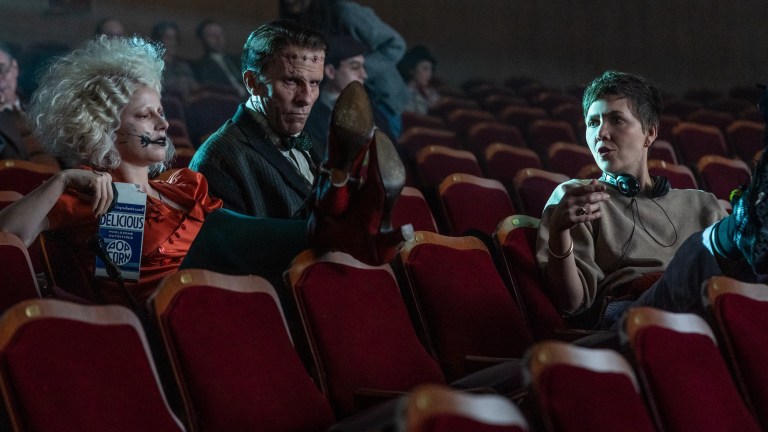
Maggie Gyllenhaal did not set out to make a typical monster movie when the Bride of Frankenstein entered her life. This might seem obvious to those who watched this morning’s fabulous new trailer for a genre mashup fantasia pulled together from various sources of style, influence, and aesthetic. (A bit like the good, undead woman herself, then.) When she’s even called “the Bride of Frankenstein” at one point in the sizzle reel, the resurrected revolutionary with the white-streaked hair simply corrects, “No. Just the Bride.”
This brazen iconoclasm matches Gyllenhaal’s own draw toward the character, which began while she was still doing press for her first film as a director, the Oscar-nominated The Lost Daughter.
“I was at a party and I saw a man with a tattoo on his whole forearm of the Bride of Frankenstein, and I was like ‘huh,’” Gyllenhaal recalls at a Q&A event that Den of Geek participated in. The iconography of the inked image was based on Elsa Lanchester’s memorable look, courtesy of Jack Pierce’s makeup design from The Bride of Frankenstein (1935), and is recognizable to almost anyone in the world, whether they’ve seen the nearly 100-year-old movie or not. This included Gyllenhaal at the time, who despite having several IP projects being offered to her, couldn’t shake the Lanchester visage.
“I was like, ‘Have I ever seen that movie?’” Gyllenhaal says. “I know the image, I know the character.’” So when she returned to her hotel room, she immediately pulled up the James Whale classic that night and was struck by an irony that monsters fans have known for generations.
“Something about her is just formidable,” Gyllenhaal says of the original Bride. “[But when] I watched the movie, which I hadn’t seen, I realized she doesn’t speak. What I thought was really interesting is that this movie called The Bride of Frankenstein is not in any way about the Bride of Frankenstein. And yet, Elsa Lanchester makes this impact, even though she’s in the movie for three minutes and doesn’t speak. Why? Well, because she’s kind of a badass and… she wakes up and says ‘no!’ That’s basically what she does, and that’s unusual.”
For her next movie, Gyllenhaal realized that she could give the revived woman a voice beyond that pained “no.” It would also be a chance to extend a legend that began more than 200 years ago in Mary Shelley’s original book where the literary Frankenstein’s Monster asks his creator to make for him a mate.
“[It’s] part of the book, part of the mythology, [and] is really understandable,” Gyllenhaal continues, “but at the same time, what about the mate? He’s asking for someone to be brought back from the dead to be his girlfriend, but what about her? And that’s what I think this movie gets into. She comes back and she has her own needs, her own agenda, her own wants, and her own terrors.”
In the new film, which Gyllenhaal wrote as well as directed, current Hamnet star Jessie Buckley plays several roles, including that of a street-wise woman living in 1930s Chicago. But after she is murdered, her body ends up in a classic Frankenstein situation, albeit with a twist. The famed monster of the story, played by Christian Bale and now simply going by “Frank,” has found a new scientist to carry on the mad-ish works of his creator from a hundred years back. But Dr. Euphronious (Annette Bening) doesn’t just make a mate for Frank, but a new woman and life out of old parts.
Thus enters Buckley’s Bride, who is every bit as extravagantly designed by makeup and prosthetics designer Nadia Stacey as the original creature. Embodying the New Woman ethos of Frankenstein’s 19th century roots, Buckley’s Bride enters an early 20th century part Bonnie Parker and part Lady Gaga, ready to remake Chi-Town and beyond in her own image, which includes an elaborate hair design all her own and new flourishes like black-streaked skin around her lips that faintly resemble smeared makeup. According to Gyllenhaal this touch came from Gyllenhaal and Stacey wanting to suggest a mysterious inky substance in Dr. Euphronious’ lab being able to literally stain the Bride’s skin after it’s injected straight into her veins.
“It has to be driven by story, all of it, but I want it to look great,” Gyllenhaal says of her title character’s appearance. “I love the Bride’s look. I love her hair, I love that splat, I love the black lips, I love the makeup, I love the dyed eyebrows, the white eyelashes, which of course the implication is that all of her hair is bleached out white due to this electricity.”
To adorn that countenance, though, Gyllenhaal turned to a performer she felt an intimate kinship with.
“I had worked with Jessie in The Lost Daughter,” Gyllenhaal explains. “She is really brilliant in that movie and I loved her, and I think we both knew when we worked together that we were really kindred spirits. One of my favorite things about being a director is figuring out what language you have to speak to each actor in, and yet with Jessie, I just talked to her how I talked to myself. It is completely pure.”
Initially the filmmaker second-guessed the desire to write the role for Buckley simply because it might “limit what it could be,” but by the time the first draft was done, it was obvious what Gyllenhaal wanted: “Okay, it’s only Jessie.”
The Bride! as a whole, though, marks a grand opportunity for Gyllenhaal to reunite with plenty of familiar friends, collaborators, and even family, not least of which includes Christian Bale whom Gyllenhaal first worked with in The Dark Knight.
“Listen, I just dreamed big,” she chuckles. “I’m just going to ask whoever I want. What’s the worst thing that can happen? They tell you no? Can I tolerate being told no?” And with regard to Bale, she notes, “There are a lot of good actors and a tiny handful of brilliant ones… and part of the skill of being a brilliant actor is being able to walk up to someone and hand them your heart.”
That is core to Bale’s character, whom Gyllenhaal refers to strictly as Frankenstein or Frank, as opposed to creature and/or monster.
“I pulled from the book in some ways,” she points out. “Frank in the book is so feeling, so vulnerable, so full of need and hunger, and he’s also so smart. In the book, Frankenstein just hangs out in the barn and learns French. That’s hard to do! So I needed someone with all of those characteristics and also tough, because he does some fucked up stuff, this monster. As monsters do, and, I would say, we all do. So I needed someone who could hold all that.”
One bit of casting that might particularly intrigue fans going in is Maggie’s brother Jake Gyllenhaal being tapped to play the director describes to be a matinee idol, a guy who exists only in frivolous 1930s fantasies.
“With my brother, I will say that he is one of the very last people I asked,” Maggie notes. “I asked him at the last minute because I wanted to make sure it was the right thing for our relationship, and I spent a lot of time thinking about it, and I came to ‘no, it absolutely was.’ I haven’t worked with him since Donnie Darko, and I was [22], but it was such a pleasure working with my brother. I found myself laughing so hard that tears were streaming down my face, I loved it. It’s true for all my actors but, of course, there’s a special something with my brother.”
Gyllenhaal’s inclusion as that toe-tapping star is also the key reason The Bride! is set in the 1930s. Because as Gyllenhaal reveals, when she first conceptualized the story, she imagined setting it around the late 1860s, a point in the distant past but also fairly removed from both the movie she made and the original novel’s late 18th-century setting.
“In the 1860s, ‘70s, there was a big thing about people speaking to the dead,” she points out. “There had been the Civil War, lots of women were losing their children in childbirth, so there was a job as common as being a therapist [where mostly] women would speak to the dead for you. And I thought in a movie about people who came back from the dead, maybe that’s an interesting time to set it.”
However, there was an image she had in her head: it featured Frank sitting alone in the dark looking up at a screen and wishing someone was by his side.
“Frankenstein is so lonely… he doesn’t have anybody to talk to, and his primary relationship before we meet him is with a movie star, because a movie star is someone you can imagine you have a relationship with, and they don’t know you at all,” says Gyllenhaal. “Also Frankenstein, whose face is so scary and people run screaming when they see him, he’s safe in the dark. So once I realized I want him to have a relationship with a movie star, I said, ‘Okay, it’s got to be set when there are movies.’”
Which led her to the 1930s, an era where the stars of cinema were defined by feel-good fantasies, musicals, and escapism. And escape is exactly what Frank seeks when he asks for a mate. Yet come March, that mate might prove to have her own ideas about what to make of this world when she breaks from her own 1930s history some 91 years after Lanchester’s eyes first opened in a lab.
The Bride! opens Friday, March 6.