28 Years Later: The Bone Temple – Nia DaCosta Reveals Exclusive Secrets in Horror Sequel
Exclusive: Director Nia DaCosta opens the doors of the Bone Temple for the next chapter in the 28 Years Later trilogy, revealing why they're doing "things differently."

This article appears in the new issue of DEN OF GEEK magazine. You can read all of our magazine stories here.
Six months ago, 28 Years Later brought the rage virus crashing back into the cultural conversation, furthering director Danny Boyle and writer Alex Garland’s not-zombie-but-still-zombie hold on the subgenre after an 18-year absence. Now, 28 Years Later: The Bone Temple is on the horizon, helmed this time not by Danny Boyle but Nia DaCosta, right on the tail of her most recent success, Hedda. Of course, both 28 Years Later and The Bone Temple were shot back-to-back, accounting for the films’ releases happening so close to one another, so Boyle, Garland, and Sony were already fully aware of what they had when it came to DaCosta’s talents. And why wouldn’t they, given her takes on films like 2021’s Candyman and The Marvels?
With The Bone Temple right around the corner, Den of Geek sat down with DaCosta to learn more about not just the upcoming film but her involvement with 28 Years Later, what drew her to the franchise, and the collaboration process between the series newcomer and veterans like Garland and Boyle. As it happens, this franchise played a critical role in DaCosta’s cinematic career, too.
“28 Days Later is one of the most important films to me in terms of my journey into becoming a filmmaker, wanting to make movies, wanting to be scared, and wanting to scare people,” DaCosta explains. While the storyteller is at a point where she’s looking to write and direct for herself, that doesn’t keep her away from picking up a good screenplay. “I still love reading scripts. When I encounter a great one, like I did when I read the 28 Years Later scripts, and there’s a possibility that I could direct it, I’ll totally grab at that.”
As for taking the helm of a franchise so important to fans, DaCosta—a fan herself—had a relatively straightforward approach when it came to discussions with the studio: “The conversation started when I came in to talk to the producers. The first thing I said was, I am not going to make a Danny Boyle movie. No one else can. It would be stupid to try. I want to make this movie the way I see it. And so for me, that meant creating these distinctive worlds between the Jimmies and [Dr.] Kelson and certain tonal things.”
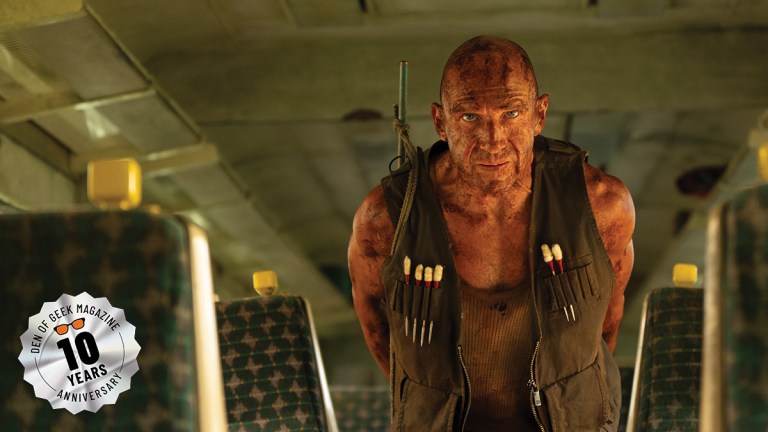
While fans are not yet incredibly familiar with Jack O’Connell’s Sir Jimmy Crystal and his band of ne’er-do-wells, aka the rest of “the Jimmies,” we did get a glimpse of them at the very end of 28 Years Later when they sprang to the rescue of Alfie Williams’ Spike. Jimmy Crystal and his enthusiastic gang of jogging enthusiasts will play a much more pivotal role in The Bone Temple, as will Ralph Fiennes’ Dr. Kelson.
“The first movie, maybe, says a lot about his solitude in our film,” DaCosta notes of Fiennes’ Kelson. “In my film, at the Bone Temple, we get to characterize that as loneliness, and we get to see more of how this man survives on his own, how it feels, and why that might push him to do really risky things like engaging with an Alpha in the way that we see him engage with Samson.”
Samson, the infected Alpha we met in 28 Years Later, will also play a much bigger role in The Bone Temple. Because of this, DaCosta collaborated with Boyle throughout the creative process from the start.
“It was really important to me that I inherited a character who had the right starting point,” she explains. “[Boyle] really listened when I had thoughts or feelings about how those decisions would impact my movie. But really, I think because he also loves the second film and loves what it was doing, he didn’t want to do anything that would hinder that at all.”
She continues, “In terms of designing Samson the character, there were some things I had to change from his movie to my movie, in part because… certain things that worked in Danny’s film would not look right in mine. We’re doing things differently.”
One of the “things” the director is referencing is a specific appendage of Samson that sent the internet ablaze after 28 Years Later was released in theaters. DaCosta was not surprised by the reaction, noting succinctly that “penises bring people together.”
Samson, like Kelson and the Jimmies, will play more of a role in The Bone Temple than he did in 28 Years Later. As many have gleaned from the trailers, his story is intrinsically tied to Kelson’s, with the Jimmies off doing their own thing right up until they aren’t. The collision between the two parties is inevitable, but it was the juxtaposition between them that really intrigued DaCosta as a filmmaker. The cruelty of the Jimmies clashing against Kelson, who DaCosta sees as the emotional heart of the film, gives opportunity for real contrast.
“You have these two trains on a track, essentially, that are going to collide,” says the director. “They’re going to end up with these two worlds in a clash, because you kind of feel that Spike and Kelson are going to interact again. I wanted to really lean into the sort of dark serenity that Kelson’s been able to find in the apocalypse, and also the cruelty, the violence, the mercurialness, the erratic energy of the Jimmies. So while we are hoping that Spike and Kelson come back together, we’re also nervous about what that will mean.”
As photos have already revealed, Sir Jimmy Crystal and his band are not the only ones with a bleak side in the apocalypse. While thus far we have only seen the doctor’s respect for the dead via his worship of the concept of memento mori—hence the mountain of skulls from which The Bone Temple earns its title—we’ll also get the opportunity to see a darker side of the healer.
“This is another thing about getting to know Kelson more. You’re like, ‘What a dark-sided freak he is!’” DaCosta says with a laugh. “But when you actually talk to him and engage with him, you realize the beauty of his point of view in life. [Through] memento mori, you understand that he’s basically a humanist, and I think a part of that is being curious and being hopeful.”
With the Jimmies’ inevitable collision with Kelson and, by proxy, Samson, comes a duality to the visuals within The Bone Temple. It wasn’t enough for the emotionality and dialogue to differentiate the characters; DaCosta insisted that the film be shot that way as well. As such, the visuals and style differ depending on which set of characters is the focus of the scene.
“[For Kelson’s world], I was imagining just beautiful sunlight; it’s summer, green grass; there’s the red of the poppies that he grows,” DaCosta says of the flowers the doctor uses to make his own opiates. “Essentially, the steadiness, stillness, of a river. You hear the river like you’re sort of on a relaxing vacation, except it’s the apocalypse.”
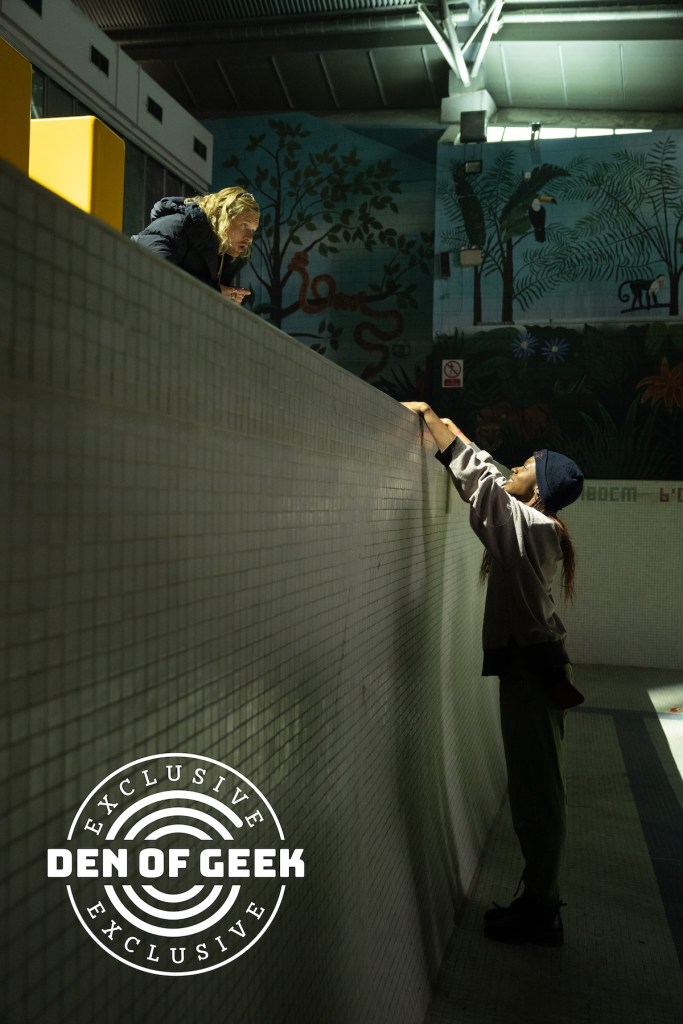
Conversely, the first time we meet the Jimmies in the new movie, the gang is in what DaCosta describes as a decaying urban space. “They’re reminded of everything that’s been left behind. [Those scenes were] a lot of really unsteady camera, a lot more cutting… then in terms of how we colored it, there’s a warmth to Kelson’s world, and there’s a coldness to the Jimmies’ world. I really wanted to contrast their worlds based on their characters.”
Coldness and warmth, light and dark, these are all hallmarks of the larger 28 Days franchise’s deadly grace. But with The Bone Temple marking the penultimate chapter of a new trilogy, it remains to be seen which will dominate when worlds collide.
28 Years Later: The Bone Temple is in theaters on Jan. 16.