How A League of Their Own Highlights the Vibrancy of Queer Communities
Much more than a baseball adaptation, Prime Video's A League of Their Own has a new story to tell about longstanding LGBTQ spaces.

This article contains spoilers for all eight episodes of A League of Their Own.
Prime Video’s A League of Their Own offers a delightful, though rare experience: at times it can be harder to remember who on is straight, rather than who’s gay. One of the strongest aspects of the new show, the queer representation was notably lacking from the original film. It’s a matter of historical fact that there were queer players in the All-American Girls Professional Baseball League (A.A.G.P.B.L.), upon which both the 1992 Penny Marshall movie and the 2022 Amazon Prime Video series are based. Moreover, as the series makes clear, charm school, policing players’ clothing both on the field and off, and the use of chaperones, were part of an effort to ensure players were perceived as straight. As the show demonstrates with characters like Jo (Melanie Field, You, 2018 Heathers), Lupe (Roberta Colindrez, VIDA, I Love Dick), and Carson (Abbi Jacobson, Broad City, Bojack Horseman), the AAGPBL at once provided an unprecedented opportunity for women to follow their dreams and achieve some measure of freedom, while also being forced to live precariously within rigid structures of a cishet perception of avoiding lesbianism, knowing that everything could all be taken away at any moment.
In the face of all that, the queer players and other characters in their orbit form deep bonds, supporting one another as they do their best to survive, understand themselves, and take back as much joy as they can, in a world that doesn’t provide for them. They find community with one another, with the local LGBTQ scene, and with other queers in the League. And because the show is populated with so many LGBTQ people, there’s no burden for any one character to represent the entire community. It all makes a few things very clear: queers find strength in one another, queer communities are many and varied, and queer people have always been here.
Importantly, LGBTQ people are not sprinkled on top for a dash of light representation, or shunted off to the side with the same tired preachy eat-your-vegetables plots. The queer characters are the bedrock of the show, and it’s hard to imagine the series without them. And while the romantic relationships are fun, sexy even, A League of Their Own achieves something more difficult than stranding a lone queer or even a starring couple amid a cast of many straights: the show invests in multiple thriving queer communities, and the many non-romantic relationships that make those communities strong.
On A League of Their Own, there is no one way to be gay. When something like half the cast is queer (even the ball boy!), there’s no obligation for any one character to get the last word on how to look, act, or feel about being gay. There are butches, femmes, a trans guy, and some folks actively exploring where they fall long the gender and queer spectrums.
There are Black LGBTQ people of just about every stripe, a Mexican player who the top brass label as Spanish, because it’ll “go over easier,” and the beauty boot camp scene serves as a reminder that being “too Semitic” was seen as an openly discussed PR issue at the time. The script doesn’t shy away from the contours of safety and visibility these differences create, like when Lupe, the Mexican butch ballplayer, points out to her white butch teammate and closest friend McCready, the way that she has been typecast as a fiery, angry Mexican and blamed for problems in the club house.
Jo and Greta’s (D’Arcy Carden, The Good Place) friendship anchors this first season. They’re the first players Carson, our audience surrogate, meets, and they’re our guides into the world of women’s baseball in the 1940s. While the exact words are never used, they are a clearly chosen family, moving from city to city to chase opportunities for baseball or other work, and to run from danger or heartbreak. They worry for each other even when they don’t worry about themselves. The moment when it feels like all hope is lost, when Jo is arrested, beaten, and traded to the Blue Sox, wouldn’t hit so hard without Jo and Greta’s friendship – and by extension, the way Jo became the team’s beating heart – at the center of the show. Similarly, the climactic scene of Greta and Carson helping Jo around the bases after she parks it for the win (but aggravates her ankle injury from the police raid) hits home so hard because of those same bonds.
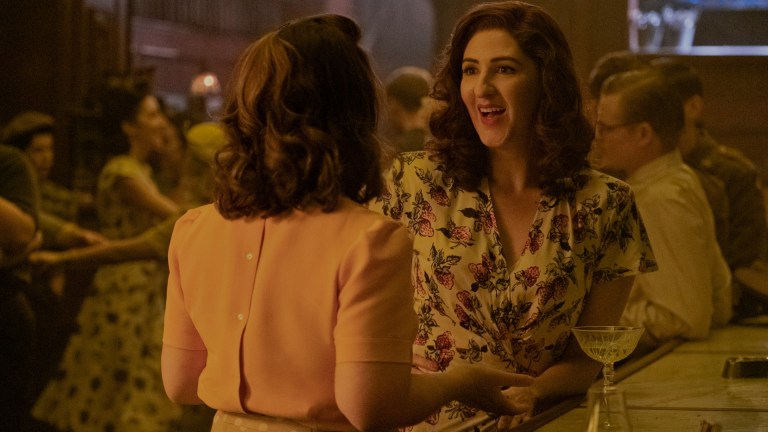
The Peaches aren’t the only gays in Rockford – there’s a thriving scene that predates their arrival. Vi, in an excellent cameo from 1992-era Rockford Peach Rosie O’Donnell, owns an underground bar for “friends of Dorothy” of any gender. Meanwhile, Max’s Uncle Bert (Lea Robinson, Unmasked, Chosen Fam) is a successful businessman connected to Black LGBTQ folks both in Rockford and around the country, hosting gatherings in the relative privacy of his home as well as going out in public with his wife, with an apparent level of confidence that surprises his niece. Vi, Bert, and their wives have carved out lives for themselves, elder queers serving as examples for the younger folks in their lives and creating relative safe spaces for their communities. They are making their own happiness, no matter what the world thinks, and honoring their love in their own way, even if their marriages aren’t legal.
They are not naive, however, nor is everything as easy as it looks. Vi might tell Carson it’s important to have fun and enjoy life, but the safety protocols at her bar and the way she reacts to the police raid make it clear that she knew the risks, and she was willing to put her body on the line to give everyone else as much time as possible to escape. For his part, while Bert walks around town with an easy confidence, he pushes back when Max (Chanté Adams, The Photograph) says life would be easier if she were a man. And when Max is getting ready to go on the road with her new baseball team, he offers her some words of caution, about protecting herself and being careful who she trusts. Bert also shares some names to look up on the road, like a much-abbreviated personal queer Green Book.
In the final episode, the Peaches’ chaperone Beverly, AKA Sarge (Dale Dickey) shares a small but powerful moment with Jess McCready (Kelly McCormack, Killjoys, Letterkenny). All season long, Sarge, who was put in place to enforce the League’s most onerous rules, has collected fines from McCready for wearing pants. For her part, McCready has gladly paid rather than spend any more time in a skirt than strictly necessary in order to play ball. With their season over and the Peaches due to head home, Sarge returns to McCready the entire season’s worth of fines, telling her the rules said she had to collect them – but they didn’t say what she had to do with them once collected. McCready is taken aback, and Sarge goes one step further, saying “We have to take care of our own, don’t we?” with a wink, signaling that she doesn’t just mean fellow Peaches.
It’s not exactly a surprise that Sarge isn’t straight, but with this act of solidarity in mind, it’s easy to see her other moments of intentional disruption. She slow-rolled giving the League names of Peaches to trade, allowed Greta and Carson to cover for McCready during the makeup section of charm school, and likely looked the other way on a number of curfew violations. While Sarge may have been the face of the rules to the players throughout the season, she came to care for the players and used her knowledge of the rules and the way the League trusted her to find wiggle room to protect her community when she could.
All eight episodes of A League of Their Own are available to stream on Prime Video now.