Scream’s Genius Was Always its Final Girls
Forget the knowing humor and winks toward other movies. Scream is all about the final girls.

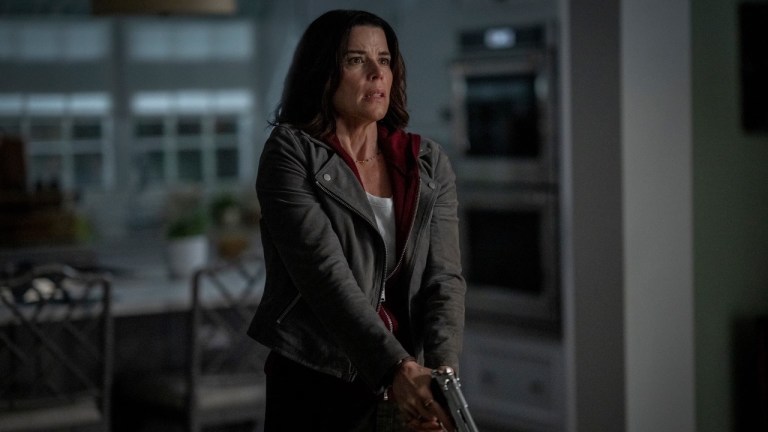
At the end of Scream 4, Sidney Prescott learns too late that her cousin Jill, played by Emma Roberts, is a Ghostface killer. Jill has grown up in Sidney’s shadow, forever jealous of the attention and fame that the older woman has received since surviving the first Woodsboro Murders from the original film. Jill bemoans and belittles everything about Sidney, calling her too slow, too out-of-date, and frames herself as the remake.
But before Jill can finish her off, Sidney (Neve Campbell) launches a counter-attack, frying her cousin with a nearby defibrillator. “You forgot the first rule of remakes, Jill,” Sid spits. “Don’t fuck with the original!”
That scene certainly works as a statement about Scream‘s position in the horror landscape, a rejection of the remakes of A Nightmare on Elm Street and Friday the 13th that came out just before Scream 4 released in 2011. However, the scene also works when played straight, showing how women are constantly forced to deal with weight of the generations before them and the expectations of the generations after them. More than its fun metatextual moments, that attention to final girls has always been the power of the Scream franchise.
Your Favorite Scary Movie Survivor
In one of the most memorable parts of the first Scream, Randy Meeks (Jamie Kennedy) lays out the rules for surviving a horror movie. “You can never have sex,” he declares to a disappointed, disbelieving crowd. “Number two: never drink or do drugs,” he continues, once again incurring the wrath of his friends. It’s no accident that those two points come up while Randy and his friends watch 1978’s Halloween, the movie that features Jamie Lee Curtis as Laurie Strode, a paradigmatic final girl.
Women survivors have been part of horror cinema from the beginning, going back to Mary Fuller as Elizabeth in Thomas Edison’s Frankenstein (1910) or Greta Schröder as Ellen Hutter in Nosferatu (1922). But in her 1987 article “Her Body, Himself: Gender in the Slasher Film,” academic Carol J. Clover identified a particular type of female survivor in a horror movie, the final girl.
Where previous survivors such as Lila Crane (Vera Miles) in Psycho had to be saved by a man, the final girl fought back herself, survived on her own merits and defeated the killer. In addition to Laurie Strode, women such as Sally Hardesty (Marilyn Burns) from The Texas Chainsaw Massacre and Ellen Ripley (Sigourney Weaver) from Alien used their own wits and strength to defeat the killer.
Without question, the figure of the final girl has deepened our appreciation of horror in general and slashers in particular, a subgenre often dismissed as disposable and crass. But as Randy’s monologue underscores, final girls were often understood to be pure and virginal—even if that wasn’t what we saw on screen, as demonstrated by Laurie’s pot smoking and her plans for Ben Tramer.
In short, final girls needed to be revamped. And that’s when Sidney Prescott picked up the phone.
Hello, Sidney
On the surface, Sidney Prescott could be read as a classic final girl. She defeats both Billy Loomis (Skeet Ulirch) and Stu Macher (Matthew Lillard) through her determination and wits. She’s downright boring compared to victims Casey Becker (Drew Barrymore) and Tatum (Rose McGowan), both of whom die by Ghostface’s blade. And she even rebuffs the sexual advances of her boyfriend Billy, at least at first.
However, where Laurie, Sally, and Ripley were victims of circumstance, being at the wrong place at the wrong time, Sidney is deliberately targeted. People have opinions about her behavior, or the behavior of her mother Maureen, and they want Sidney to pay for it.
Before Jill blames Sidney for being old and out of date, Billy Loomis tries to kill her because Maureen had an affair with his father and drove away his mother. Billy’s mother returns in Scream 2, masquerading under the name Debbie Salt (Laurie Metcalf) and hoping to end the destruction that began with Maureen by killing Sidney. Even Scream 3, which adds a convoluted backstory for Maureen, introducing her son Roman (Scott Foley), the product of her sexual assault, still ends up with Sidney being held responsible for what her mother did.
Although she receives more help from Deputy Dewey (David Arquette) than Clover would allow, Gale Weathers (Courteney Cox) certainly has beaten up enough Ghostfaces to qualify as a final girl. The films don’t always ask viewers to approve of Gale’s unapologetic career climbing, but they never suggest that her rudeness or success make her a viable candidate for murder. Instead, they present her individualism, her no-nonsense attitude as cause for celebration, especially when she gets to punch someone in a Ghostface mask.
However, the most interesting revision came in the two reboot films, Scream (2022) and Scream VI (2023). Both of those movies tie their Ghostfaces to the franchise’s central meta conceit, as Amber (Mikey Madison) and Richie (Jack Quaid) are superfans of the Stab franchise who dislike the direction of the recent movies and want to inspire a better film with a new set of murders. Richie’s family, led by father Wyatt (Dermot Mulroney), become Ghostfaces to get revenge for their boy’s death, using Stab iconography as a tribute to his passions.
However, the real tension in the movies comes from the relationship that new final girls Sam and Tara Carpenter (Melissa Barrera and Jenna Ortega) have with their father, Billy Loomis. Throughout the franchise, Sam sees hallucinations of Billy, urging her to take up the family business and become a killer herself. The elaborate deception that Wayne and his children embark on in Scream VI inadvertently becomes a manifestation of those hallucinations, driving Sam and Tara closer to acting like the father—a plot point that surely would have been addressed in the now canceled third reboot entry.
In each of these cases, women endure the expectations of men. And in each case, they overcome and survive.
No More Rules
Obnoxious as he is, Randy Meeks is right. The classic final girls lived by rules. Even before they became targets, Laurie took on a babysitting job, Sally told her friends to lay off the hitchiker, and Ripley enforced quarantine protocols. They did the right thing, and they got to live to the end of the movie.
For Sidney, Gale, Sam, and Tara, the rules don’t matter. Ghostface tries to kill them because of what their mother did, who their father was, or just because they aren’t polite. And yet, they survive each time, beating the killers not because of their moral virtue, but because of who they are.