How Nativity! Became a UK Christmas Classic
Nativity! has earned its place as a holiday classic by being utterly relatable and free from the kind of schmaltz you would usually expect from a Christmas movie.

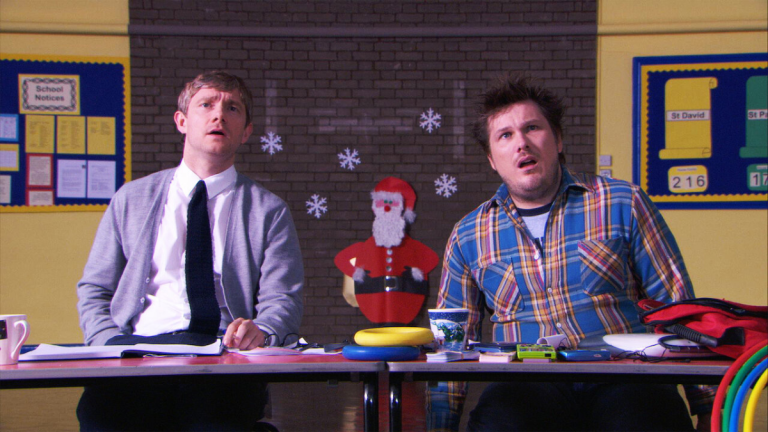
In some ways, Debbie Isitt’s 2009 musical-comedy Nativity! is an unlikely Christmas classic. Its partially improvised dialogue and use of local, untrained child actors could have turned it into an unwatchable nightmare. Instead, these factors helped to create one of the most rewatchable Christmas movies of all time.
Since its release, Nativity! has become a U.K. holiday staple embraced by kids and adults alike. Every year, social media is awash with Nativity! edits on the run-up to Christmas, easily rivaling the popularity of Home Alone or Elf in the U.K. But how did a low-budget movie about a school play starring Martin Freeman and a little-known comedian become the kind of success that has spawned three sequels and a stage musical?
Let’s unpack all the ways Nativity! continues to resonate with U.K. audiences…
It’s Painfully British
You won’t find any magical elves or billionaire generosity arcs in Nativity!. The movie focuses on a completely down-to-earth scenario: Freeman’s grumpy, jaded teacher Paul Maddens is once again picked to run the annual nativity play at an underfunded primary school, and while trying to cover up for his own perceived failures in life, he tells a lie that spins out of control, leaving him with no other options than to either admit the truth or put on possibly the most impressive nativity play of all time with little in the way of resources.
The atmosphere at the state-funded school is instantly recognizable to most people who attended one in the U.K. The buildings are drab and drenched in fluorescent lighting, the teachers are overextended and on the brink, the kids are pure chaos and need to be constantly herded like overexcited sheep, and the end-of-year nativity play is set to be another gruelling experience for everyone involved. You can almost smell the combination of cheap bleach and tinsel in the air.
The Kids Are Just Regular Kids
Filmed in Coventry, Nativity! sourced its child actors through open casting calls in the Midlands. None of them had any prior acting experience, which makes their kinetic performances totally authentic.
The kids are natural and funny in a way that isn’t contrived. We don’t see anyone putting on their best stage-school voice or overacting for the cheap seats. Some kids mumble or yell, some are painfully shy. The “skills” they show off are also precisely what you’d expect from a bunch of everyday schoolchildren, from armpit farts to the kind of inspired breakdancing that almost matches Raygun’s cringeworthy Olympics efforts in 2024. They’re allowed to be weird, loud, and brutally honest with the adults who are dealing with them. None of them are perfect angels until they’re literally dressed like one, and even then, you never know what they’ll do next.
In Nativity!, the kids are desperate to be noticed, whether that’s by their neglectful parents or by their own metric, but their aspirations are also completely standard. If you’ve ever starred as the third donkey or a bale of hay in a U.K. school nativity play, you can recall the hope you had that maybe you’d score a better role next time around. Maybe, just maybe, you’d be cast as Mary or Joseph. Everyone remembers the more popular or talented kids getting a plum part, that’s why Mr Maddens’ decision to cast multiple kids as Mary and Joseph in the final show strikes such a chord, showing us that there are always opportunities to spotlight the kids who are so often ignored or left behind.
Mr. Maddens vs Mr. Poppy
The film nails a particular shared experience in the U.K. when we see the costumes fall apart, the kids keep forgetting their lines, and the teachers slowly lose the will to live. Meanwhile, their parents pray they’ll witness anything other than a poorly-produced mess. If they’re lucky, they won’t have to see one kid projectile vomit on the baby Jesus as they sit there on an uncomfortable plastic chair, hoping it’s all over soon.
Nativity! turns that shared trauma into comedy gold, largely thanks to the addition of Mr. Poppy (Marc Wootton), a man-child teaching assistant who won’t take no for an answer and who keeps Mr. Maddens’ lies alive in the hope that everything will turn out fine on the night. As Deadpool might say, he makes an educated wish, except it’s not so educated.
Mr. Poppy’s earnest, excitable nature isn’t just contagious for the kids; it also breaks down Mr. Madden’s walls, allowing him to throw himself into the play in a way that he never would before, leaving him utterly vulnerable to consequences, both good and bad. While Freeman’s bitter, pathetic teacher is entirely relatable for most adults, Mr. Poppy represents the childlike optimism we’ve let slip away and need to claw back into our lives to avoid becoming total husks.
Low-Stakes Comfort Viewing
The plot of Nativity! is intentionally small. It’s not about saving Christmas, and there are no global consequences. It’s just about one school trying not to embarrass itself. Mr. Maddens has lied and promised that Hollywood is coming to see the play and the sky’s the limit for everyone involved, but whether he makes good on this promise is much less important than the play actually being worth the effort after all the work they’ve put into it.
Though the film’s nature is fundamentally kind and there’s no real villain, some moments still hit hard. As Mr. Maddens spirals into crisis and the lies stack up, he decides to read the kids’ letters to Santa and learns about their troubled home lives, along with the hopes and dreams riding on his efforts. When he becomes furious at Mr. Poppy for perpetuating said lies, it’s a genuinely distressing part of the movie because he’s only really angry at himself for letting them down.
We want to see Mr. Maddens’ happiness restored just as much as we want to see him pull off the play, but those are the only things we need to worry about. Nativity! taps into the part of us that knows what it’s like to have everyone counting on us when we’ve stopped believing in ourselves, so to see Mr. Maddens slowly embrace the possibility that he can make the play happen against all odds feels overwhelming.
The Final Show Is Worth the Wait
When Mr. Maddens and Mr. Poppy finally take the nativity play to the stage after their lies are exposed and everything is called off, it’s an utter delight. The catchy songs – written by Islitt and composer Nicky Ager – are all revealed as instant bangers. You might be surprised by how many regular people in the U.K. can now deftly break out into “Sparkle and Shine” at a moment’s notice, and the kids’ riffs during certain songs are endlessly joyful (“extra spicy!”).
In the end, the nativity performances turn out to be genuinely heartwarming. It’s not like the kids have become Hugh Jackman or Barbra Streisand overnight, but after working so hard to up their game, they’re giving it their very best, and the play is choreographed perfectly to highlight their strengths.
The nighttime cathedral setting, fun costumes, and everything that goes wrong during the play are also grounded and realistic. The most fantastical moment of the film, when Clarke Peters’ American studio boss flies into town on a chopper, almost seems like an afterthought. The ending has already earned its sentiment: it doesn’t matter if Hollywood notices these kids; they’ve done everything they can to make this moment matter.