The Great Review (Spoiler-Free)

This The Great review contains no spoilers.
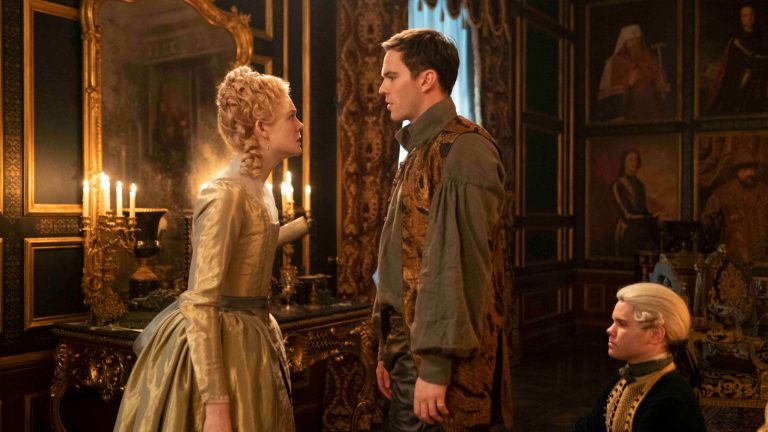
In The Great, Elle Fanning anchors a deceptively biting romp punctuated with the visceral realities of the 18th century Russian court of Peter III. With a passing resemblance to history, The Great tracks Catherine’s trajectory from a naive German princess obsessed with romance to a savvy woman managing affairs of state and plotting a coup against her husband. A wild ride through the romance, grit, and plotting it takes to become the storied Catherine the Great, Hulu’s new series is frothy fun with a deadly dark side.
Billed as “an occasionally true story,” The Great is history in the style of Apple TV+’s Dickinson, albeit without the needle drops. (The contemporary music is saved for the credits, where it usually serves as an effective punctuation on the episode.) The asterisk on every title card allows The Great’s playful nature to apply to its take on the historic record as well as gender roles, dialogue, and probably the behavior of bears.
It’s not surprising that The Great comes from The Favourite’s Oscar-nominated writer Tony McNamara (he also wrote the 2008 play of the same title) and the line from The Favourite to this series is so direct and short that it’s more like a pinprick. Both are billed as satirical black comedies, star Nicholas Hoult, and are more interested in style and sass than stodgy fidelity to the time period or historical reality. But The Great also clearly owes a debt to Marie Antoinette, especially the wistful carriage rides and its foppish depiction of a young male ruler.
Aside from Tony McNamara, the show is shaped by writers Tess Morris (Casual), James Wood Gap Year), and Gretel Vella (one of several Doctor Doctor alums). The array of powerhouse directors includes Matt Shakman (Game of Thrones, Mad Men, also a producer), female duo Bert & Bertie (Kidding), Geeta Patel (The Mindy Project), Colin Bucksey (Breaking Bad), and Ben Chessell. Between them, they’ve directed at least one episode of practically everything worth watching for the last 10-20 years.
While Sofia Coppola’s Marie Antoinette found a mental escape in clothes, confections, and vaguely anachronistic cosmetics, Catherine would rather read Voltaire and fantasize about a better world for women and surfs with her cunning lady’s maid, Marial (Phoebe Fox, who owns just about every scene she’s in). Catherine wears pastels and tall hair when necessary, but mostly prefers plain skirts and functional open-collar dress shirts. Her extravagance comes instead in the form of romantic hopes – for a liberated Russia and a love of her own.
The whole spectacle is less precious than Marie Antoinette, or most period dramas. The Great knows how most Americans view Russia, and is uninterested in disabusing us of those notions. Instead it leans in to a sense of bleak fatalism and ever-present danger. Characters write-off murder (“it’s not my thing, but it’s Russia; it happens”) and corpse desecration. Other old-timey ills like burning surfs and murdering children are presented as both horrifying and completely commonplace. Here, The Court of Peter is chaotic and loud, casually violent, and prone to absurd, graphic flights of fancy. Just about every bodily function takes place on screen, in all their squelchy, squishy glory.
Fanning is bewitching in her ability to toy with Catherine’s innocence and greater ambitions, for the benefit of the court as well as the audience. As she wises up to the realities of court and power, the transformation is so subtle that it’s hard to believe the character in episode one is the same who finishes out the 10-episode season, and yet it’s nearly impossible to put one’s finger on when, exactly, she changed. So much of the show rests on Fanning’s mix of well-read and sheltered, optimistic about what could be and completely aghast at what she sees before her.
The show finds a deeply necessary counterbalance in Nicholous Hoult’s Peter. As vexing as he is, it’s hard to imagine the show ever existing without him, history aside – although perhaps “history aside” is the very point. In Hoult’s portrayal, petulant Peter is surprisingly three-dimensional. In less skilled hands, the irascible emperor could easily grate on the nerves. But Hoult opens Peter just a crack to show the tiniest sliver of humanity, in the way he loves his deceased mother or his occasional desire to see Catherine happy, or at least content enough to shut her mouth. In some of his more vulnerable moments, you can even manage to see that sweet, hurt kid from About a Boy nearly two decades ago.
Other standouts include Sacha Dhawan (Doctor Who) as Count Orlo, a nebbish in Peter’s inner circle whose ideals are more closely aligned with Catherine’s. Dhawan makes a meal out of what could be a boring type, but he excels as Orlo comes into his own. Hoult’s fellow Skins alum Sebastian Denis de Souza brings devil-may-care heartthrob energy as the queen’s official lover Leo. Phoebe Fox’s Marial could be seen as the second lead instead of Hoult’s Peter, given her savvy knowledge of court and Fox’s likeable and continually surprising presence as Catherine’s maid-turned-best friend.
It’s worth noting that The Great is one of several historical dramas to practice colorblind – or rather, color-conscious – casting, along with The Personal History of David Copperfield, Mary Queen of Scots, or even going back to Denzel Washington’s Don Pedro in Much Ado About Nothing. Already, far too many period pieces whitewash people of color out of history in favor of a default white understanding. But in a show where language, timelines, and other aspects of history are changed, it would have been a deliberate choice to insist everyone remain white while moden pop features on the soundtrack. There’s no denying that Dhawan, in particular, is perfect for his role. Moreover, Peter disrespecting a Black noble in favor of allowing his white best friend to break the same rule reads differently, in ways that add to the story.
While The Great’s relationship to the historical record is not entirely loyal, it never purports to do otherwise. Folks who like a strict attention to detail will have trouble stomaching the reshuffling of Catherine’s various lovers and collaborators or the tendency for characters to casually invent the Moscow mule and the word “woah” or to fortuitously drink one of the first bottles of Dom Perrignon. But the whole endeavor is more fun if you throw yourself into the chaotic vibe of hot people having sex, plotting against one another, having an occasional bout of feminist thought, and killing people, like a less squeamish, more grounded Prestige TV Riverdale.