The Further Mis-Adventures of Cliff Booth Review: The Odd Coupling of Tarantino and Fincher
More downbeat noir than grooving hangout movie, The Further Mis-Adventures of Cliff Booth is definitely a David Fincher joint, but with that irascible Quentin Tarantino and Brad Pitt charm.

The earliest of many vintage songs in The Further Mis-Adventures of Cliff Booth is “War,” Edwin Starr’s rousing anti-Vietnam screed that even by 1977 could get the blood up. It still does, so it’s not a surprise to hear it popping off in a film written by Quentin Tarantino, one of the modern masters of the needle drop. He certainly was dropping ‘em right and left in Once Upon a Time… in Hollywood, the last QT joint set in the wilds of mid-20th century SoCal showbiz.
But Once Upon a Time was also directed by Tarantino. Cliff Booth, decidedly, is not. Famously helmed by fellow ‘90s wunderkind and Brad Pitt booster, David Fincher, Cliff Booth the Spinoff always seemed destined for a different flavor. Still, it comes early and loud when Pitt’s titular stuntman is introduced moonlighting as a projectionist, a fact that feels like a throwback to another Fincher/Pitt collab, Fight Club. Also like that film, one senses Fincher is far less concerned with what’s happening on the screen-within-the-screen as he is with building an aloof, downbeat sensibility, befitting the tastes of the director of Gone Girl and The Social Network. Hence when Starr’s sweaty chorus reaches its crescendo, with the singer asking 1969 crowds just what the hell war is good for… the scene cuts away to two bad men in a car outside the theater. The highpoint of the music, and its energy, occurs offscreen.
I cannot be certain that dicing up this song is not in Tarantino’s screenplay, but I can also recognize aural disinterest from a filmmaker. Here’s a storyteller more keen in cutting the rhythm of his scenes to achieve a certain type of tone beyond fetishized nostalgia. It betrays a statement of intent. Fincher is working with Tarantino’s characters, Tarantino’s unmistakable Chatty Cathy dialogue, and Tarantino’s interests—The Movies!—but it’s in a filter that feels unique; separate; and maybe slighter too.
So the real litmus test for many viewers will be how much of a dealbreaker that is in Cliff Booth, a film that has relatively little to say about its setting or vision of a shaggy, post-Star Wars Hollywood, especially when compared to Once Upon a Time’s obsession with the 1969 New Hollywood inflection point. Yet in keeping with Cliff’s own irascible nature, this sequel still has plenty of laconic, laidback charm all its own to offer. And also similar to the increasingly scraggly fall guy, things like crime, murder, and noir can still come in a more aged, leisurely package with twinkling blue eyes.
Pitt twinkles them real good, too, as we meet Cliff in ’77, eight years removed from the film that ended with him and his TV star BFF, Rick Dalton (Leonardo DiCaprio), preventing the Mansion Family murders at Cielo Drive. In the interim, Rick apparently got fat and left Los Angeles for greener TV pastures in Australia. (There is also a sweeter, more discreet nod to the events in the previous movie I won’t spoil here.) Meanwhile, stunt work has dried up for Cliff without his buddy, plus a newfound limp after he took a Manson knife to the leg in ’69.
Not that the dangerously disarming Booth would ever complain about it. He makes it clear he’s just happy to be here, doing odd jobs like the late shift at the New Beverly Cinema (another easter egg for QT fanatics) and tiki bars the rest of the week. He also has an aging father to look after with his cantankerous old man Gus (a delightful Peter Weller), and more off-the-book favors for friends like an unnamed Oscar-winning director that I’m pretty sure is supposed to be George Cukor. Still, luck turns in more than one way when he is tracked down by Karen Crosby (Elizabeth Debicki), an Aussie expat who was at one time a movie critic but these days works for the quasi-famous TV actor Charlie Peters (Scott Caan).
Like Rick Dalton in another era, Charlie is a B-celebrity, albeit with a Napoleon complex and enough narcissism to light the Hollywood sign. Charlie also, allegedly, does all of his own stunts. So why he wants to become Cliff’s friend is not entirely clear. Neither, perhaps, is why Cliff is so familiar with Charlie’s wife Toni (Carla Gugino). Yet all parties will soon find themselves ensnared in a plot that involves extortion, murder, and a couple of Filipino hard cases (Matt Groove and JB Tadena) with a sledgehammer strong enough to take down a rhino.
Once Upon a Time is famously a hangout movie, a film designed by Tarantino to be a three-hour chill session with Rick, Cliff, and sometimes Margot Robbie as Sharon Tate. Cliff Booth is not that. Harkening back in more than one way to Tarantino’s Jackie Brown, this is a gingerly, adult-skewing piece of pulp that takes its time before sliding in the knife.
Also like Jackie Brown, it’s a love story; something I wouldn’t apply to any other Tarantino screenplay, save True Romance (1993), another movie he famously did not direct. True Romance was also, by Tarantino’s own admission, a film he wrote before he had a firm understanding of what a long-term romance could be. Jackie Brown, meanwhile, was liberally adapted for the screen by a young man imagining what middle-age kismet means for two people at the end of their emotional rope, courtesy of magnificent (and magnificently underrated) performances by Pam Grier and Robert Forster.
Cliff Booth was authored by a much older, and married, QT, and is directed by a man happy to explore relationships in his films, although I’d hardly call Gone Girl, Fight Club, or even The Curious Case of Benjamin Button swoon-worthy. But to both’s credit, their matchmaking instincts are absolutely on point with the casting.
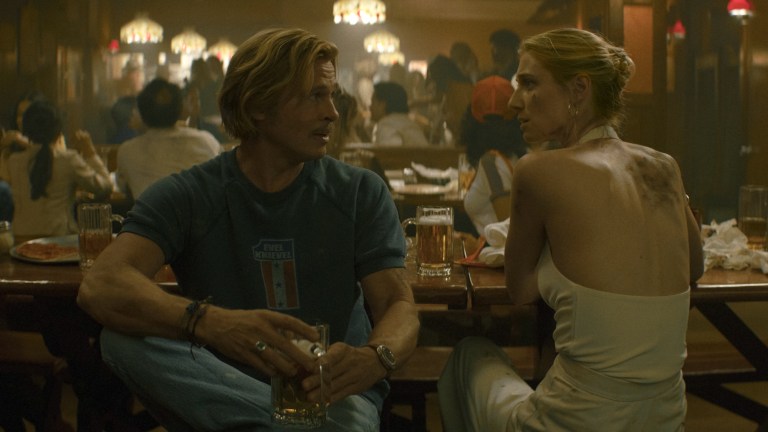
Pitt and Debicki have crackling chemistry. And better than that, they have an oil and water dynamic where despite having every reason to be turned off by the wily, hard-drinking, hard-living Cliff, Debicki’s patrician Crosby finds herself drawn to the flame like a porcelain moth.
Her Karen is erudite, intellectual, and thoroughly exhausted with the Hollywood bullshit raining down from her egomaniacal boss. Obviously, there is something of the “Tarzan and Jane” dichotomy of Tarantino’s narrative setup, but Fincher’s fascination in the Karen half of a couple whose first date includes Cliff asking Crosby to slap the hell out of him suggests a richness to the characterization that is only partially explored. While Tarantino denies The Further Mis-Adventures is the same screenplay as his shelved, once-intended final film, The Movie Critic, the 1977 setting and Crosby’s snobbish condescension toward cinema, stuntmen, and even her fellow film critics, suggests there might have been a version of this movie where Crosby was the protagonist and Cliff still the good-natured knucklehead in supporting.
If so, that might’ve been the better movie.
What comes to the screen is highly entertaining, but like Booth and Crosby, it’s largely unconsummated, content with just screwing around while bashing the occasional head in. And the more it drifts toward seedy noir entanglements and violence, the more it feels like a coasting exercise in style. Cliff still rockets through vintage Hollywood roads in sexy muscle cars (although perhaps with a lot more green screen or rear projection now), but even these overt echoes of Once Upon a Time suggests a diminished sense of obligation. That’s what audiences expect, but Fincher’s camera seems more intrigued in drawing out the sleazy underbelly of the city and its various ghouls.
To be sure, the bad guys are so heinous in this movie that when Cliff Booth finally puts on his white hat (or perhaps more light gray), it is mesmerizing. Pitt knows how to lay a charm offensive on so thick that it becomes difficult even for the audience to remember what happens when the friendliness recedes in those eyes, like the sun behind grim clouds. It’s a magic trick that nabbed Pitt an Oscar in 2019, and in 2026 he gets several scenes to play the good ol’ boy who, eventually, drops the pretense of being good.
Cliff’s various humble-brags that can endear lovers, employers, and even enemies also builds out a backstory that at this point takes on a comical mysticism worthy of The Wolf from another QT classic. But on a certain level, it does feel like an excuse to just bask in this performance and character again, often in a film that fails to light Pitt’s scamp with as much warmth and joie de vivre as QT and Robbie Richardson did seven years ago. Fincher’s instincts are literally shadowier, more oblique, and frankly less interesting when captured via digital photography.
That applies to Cliff Booth as a whole: it just seems smaller when compared to one of the greatest movies about making movies. But if you can divorce the film from the one with Rick Dalton, there remains a relentlessly ingratiating neo-noir with an affable sense of humor and an unlikely romance so good, it should’ve been the whole movie. I imagine it’ll be divisive, but I’d be lying if I didn’t say hanging with Cliff Booth after hours is a grand ol’ time.
The Mis-Adventures of Cliff Booth opens in IMAX theaters on Nov. 25 and premieres on Netflix on Dec. 23.