The Odyssey Completes a Career-Long Journey into Christopher Nolan’s Greatest Fear
The Odyssey is yet another peak and peek into Christopher Nolan’s biggest fears about the women "great men" leave behind.

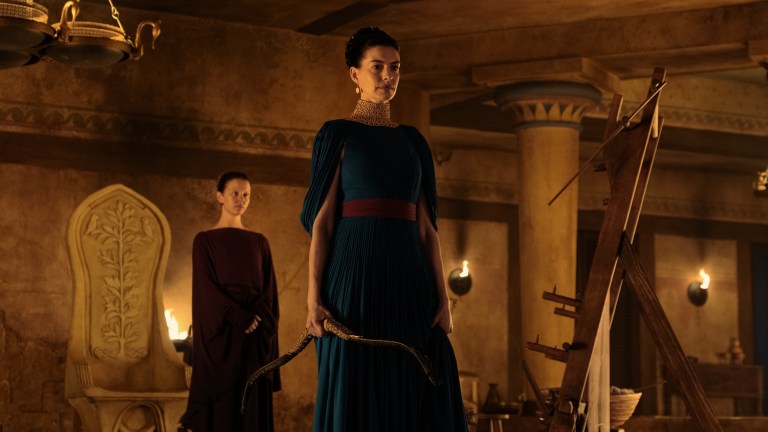
During one of the few scenes shared by Odysseus and Penelope in the new, staggeringly realized adaptation of Homer’s Odyssey, our married couple is in a state of mourning while lying in bed. The grief that snuffs their hushed whispers and moistens downcast eyelines is not due to a loved one who is lost, or a memory of pain long gone by. It’s agony felt for the years yet to come where they will be separated. And as played by Matt Damon and Anne Hathaway in the new Christopher Nolan film, these versions of the mythical Greek figures find no comfort in the prospect of Troy’s sacking. Odysseus leaves solely out of obligation; otherwise his home can never know peace. All Penelope asks for in return is that Odysseus promise her he will return.
“What if I can’t?” Damon’s broods.
It’s a question left hanging over the final edit of the film like how the shadow of Athena haunts Odysseus’ steps. It is also an articulation of one of the chief, driving obsessions of Nolan’s career, which has only deepened with time and age before culminating in The Odyssey’s monumental bloodlust of a finale.
“I’ve written a few dead wives, that’s true,” Nolan once joked about a running motif throughout his early work, which usually involved men and the deceased women who trail behind them. “But you try to put your relatable fears in these things, that’s what film noir is, and I do view Inception as film noir. You take the things that you’re actually worried about in real life, or things that you care about in real life, and extrapolate it into a universal [story].”
It is a (perhaps) sweet gesture toward his real-life wife, producing partner, and raven-haired muse, Emma Thomas, that the best way Nolan could think of heightening the pathos of his hero in Inception —or Memento, or The Prestige, or The Dark Knight, or…—was via this great and terrible fear. Yet as Nolan has evolved as a screenwriter and storyteller, he has put a finer point on his dread by not only revealing what it is, but considering why it is so terrifying.
In a separate interview on her own, Thomas told 60 Minutes, “I cannot imagine Chris if he wasn’t making film, and outside of family which is probably the most important thing to him… it is horrifying to think how frustrated he would be if he wasn’t able to tell stories by the medium of film.”
Nolan is aware of the mystique he’s cultivated with as much care and effort as he’s put into emphasizing practical effects and the magic of IMAX photography. His reputation as the Hollywood genius of his era grants him the capital to turn a project about the father of the atomic bomb into a three-hour summer blockbuster, and an adaptation of a 3,000-year-old myth into a quarter-billion-dollar event. Yet the more movies he’s made, the better he interrogates the myth behind the Great Man™, plus the often destroyed home life he throws away.
Matthew McConaughey’s Cooper leaves to literally save the world on the other end of the cosmos in Interstellar, but only once he’s on the far side of a wormhole can he confront the enormity of his sacrifice. He realizes he’s missed his children’s entire lives as they age from adolescence to middle-age in the span of a few minutes on his TV screen. He felt what he was doing was important, but only after he spent that most invaluable resource that hovers above all of Nolan’s oeuvre—time —does Coop appreciate what he’s lost. Meanwhile J. Robert Oppenheimer is the epitome of the lauded genius who in real life changed the world by building a team of similarly ambitious minds. That, too, is a theme consistent throughout Nolan’s work, be it Interstellar’s Coop, Inception’s Cobb, or even the gosh darn Batman and his network of public servant accomplices throughout Gotham City.
Yet unlike The Dark Knight trilogy, Oppenheimer carries on past the team’s greatest triumph and sits with the totality of their brilliance. Which in this case was able to level cities, kill tens of thousands, and shape the world for the worst. Also, once again, Oppenheimer’s domestic homelife as a spouse… took some hits along the way.
As Damon told me the other week, Odyssey feels like the ancient flip-side of Oppenheimer’s modern foreboding: “The first thing I said to Chris when I read the script was, ‘Wow, this traffic’s in a lot of the same themes as Oppenheimer… I just felt that’s a story about accountability for what you’ve done and the decisions you’ve made. Odysseus is very much responsible for his own ingenuity and living with the effects of that.”
Here is yet another genius whose greatest contribution to history is winning a war by annihilating a city and condemning its inhabitants to mass death and suffering. He is celebrated because of it, but more so than Homer’s Odysseus, he also is forced to reckon with the psychic horrors it unleashed not only on Troy but also his own homeland where the bonds of what is considered moral and justifiable corrode.
This time he’s even deprived of the opportunity of going home to the wife, who is very much not dead. In fact, as played by Hathaway, Penelope’s more alive than Odysseus has been in years, making his dutiful choice to leave—and to theoretically do great things—all the more painful. It transforms the eventual homecoming during the film’s final, and most pensively paced act, into something cathartic but inevitably bittersweet.
Despite adapting perhaps the greatest of epics, The Odyssey achieves Nolan’s quietest intimacy. At last we get to sit in what happens when one of his heroes go home.