The Odyssey Review: Christopher Nolan’s Grand Homecoming
“Epic” barely scratches the surface of The Odyssey, a return to the obsessions and dizzying scale that make Christopher Nolan movies so singular.

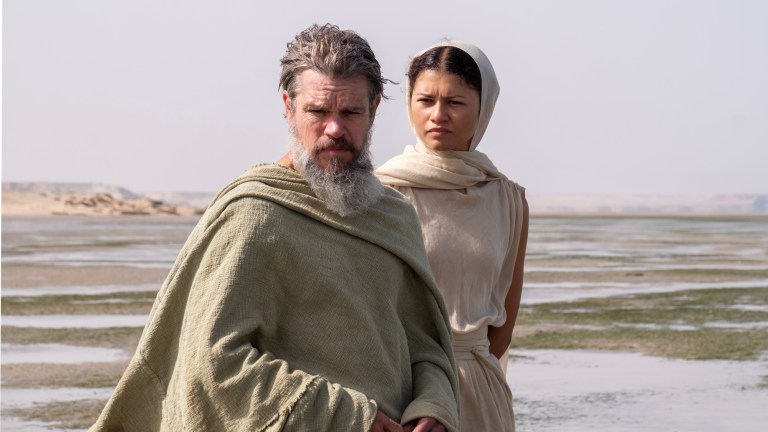
Before we ever meet him, the Odysseus of Christopher Nolan’s The Odyssey has already been subsumed by myth. He is in the first scene, technically, bravely concealed within the wooden contours of a monumental horse left along the shores of Troy. Yet that is not the Odysseus Matt Damon actually plays in the even more monumental film from the mind of a filmmaker obsessed with obsessives. The heroic figure we see springs from a tale, a story, a song sung to revelers in Ithaca about their wily and absent Greek king. These diners listen while feasting on Odysseus’ meat, drinking Odysseus’ wine, and attempting to make love to Odysseus’ wife Penelope (Anne Hathaway), their entertainment having preceded the husband home by seasons and years.
The real Odysseus, the man who dreamed up a wooden horse that won a war and burned a civilization to ash and slavery, does not appear in full for nearly half an hour into the three-hour epic, and by this time, he is gray, sun-beaten, and so wrecked by his travels that he can barely remember the wife and son he left behind nearly 20 years earlier.
The contrast between that reality and myth, genius and the dangers worshiping it invites, weighs heavily on Nolan’s film as both one of its many daunting thematic ambitions and, at times, a minor Achilles heel. (Apologies for mixing Homer metaphors.) It’s there, but as a small piece of a cinematic vessel so rich, so grandly constructed, and built from so many resources that the sheer audacity of the thing is breathtaking to behold. “Epic” does not begin to describe how massive the whole enterprise becomes. And when the time arrives to take it all out on those real Mediterranean waters, the wind could never be higher at the movie’s back.
Shot entirely in IMAX 70mm photography by cinematographer Hoyte van Hoytema—including for the first time ever in every dialogue sequence—The Odyssey is a visual wonder with actual seaworthy galleys cutting across the chop of the Greek Archipelago. If there was ever an Odysseus or a Trojan War, these are roughly the same sights and travails his fleets would’ve crossed, and they’re where Nolan, ever the showman visualist, is most in his element of adding a natural verisimilitude—or at least the illusion of it—in a tale that features one-eyed giants and a goddess who can turn men to swine.
All of those most fantastical elements are present in The Odyssey, yet what might surprise longtime fans is that the strongest stuff comes from the emotional yearning and passion that was once so foreign to the filmmaker’s early films. Down to its bones, Nolan’s Odyssey is a sweeping love story between a revered man and the wife and family he leaves behind. While Damon’s Odysseus has relatively few scenes with Hathaway, and even fewer with Tom Holland as the teenage Telemachus, the son Odysseus never knew, it is the absence felt by all parties where the film crackles.
It is perhaps for that reason—plus the gargantuan 10-year arc of the story—that The Odyssey really takes place mostly at the end. Beginning in media res, we open on the final days of Penelope’s attempts to keep the now small army of suitors and covetous ne’er-do-wells at bay. Given Odysseus’ nearly two-decade vacancy from Ithaca’s throne, every opportunist and huckster in the Greek diaspora has taken up residence on the island, hoping to win Penelope’s hand and her husband’s seat of power. As Penelope is painfully aware, no woman is allowed to officially rule in these dangerous times, in spite of the fact she has done so in all but name. Eventually, she will be forced to marry one of these fools, and on that day her son’s life will be forfeit.
Meanwhile Odysseus is himself trying to find the ability, or even the will, to return home after winning too much comfort in the arms of Calypso (Charlize Theron) on an island not far from Ithaca’s shores. It was his last stop, but one after his several ships were left in ruins and his memories in tatters. As he recalls his past adventures—replete with siren songs, cannibals, a trip to the Gates of Hades itself, and that damned horse—he is forced to reconcile his greatest triumphs with his greater shames. The judging, wise eyes of the goddess on his shoulder, Athena (Zendaya), does not make it any easier. But it might be her influence that finally will give him the strength to get home.
In many respects, The Odyssey feels as much like a culmination for Nolan as Oppenheimer did. Both are films about ostensibly great men who must face apocalyptic consequences for their actions, and both feature characters whose legends obfuscate the blood stains. But then, Odyssey is also apiece with many films in the director’s oeuvre—The Prestige, Inception, Interstellar, two-thirds of the The Dark Knight trilogy—which all dwell on the desire to go home, and the fear that it will be impossible to find the same wife and kid(s) waiting for you there. This isn’t even Hathaway’s second time as the woman left behind. It is the first, however, where she gets to play the ultimate arbiter of whether the great man’s hubris has burned all the bridges and world.
What is most richly rewarding about The Odyssey, then, is how much the passion between Odysseus and Penelope propels the movie. We see them together in flashbacks and—three-thousand-year late spoiler warning—quite a bit in the third act, and both sides’ anguish over the break is evenly considered and agonized upon. Penelope is a monarch in all but name in a land that treats even its queens as property, something that is chillingly teased when young Telemachus learns the fates of both Helen of Troy and her twin sister Clytemnestra (each played with brief red-hot ferocity by Lupita Nyong’o).
Odysseus, for his part, does not go to war out of pride. He goes to Troy because the more powerful and fearful King Agememnon (Benny Safdie in armor that looks like Corinthian Batman) demands his fealty and aid after sacrificing his daughter to the gods. Like Matthew McConaughey in Interstellar or Leonardo DiCaprio in Inception, Damon’s Odysseus leaves because it’s the only way to see his family again, but the choice ultimately drives him to the brink of madness.
Thus The Odyssey really is another outgrowth for Nolan’s fixations, but the context is jaw-dropping in a film that unapologetically and with shocking fidelity adapts Homer’s epic poem, which was first committed to paper around 2,800 years ago. Every monster and spectacle is here, but it’s still told through the lens of the filmmaker who once eschewed Ra’s Al Ghul’s immortality-giving Lazarus Pit in Batman Begins, or Bane’s ability to use a nigh magical serum to hulk out in The Dark Knight Rises. Which is to say, the film approaches its magical and fantasy elements with as much trepidation as Greeks treading through a cyclops’ cave.
That is also one of the standout set pieces of the film—an extended showcase in suspense as Odysseus and his companions, including second-in-command Eurylochus (Himesh Patel), are trapped in pitch blackness with the one-eyed Polyphemus, the actual name of the cyclops that is not uttered in a film that’s cautious to a fault about toeing the line with what is believable.
Similarly, the magical menace of the Laestrygonians, a race of bloodthirsty giants, is signaled by bizarrely anachronistic medieval armor, which comes across as more inexplicable than incredible, and the multi-headed Scylla is rushed off-screen almost as quickly as it appears. Elsewhere the divinity of certain characters, such as Theron’s Calypso, is only obliquely hinted at, which in turn truncates the allure of her offer of literal eternity. Peter Jackson’s sense of vivid enchantment, this is not.
Critiques such as these, or noting that Nolan’s penchant for clunky, hand-holding exposition is pronounced here, are necessary due to the sheer breadth and sprawl of the film. But listing them out risks obscuring a magnificent forest for a few blemished trees. While a couple sequences do not live up to Homer’s wonderment, others frankly exceed it, with Samantha Morton’s handful of scenes as Circe, the witchy goddess with the power to reveal the beastly nature of men, all but stealing the movie. Almost single-handedly the actress waylays Odysseus’ plight into the realm of folk and body horror that’s as sinister as anything we’ve seen in a full-born genre picture this year. In a film full of award-worthy performances, Morton’s might just be the highest of highlights.
But as with so much of the filmmaker’s work, home is where the heart is in Odyssey, and where the most compelling worldbuilding is achieved, be it in Ruth De Jong’s textured production designs or John Leguizamo’s regal equanimity as the last loyal servant in all of Ithaca (in another turn from a character actor the Academy would do well to remember). A subplot involving Odysseus’ dog Argos, a puppy when Odysseus left, but now a broken and aged victim of abuse from Penelope’s suitors in the present is sure to moisten more than a few eyes. It turns out, Nolan is a softie at heart, as demonstrated by the most heartbreaking scenes between Damon, Hathaway, and the dog, which in turn are only surpassed by the heartpounding finale where Odysseus visits everyone else in his house, beginning with Antinous, a delightfully scenery-chewing and sniveling Robert Pattinson.
The breadth of The Odyssey’s massive scope, married to its final, living-room scaled concerns, gives it a conviction that exceeds any other Hollywood production based in Greek myth. Whereas Wolfgang Petersen’s Troy feared even acknowledging the gods and reduced the war of its title to a fortnight frolic on a beach, Nolan’s Odyssey is all-encompassing, faithful, and dares incorporate actual history we know from the late Bronze Age. There is indeed a crucial subplot involving the arrival of “the Sea People,” which should send a shiver down the spine of classist professors.
Nolan is determined to marry history with mythology, and Hollywood spectacle with his own obsessions, in order to tell an epic overwhelming in scale, and with multitudes of layers I’ve barely touched, including how the picture uses those menacing Sea People and the collapse of civility in the the Trojan War’s aftermath to confront the dangers faced by a civilization that no longer remembers how to treat strangers from distant shores.
The film is an awesome undertaking in the ancient sense of the word, captured in van Hoytema’s glorious IMAX compositions. It’s a homecoming for a storyteller who spent his career chasing this destination, which by the film’s closing arrives with the charge of a thunderbolt.
The Odyssey is in theaters on Friday, July 17.