Mortal Kombat II: The Nastiest Death Scene Says Something About Fandom
We unpack the gnarliest death scene in Mortal Kombat II and why it probably went down like that.

This article contains some spoilers for Mortal Kombat II. (But like, you already know, right?)
In what is probably not surprising for anyone paying attention, poor Cole Young did not make it to the next round in his match or his life. The one-time new protagonist of the rebooted MK franchise played by Lewis Tan in 2021’s Mortal Kombat returns in the sequel only long enough to go out during his first round in the fate-of-the-world tournament from whence the series earns its name. And he goes out bad.
Upon being obligatorily reintroduced to new franchise lead Johnny Cage (Karl Urban), as well as audiences with fuzzy memories, in one of Mortal Kombat II’s exposition dump sequences, Tan only appears in a handful of other scenes. He’s onscreen long enough though to remind us that it took him a whole film to develop his superpowers, he is the descendant of Scorpion, and that he has a wife and daughter he’s fighting for. Said family is also awkwardly left off-screen, lest we remember we were asked to invest in this guy’s personal life five years ago, and thus would feel bad about what’s coming.
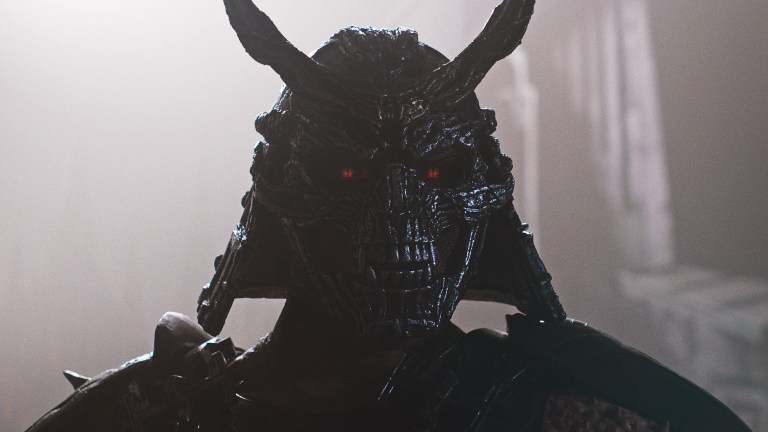
Afterward he is sent into his first and only tournament bout against Shao Kahn (Martyn Ford), the menacing Emperor of Outworld. The viewer knows the deck is stacked against Cole even before the fight since Shao Kahn is revealed to be cheating, using the stolen magic of Lord Raiden (Tadanobu Asano) to essentially become immortal. Which is too bad for Young since he’s allowed to look formidable. He even seems to defeat the baddie in a fair fight by slicing the evil inter-dimensional despot’s throat.
… But then, Shao Kahn gets better. And he immediately flips a stunned Cole on his back so he can smash his face in with the nightmarish Wrath Hammer. The geyser of red stuff that erupts makes it look like Gallagher Night at the Comedy Cellar circa 1989. Furthermore, even in a franchise where death is negotiable—we saw five full or quasi-resurrections in this movie alone!—it seems pretty final here. After all, this sequence takes place in the Dead Pool arena where an alluring pit of glowy green acid rests just off-platform, and Shao Kahn makes sure to knock Cole’s body deep into the bone-melting dip.
It’s a brutal end to a character who was once thought to be an audience surrogate and instead ended up the butt of a fairly mean-spirited joke. On one hand, it’s hard not to laugh along as it’s delivered in Simon McQuoid’s movie with the kind of cheeky, lizard-brain barbarism that made the Mortal Kombat franchise so popular in the first place. On the other, you suspect this was a rather overt attempt at a course correction, intended to please the most vocal online fans who were eager to turn Tan’s work in the first film into a gooey punch (or hammer?) line.
While no reason has officially been given (yet) for Cole’s coup de grâce beyond general flowers for anyone who is killed off in Mortal Kombat II—MK co-creator Ed Boon previously told us he thought, “Oh, I don’t want to see this person die!’” when reading the script—we cannot help but suspect it has something to do with an online narrative among fans. And it’s not a friendly narrative to Cole or Tan either. A cursory glance of social platforms like X or Reddit finds comments like, “He’s boring protag that’s shoved down our throats and is nothing more than someone who listens to exposition who through the power of his lazy arcana called plot armor beat one of FG’s most iconic boss.”
Some criticism may be aimed at Tan’s performance but more seems dedicated to the fact that in a franchise famous for having dozens of playable characters, Warner Bros. inexplicably elected to create an original audience surrogate for the 2021 film. And fans did not like seeing this guy win fights against familiar video game characters.
One has to feel a certain amount of sympathy for Tan, who was quite solid in Into the Badlands but was set up here to fail by playing a character diehard fans would reject. Granted, his backstory as a reluctant fighter and self-doubting father in 2021’s Mortal Kombat left something to be desired, especially opposite the flashiness of Josh Lawson’s scenery-chewing as Kano or the sheer gravitas and grace Hiroyuki Sanada brings to any role, even that of a guy who fires harpoons from his hands. Nonetheless, Tan might have had better luck (or a reception) with a character fans recognized.
Instead the fact he was an original character made some instantly resistant. And in an age where social media discourse shapes marketing decisions, the choice became not only about introducing a new lead like Johnny Cage, but removing the effrontery of Cole Young altogether. Violently too.
I’m of two, conflicting minds about this. In the first, Mortal Kombat II is easily better than the previous movie. A major reason for this is the ability to rely on the charm of Urban and Lawson, who anchor half the film as fan favorites Johnny Cage and Kano. The emotional/dramatic side of the film is meanwhile carried by Adeline Rudolph playing it straight as Kitana, a video game character who has more reason than anyone to hate Shao Kahn and the tournament, but who has curiously been often reduced to a love interest in previous film adaptations and adjoining media.
Putting Rudolph’s Kitana front and center gives Mortal Kombat II a better hook than the first film, and one which should please a vocal subset of fans who seem to only respond to seeing something they already know.
And yet, it’s worth considering why filmmakers and studios increasingly feel less like they’re telling stories with these bigger franchises than they are managing a brand or mascot. Whatever plans or hopes they might’ve had for Cole Young were not only abandoned but gleefully mooted with extreme prejudice. It’s akin to human sacrifice with a fictional character. Mortal Kombat might be one of the few popular IPs out there where you can turn such fan-appeasement into a humorously dark gag, complete with acid wash. Still, it is rewarding a certain level of entitlement and vitriol from a type of online fandom that can get outrageously possessive of a character, story, or media brand.
Which is to say, Mortal Kombat II gets away with the pivot, but the instinct is not that far removed from the far grimmer time Disney all but fired Kelly Marie Tran from Star Wars because of the bottom dregs of 2010s Twitter fandom.
In any event, Mortal Kombat II does level up its game from the 2021 installment, and Johnny and Kitana anchor a better tournament that is sure to make a big splash with audiences. Especially in the Dead Pool.
Mortal Kombat II is in theaters now.