Elon Musk’s AI Odyssey Redo Should Kill AI Movie Talk Once and for All
Christopher Nolan's The Odyssey is inaccurate, which is exactly why AI could never make it.

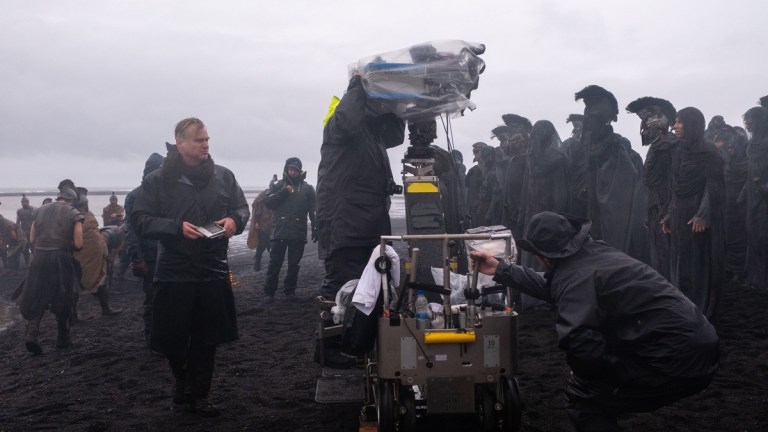
In the first line of Emily Wilson’s translation of Homer’s Odyssey, the poet beseeches the Muses, “Tell me about a complicated man.” That line, of course, refers to Odysseus, the crafty genius whose journey back home to Ithaca takes up most of The Odyssey. It could also refer to Christopher Nolan, who worked from Wilson’s translation to make an idiosyncratic, historically inaccurate, but critically and commercially successful film adaptation of The Odyssey.
It could not, however, refer to Elon Musk. Not because he’s any less worthy of complication than any other human being. But rather because the inheritor of riches his parents hoarded from diamond mines in Apartheid South Africa works so hard to present himself as a great man, a genius, an innovator, and anything but complicated. Musk demonstrated that tendency again when he took to his social media platform to repost an AI-generated recreation of a scene from the poem, boasting, “Before this year ends, Grok Imagine will make a full-length movie of The Odyssey that is historically accurate and true to the art of Homer.” In that line, Musk proves not only the lack of genius that made Odysseus an enduring hero but also an adherence to technology that lacks the humanity which allows Nolan to make flawed, inaccurate, but nonetheless resonate masterpieces.
A History of Inaccuracy
The first problem with this new AI Odyssey is evident in Musk’s post. What, exactly, is a “historically accurate” version of The Odyssey?
This may come as a surprise to those with no concept of the past, but The Odyssey was a work of historical fiction even at the time it was new. Scholars cannot pin down the exact origins of the poem, estimating it was committed to paper for the first time somewhere between the 8th and 7th centuries BCE, while allowing that it likely existed in oral tradition centuries earlier. Even then, the Trojan War that serves as the inciting incident for The Odyssey is supposed to have happened in the 13th or 12th centuries BCE, meaning there’s a gap of hundreds of years between the events of the story and its telling.
Furthermore, an emphasis on historical accuracy is inaccurate to the historical fact of The Odyssey. Ancient peoples didn’t have the same understanding or expectations of empirical truth that we have today, and thus would have easily accepted a blurred line between fact and fiction. Moreover, they would have understood the poem to be a mixture of historical myth (not unlike the way Americans tell ourselves inaccurate versions of the first Thanksgiving or Washington cutting down a cherry tree), community-building entertainment, and moral teaching.
But this isn’t about facts, is it? Musk is simply once again repeating bad-faith, poorly informed talking points about the casting of Black actors Travis Scott and Lupita Nyong’o and trans actor Elliot Page. Ironically, Musk is making an interpretation here; a hateful, noxious interpretation, but an interpretation nonetheless. Interpretations are the soul of art, and something done by everyone from the translators who brought The Odyssey into English to Angelica Kauffman to Alfred, Lord Tennyson to Nolan himself. If Musk were an artist, he could have just made his own version of The Odyssey.
But being an artist requires vulnerability, an acceptance that you might be wrong; it requires being so committed to your unique vision that you must expound upon it, even though no one agrees with you. And that’s where Musk fails, especially in his allegiance to AI.
Mistakes and Influences
No one understood the importance of human error better than critic Harold Bloom, a useful touchpoint for this conversation. An avowed conservative who advocated for defending the Western literary canon, Bloom is exactly the type of white, male intellectual that Musk and his ilk pretend they’re supporting. Yet in one of his most important books, 1973’s The Anxiety of Influence, Bloom argued that predecessors limit artists, and that the best poets are those who break away from their predecessors, even if they do so through “misreadings.” For Bloom, good art occurred when the poet did his (pronoun used intentionally here) own version of a form or a trope or a theme, regardless of what came before.
Musk and other tech bros love to position themselves as trailblazers and independent thinkers. Remember that Crypto.com ad that Matt Damon, Odysseus himself, did years ago, comparing cryptocurrency to the work of inventors like the Wright Brothers? But Grok can never blaze trails because it is a large language model, and is thus beholden to those models. It simply regurgitates output based on input that already exists, often in an even more derivative, even more calcified version.
For proof, one need only look at the post that prompted Musk’s declaration. Musk made his prediction while reposting a thread from the account @heavypulp, which included a three-minute Odyssey clip made with Grok Imagine. Even if we ignored the Roman-style armor, the brush-top helmets, and other historical inaccuracies, the clip fails to excite anyone. The landscapes and lighting are flat, the lines delivered by Odysseus and Calypso lack conviction and emotion, and the music fails to inspire. The entire thing is derivative, from Odysseus’ faux-Laurence Olivier accent to the indistinct 1950s Hollywood beauty of Calypso, to the sub-Hans Zimmer score.
Because, of course, it is. Grok Odyssey can only copy Hollywood epics. It can’t feel anything when reading about Hermes arriving to demand that Calypso set Odysseus free, or Odysseus recovering the will to see his wife and son. It can only repeat what others have already done, removing anything that stands out until it spits out something generic and bland.
The Human Epic
Without a doubt, Nolan’s version of The Odyssey is very much his story, and not that of Homer. Odysseus’ guilt over his actions in Troy, his emotional longing for Penelope and Telemachus, even the relationship with his men all feel more like something from Inception or Oppenheimer than what we know of the Ancient Greeks.
But Nolan’s version of The Odyssey resonates with viewers for those very reasons. They don’t go to the movie to see history accurately portrayed on screen, nor do they go to praise the technology for being technological. They go to the movie for the same reason that they engage with any other type of art, to experience humanity in all its messiness and imperfection and complication. They go to feel something. That’s nothing any machine could make, no matter how advanced, nor is it anything that could be made by a person who refuses to let themselves be vulnerable and wrong, who refuses to be complicated.
Christopher Nolan’s perfectly imperfect The Odyssey is now playing in theaters worldwide.