The Odyssey Is Christopher Nolan’s Warning for the Imminent Collapse of Our World
Christopher Nolan turned a 3,000-year-old myth into an urgent warning for today.

This article contains spoilers for The Odyssey.
This weekend’s The Odyssey is remarkably faithful to a story that likely dates back more than three millennia. Writer-director Christopher Nolan makes plenty of nips and tucks to the material due to the necessity of modern filmmaking—not to mention the built-in three-hour time limit imposed by 70mm IMAX projection platters—but most of what Homer eventually wrote down from an oral tradition in the 8th century BCE is here. The cyclops, the Sirens, old blind Tiresias, and more.
What’s changed is how Nolan, ever the rationalist, interprets the material and reflects it back in his own image. Like so many of the filmmaker’s previous protagonists, and perhaps most hauntingly J. Robert Oppenheimer, the Odysseus played by Matt Damon is another great man who feels greater shame due to how his celebrated genius was used to kill thousands in a now dead city. And the horrors of that deed must be reconciled with the man, including as a husband and father, before he earns the right to go home.
That is in keeping with many channels that course through Nolan’s work like the River Styx. Yet the most striking change in Nolan’s Odyssey isn’t that he made it another film about a flawed hero who misses his wife; it’s that he uses a story that predates Christ by centuries to discuss what is going on in our modern 21st century world right now—and how like the Mycenaean and Achaean Greeks in The Odyssey, our civilization is dangerously close to going over a self-engineered cliff.
As we’ve detailed elsewhere, Nolan’s biggest addition to Homer’s text is the inclusion of the Sea People(s) as a vaguely ominous off-screen threat. They are whispered about by Penelope (Anne Hathaway) and Telemachus (Tom Holland), and are a foreboding menace when one stranger along the Aegean asks Odysseus’ right-hand man Eurylochus (Himesh Patel) if they’re “the people from the sea.”
These “people” are not in Homer, but they are in actual Greek and Near East history; a mysterious collection of cultures and tribes who, depending on who you ask, either hastened or downright caused the Bronze Age collapse by sacking city states all along the Mediterranean, from the Hittites in modern-day Turkey to the Mycenaean Greeks. Only Egypt was able to resist and defeat the “people from the sea” (which is also why we know they exist and have that ominous name). Their mystery was written down in Egyptian temples and records. Conversely, all recorded history of the Hittites simply stops. Meanwhile Greek civilization (of a kind) survived, but it was still an apocalyptic occurrence for those who remained, with conditions regressing to a more rustic, primitive culture without written word or history. It was the Greek Dark Ages and it lasted more than 300 years.
Nolan takes this catastrophic historical mystery and bends it to his purposes by tying it directly to xenia, an ancient Greek concept that roughly translates to “guest-friendship” or “ritualized friendship.” In Nolan’s Odyssey, they call it simply “Zeus’ law,” and it is the idea of recognizing shared humanity and kinship in strangers from distant shores. Furthermore, it demands a political and moral imperative to treat guests with honor, respect, and kindness. It is the ancestor of the Christian faith’s “do unto others as you would have them do unto you,” or the more modernized “Golden Rule.”
In the time of Homer and antiquity, it might have been partly implemented because there was a fear that the stranger you bully or belittle could be a god in disguise, or Odysseus himself returned (a concept that also trickles down into parables about good Samaritans), but it was also an ethical and even pragmatic gesture. Politically, is it not better to build bridges with foreign lands than it is walls or siege towers?
Xenia is a crucial element of Homer’s original epic poem, but Nolan is the first adapter to my knowledge who recognizes the hypocrisy of Odysseus surviving due to the comity and hospitality of good hosts like the Phaeacians, but only after he broke Zeus’ law by offering a gift of peace to the Trojans and then using it to enslave, rape, and murder them in their beds.
The way The Odyssey frames this is, like Oppenheimer ushering in the Atomic Age beneath the mushroom clouds of Hiroshima and Nagasaki, Odysseus has given permission to his fellow Greeks to dismiss Zeus’ law, one of their most sacred rites of civility and fellowship. That includes his fellow Trojan War veterans who are “mistaken” for Sea People while burning a village or later threatening to execute Circe (Samantha Morton) as a witch after she revealed these men’s true animalistic nature. But it’s even more transparent in younger men who never saw the great towers of Troy and were instead raised on stories of their fiery collapse.
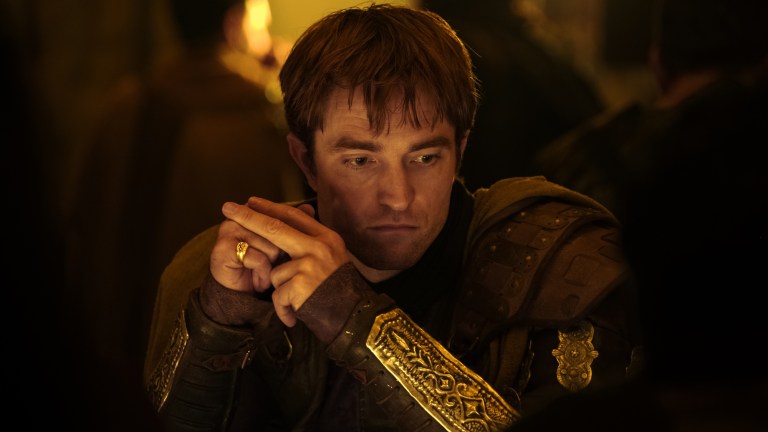
Zeus’ law would have it that strangers like Odysseus in a beggar’s disguise should be treated with empathy and humanity, but the entitled suitors who did not fight in Troy, yet seek to enjoy its spoils by marrying the wife Odysseus left behind, would rather beat and deride the beggar than give him a scrap of food they never paid for. Robert Pattinson’s Antinous is a particularly special piece of work: sniveling, capricious, vain, and a diva who almost chokes with glee on the venom in his throat while spitting, “Filthy beg-GAR!” at Odysseus in disguise.
Nolan and Pattinson seem to have a field day developing the most disgusting collection of vices that increasingly become virtues in a post-Trojan War Greece—and one cannot help but see echoes in similar foibles that have turned into political assets in the 21st century.
In Homer’s Odyssey, Antinous is also a selfish and self-aggrandizing snob, but he has no real backstory with Odysseus. In Nolan’s film, we learn Antinous was essentially drafted to fight in the Trojan War but bought his way out by getting his poor shepherd’s son Sinon (Elliot Page) to go in his place. This is not in Homer, and Sinon did not appear in Trojan War stories until centuries after Odyssey. Yet one need not squint to recognize parallels with modern-day leaders and self-styled strongmen who also avoided drafts in their youth by relying on their wealth and connections.
Such men do not fight in wars but are quick and eager to seek other people’s sons to commit violence on their behalf, all while indulging in luxury paid for by others, and perhaps leering at another man’s wife. Pattinson’s Antinous is a deliciously boorish caricature of modern leaders who hide behind their banquet tables and pillars while demanding subordinates go die in their name. And when his own time comes in Nolan’s film, it is with Nolan’s added line that Odysseus seeks to “give you back your shame.”
Like Antinous in Nolan’s Greece, such preening thuggery is ascendant today. Values that were once considered sacred or institutionalized have been marginalized or undermined by the sycophants and opportunists always holding court at their feasts. Even Elon Musk, the wealthiest and most prominent critic of Nolan’s Odyssey, has derided the movie by amplifying social media posts that claim it will “destroy Western civilization,” even as the trillionaire born with a silver spoon in his mouth has lamented in the press that “the fundamental weakness of Western civilization is empathy.”
One of the 3,000-year-old cornerstones of xenia, and the foundations of Western civilization, including Homer’s Odyssey, is now viewed as a “fundamental weakness” by the richest man in the world and his fellow travelers who claim to be protecting the West. Others might say they are perverting it like Antinous in Odysseus’ once great house. They certainly recoil at sharing their scraps, just as Musk was giddy about feeding USAID “into the wood chipper” during his brief stint in government, an action that according to a Boston University epidemiologist has already caused the deaths of roughly 600,000 people. Most of them children.
Earlier in The Odyssey film, Penelope and young Telemachus share a conversation about the people from the sea and the future of their Mycenaean culture. Telemachus scoffs that anyone could destroy their world. Just look at their great house! Yet the building isn’t what makes a civilization great, his mother counters, it’s the people inside of it, their values, their morals, that give it meaning.
By breaking Zeus’ law with the Trojans and murdering women like the young Trojan girl (Zendaya) who becomes the very image of Athena in Odysseus’ mind, Odysseus won a war but gave permission to his society to drift from their decency. He helped create a world where jackals like Antinous rise to power and high halls, and empathy for foreigners, elderly dogs, and even a lowly beggar is treated with disdain and hostility.
In Nolan’s mind, it created the “Sea People” and was the death of a civilization 3,200 years ago. And it can do it again.