The Odyssey Is a Secret Prequel to Dune
Agamemnon links the two biggest blockbusters of the year. Also, cyborgs are involved.

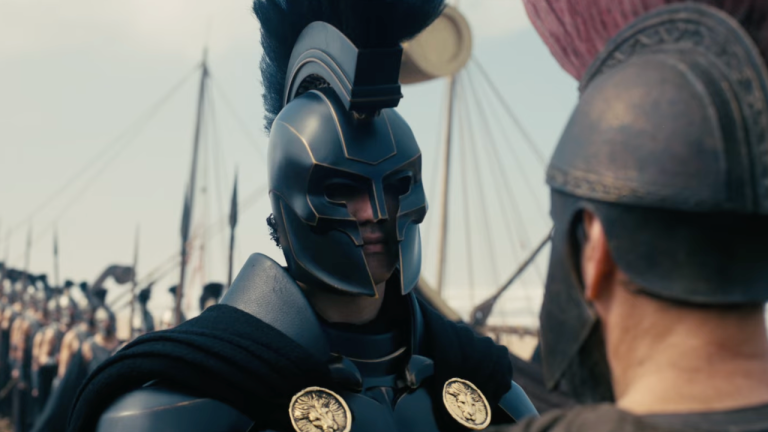
With Christopher Nolan‘s latest dominating the box office, cinema lovers aren’t just excited to learn what the director has planned next. They’re also excited about the second epic we have this year, another massive movie helmed by a filmmaker whose name evokes big ticket sales: Denis Villeneuve‘s Dune: Part Three. It’s not hard to see the similarities, as both films feature mythic heroes on strange adventures, and they even share cast members in Zendaya and Robert Pattinson.
However, fans of the books know that the connections between Dune and The Odyssey go deeper than one might expect. The secret is right there in the name of Frank Herbert‘s lead character, Paul Atreides. The surname “Atreides” means “Son of Atreus,” referring to the Greek hero Atreus, father of Agamemnon and Menelaus. However, nothing is quite as it seems in either Greek mythology or the world of Dune, meaning the connections are far more complicated than just lineage.
The Founding and Fall of the House of Atreus
Fittingly enough for a story that leaves us longing for more, we have to begin with Tantalus, son of Zeus and Pluto. Tantalus established his family’s penchant for infanticide by killing his son Pelops, in order to test the gods. Most of the gods passed that test, except for the agricultural goddess Demeter, who actually ate some of the meal that Tantalus made out of Pelops. Infuriated, Demeter sentenced Tantalus to the underworld, where grapes and water remained forever out of reach, giving us the word “tantalizing.”
His father punished, the gods resurrected Pelops, who later married Hippodamia by sabotaging her father’s chariot race, a decision that results in his line being cursed… which might account for the family killing that happens in the next generation. Pelops and Hippodamia give birth to Atreus and Thyestes, who kill their half-brother Chrysippus, and then get banished. Later, Atreus learns that his wife is having an affair with Thyestes, and also they’re fighting for the throne. So he channels his granddad and kills Thyestes’ sons and cooks them in a meal he serves to his brother, and then also engaged in incest, which eventually gets him killed. But not before he gives birth to two sons, Agamemnon and Menelaus.
At this point, people who saw The Odyssey know about those guys, as Jon Bernthal stepped into the role of Menelaus, and Telemachus (Tom Holland) let Menelaus tell him something about Agamemnon (Benny Safdie), who sacrificed his daughter for good winds and got killed by his wife Clytemnestra (Lupita Nyong’o) because these Atreides boys never learn.
So what does that have to do with Paul of Dune?
Paul’s Cyborg Great Granddad
The first Dune novel takes place 20,000 years in the future, and while much has changed, humanity’s love of myths has not. The stories have mutated over time, mixing together, but religion and myth still have power, which is why Paul’s surname resonates with people of the empire. But, as we saw in the first Villeneuve movie, Paul and his father Duke Leto think more often about the former’s grandfather, a celebrated bullfighter. Thus, readers could be forgiven for dismissing the name Atreides as a meaningless word grandfathered into their language.
However, the third novel Children of Dune revealed that the name had meaning. While consulting her Ancestral Memories, the Bene Gesserit ability to “speak” with previous members of one’s bloodline, Paul’s sister Alia briefly encounters a person the text identifies as Agamemnon. However, Alia gets overpowered by the memory of her maternal grandfather Baron Harkonnen, and the Mycenaean king is never heard from again.
How, you might wonder, could someone like Harkonnen overpower such a mighty warrior? The answer might be that, despite what the characters say about Paul’s lineage, he is not in fact descended from the hero of myth. Instead, Paul’s true ancestor may be a different Agamemnon, a guy born Andrew Skorous, and here’s where things get really weird.
Frank Herbert only wrote six Dune novels before his death in 1986. Later, his son Brian took over, writing a number of prequels with Kevin J. Anderson. Although not nearly as good as his father’s work, Brian’s novels make up for their lack of quality with a quantity of lore, fleshing out the centuries leading up to the moment that Duke Leto takes stewardship of Arrakis.
In 2001’s Dune: The Butlerian Jihad, Herbert and Anderson introduce General Agamemnon, the Cymek Titan and father of Vorian Atreides, a leader of the Butlerian Jihad that saw the destruction of all thinking machines (or, as we’d call them, Artificial Intelligence). Vorian’s rebellion shocked the world because of his father’s status as a Cymek Titan. Cymeks are this world’s word for cyborgs, specifically humans who sought to augment themselves by placing their brains inside robotic bodies, allowing them to live forever.
Before becoming a Cymek, Agamemnon was born Andrew Skorous in the year 1300 BG (the first Dune book takes place in 10191 AG, to give you an idea of the timeline). As an adult, Skorous leads a revolt against the Old Empire, the rotting government that existed long after humanity discovered faster-than-light space travel. Calling themselves the Twenty Titans, Skorous and his allies inaugurated a new golden age for humanity. However, they succumbed to a lust for power, which led them to become Cymeks and rule for centuries, growing increasingly brutal. During this period, Skorous took the name Agamemnon and declared his people House Atreides, in an attempt to establish himself as an eternal leader with roots deep in humanity’s past.
Thus, the Agamemnon who speaks to Alia may not have been the man who waged war against Troy so long ago. It may have been a man who forfeited his humanity in search of power, and made myths around himself to justify it.
Mistakes of the Past and Future
Of course, The Odyssey isn’t really a prequel to Dune. Herbert invokes Homer’s poem as part of the detritus of humanity’s past, just one more lesson that people failed to learn about the cost of pursuing power. Yet, it’s not hard to see thematic similarities between the two stories, especially Christopher Nolan’s take on the myth.
Nolan changes The Odyssey‘s final act into a meditation on the cost of war, as Odysseus’ great victory via the Trojan Horse comes only because he sacrificed his values and his humanity. In this telling, he stays far from home not just because he’s been trapped by Calypso, but because he no longer feels worthy of his wife Penelope and his son Telemachus.
Ultimately, Dune warns against charismatic leaders, arguing that they always give into a lust for power. In doing so, they’ll sacrifice their humanity, whether that involves becoming a brain in a robotic tin can or launching a jihad in the name of progress. What better person to link the two stories than Agamemnon, the angry king who killed even his own daughter to expand his control?
The Odyssey is now playing in theaters worldwide.