Ebenezer: Ti West on Johnny Depp, the Freddy Krueger Homage and a ‘Gray’ Scrooge You Can Agree With
Exclusive: We chat with Ti West about reimagining Charles Dickens with Johnny Depp as Ebenezer, from giving the movie a Hammer Horror tone to daring audiences see where Scrooge "is coming from."

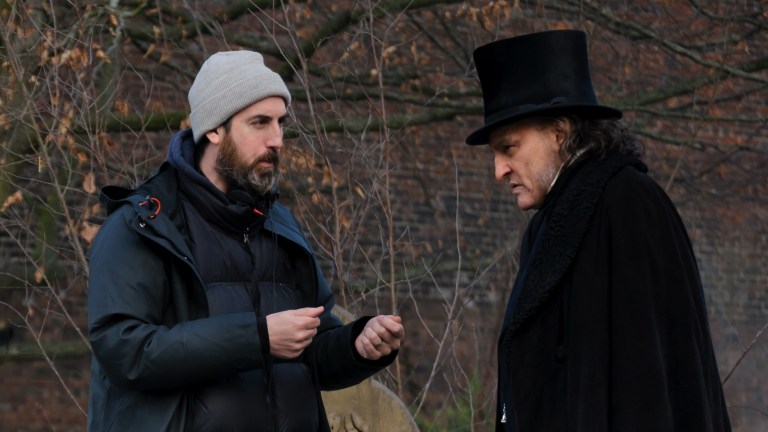
Ti West knew he wanted to do something different. After writing and directing a decades-spanning trilogy of horror and cinematic homages via X, Pearl, and MaXXXine—films that count Martin Scorsese among their fans—the New England filmmaker needed to step away from the genre. If perhaps by only a few inches.
“Everybody loves IP, and I was like, ‘Well, what IP do I really love?’” West muses when we catch up with the filmmaker while he’s on a whirlwind press tour for Ebenezer, a thoroughly reimagined take on Charles Dickens’ classic A Christmas Carol. By virtue of the film he’s promoting, it’s obvious where his nostalgia took him, albeit the filmmaker admits that his own memories of watching a specific 1984 TV movie adaptation of Dickens informed just how dark and horror-twinged he wanted to take the tale of Ebenezer Scrooge.
“As a kid, I watched the George C. Scott version, and Marley really freaked me out,” West explains. “I have this visceral memory of one of the earliest horror-ish things that I watched being A Christmas Carol, and I got a little scared in a couple parts… So when I was talking about making the movie to the studio, I was like, ‘It’s hard-PG.’ I want to make something like the movies I grew up on that you were allowed to watch as a kid but occasionally pushed it just a little too far.”
Right down to casting the once and future genre-connoisseur Johnny Depp as a different take on Scrooge, West’s Ebenezer feels a world apart from Disney or Muppets interpretations, or even the slightly more sinister George C. Scott iteration. Right down to its visual aesthetics and antiquated opening credits sequence, West deliberately evokes the cinematic vernacular of mid-20th century British chillers like Hammer Studios’ cycle of lurid Victorian horror movies.
“I think Hammer has just such a pleasing aesthetic to me,” West explains, “The amount of conversations I had about ‘no, no the candle should be really red, or that candle should be really green or really blue.’ When you first put them on set, you’re like, ‘This is preposterous! This is a crazy thing to do,’ but I’m so charmed by the aesthetic of Hammer because there’s a beauty to those movies… they’re somewhat preposterous choices, but they are aesthetically appealing.” They also bring the film in line with a timeless sense of British cinema that West is aiming to evoke in a very familiar tale.
Indeed, when it comes to A Christmas Carol, whether it’s under the title of Ebenezer, Scrooge, or any other, the differences are key to make the effort worthwhile. In addition to heightening the spookiness of all three Spirits of Christmas, West has sought bold choices, such as beginning the film not with a time where “Jacob Marley was as dead as a door-nail,” but rather alive and played by Ian McKellen for an extended sequence where he trades pithy barbs with Depp’s Scrooge.
“It’s very hard to photograph ‘he was dead to begin with;’ it’s very hard to photograph ‘you must understand that he was dead,’” West observes. “There’s a sense of humor to this that gives you a context. But what I wanted to do is to really put the audience in Scrooge’s perspective more than they typically have in the past, and I wanted to make it a more subjective journey.” The director hopes audiences might have an involuntary giggle at Scrooge or Marley’s cynical asides, which puts you more on the journey with a man in desperate need of redemption.
As that man, Depp is a bold choice, not least of all given he is a bit on the younger and American side for Ebenezer Scrooge, but the counterintuitiveness of Depp was the appeal for the director.
Says West, “A Christmas Carol is one of the few stories that can be remade over and over again because the story is profound and rock solid, but the interpretation of the story is interesting every time, depending on who’s doing it. The brilliance of the book is that it can handle Bill Murray doing it, it can handle the Muppets doing it, and it can handle Johnny Depp doing it, and it’s intriguing to see how they do it.”
When he first reached out to Depp, the two got jazzed by comparing their own childhood memories of A Christmas Carol, and West couldn’t shake how much he could only partially imagine the choices Depp would make with his and Nathaniel Halpern’s script.
“His enthusiasm was just so high, but I also don’t totally know what he’s gonna do,” West says. “I sort of have a sense from what we’re talking about, but you look historically at all the characters he’s done [and there’s an element of surprise]. Edward Scissorhands on paper shouldn’t work. It’s ridiculous. He’s wearing this leather outfit, he’s got these [scissors], but you’re crying in that movie, because he’s able to bring in that humanity.” He also is able to bring in those horror-flecked homages, even to Depp’s previous work, although West insists the bit that is already in the trailers where Scrooge is swallowed up by his bed was in the script long before they cast the guy who suffered a similar fate in A Nightmare on Elm Street.
“Nathaniel and I put that in the script because we thought it was a cool, cinematic way to go to the past, and we both like Nightmare on Elm Street,” says West. “[We had] no clue that Johnny Depp would ever be in this movie. Never had met him, nothing. So when I finally talked to him about it, and he wanted to do the movie, I had kind of a mild panic the next day, because I realized we never talked about that.” The filmmaker ultimately called Depp back and offered to take it out of the script if the actor thought it was too self-referential, but Depp replied, “No, man, that’s my first movie. I think we gotta do it.’”
With that said, the likely most controversial innovations will be new wrinkles added to the social, economic, and, perhaps, political context of Ebenezer Scrooge’s worldview. While the story is eternally that of a miser being redeemed to see the best in his fellow man, in the new film this occurs after audiences also see the world from a cynical rich person’s perspective: scam artists on the streets of London who pretend to be disabled when they’re not, or charity workers who on the page have the poor’s best interest at heart, but in the film are taking donations to spend lavishly on their own coats and refinements.
“A lot of that stuff was to try to take characters that are a bit black-and-white at times and put some gray area into it,” says West. “In a lot of versions, Ebenezer Scrooge is kind of terrible in the decisions that he makes, but everybody else is pretty benevolent and without sin, if you will. So what we want to do is humanize everyone to say, ‘Not everybody’s perfect in this movie.’ It doesn’t make Scrooge any less bad because of it, but it does highlight that in this era, if he has a resistance to charity, is it just because he hates people? You could do that, but what if it is because he has a perspective on it that is probably not the right perspective to hold overall, but you see where he’s coming from? If he thinks there’s a bit of a scam in there, it doesn’t make him right, you should still give money to charity because it benefits people, but I could see why you would think it’s bullshit if you’ve had a bad experience with it.”
It’s an interesting juxtaposition compared to Dickens’ A Christmas Carol, which the author wrote as an indictment for the cruelties of society in his time, specifically of the rich. Before he penned Carol, Dickens initially intended to publish a pamphlet titled “An Appeal to the People of England, on behalf of the Poor Man’s Child,” before pivoting to a fictional story he thought would “feel that a Sledge hammer [has] come down with twenty times the force.”
West doesn’t necessarily seek to view his film in such macro terms, telling us, “I’m not profound enough to say that, but there are funny moments in the movie based on things like you’re talking about that get a reaction from an audience that is an involuntary reaction. There must be some truth to that in order for them to have that reaction. And I think there’s irony throughout the movie, and there is a bit of a wry sense of humor that Johnny brings to the character, that, again, I don’t really agree with him, but I know where he’s coming from, and that I think puts you in his perspective.
“Throughout the movie, he learns the lesson of it’d be better to come from somewhere else, and it would be better to adjust, and he does so… [we’re] just kind of sending him on a slightly different path along the way. It keeps it fresh and it lets it be our retelling of it, because that’s the fun of an enduring classic like this.”
Ebenezer is in theaters on Friday, Nov. 16.