Ebenezer Review: A Christmas Carol for Capitalists
Johnny Depp plays Ebenezer Scrooge in a much spookier take on Charles Dickens’ A Christmas Carol, but the scariest thing about it might be its politics.

It’s been said that Charles Dickens is the Father of Christmas. There’s always been a touch of hyperbole to that statement about a man born some 1800 years after the first Christmas—and several countries away from where Weihnachtsbaum trees had been happily flourishing for generations. When Dickens wrote A Christmas Carol, however, he did invent the Victorian Christmas.
By modern standards it looks quite similar to our own today, but with key differences. For starters, the story of Ebenezer Scrooge inspired a renewed public tradition with ghost stories at Christmastime—and not just the story of a miser and three spirits of his past, present, and future. We’re talking ghoulish, depraved tales of macabre suspense with escaped lunatics climbing into your bed on Christmas Eve or ghostly children tapping at the window pane. What became the stuff of Halloween a continent and century over was as Yuletide as mistletoe to the Victorians. Dickens also put the fear of God, not to mention the starving poor, into the wealthy. “Beware them both,” the Spirit of Christmas Present warns Ebenezer about the Children of Man, Ignorance and Want. “But most of all beware [of Ignorance], for on his brow I see written the word which is Doom!”
All of which is a bit of preamble to note that Ti West’s new take in the movie Ebenezer is a kind of fascinating paradox of adaptation. On the one hand, the helmer of such horror cult classics as Pearl and House of the Devil has dialed up the spookiness to its breaking point, landing closer to the grisly short stories Dickens would later publish in the Household Words periodical than the scribe’s own Christmas story. West tells me he wanted this to be a “hard PG,” and if so he landed closer to where they might’ve been in the days of Spielberg standing over a pit of human sacrifice in Temple of Doom. His Ebenezer is so dark, so relentlessly dreary, that it’s frankly hard to imagine any child will find much festive cheer in the thing.
On the other hand, whether by pressure from untold studio execs or chasing his own muses, West has excised or otherwise softened the scathing indictment of the wealthy that defines Dickens’ tale. He wouldn’t be the first. Plenty of Hollywood adaptations downplay the social foreboding in the name of family-friendly entertainment (and perhaps holiday commercialism). But as far as I’m aware, this is the first Scrooge movie that feels like it was designed by the Heritage Foundation, an overeager “both sides” bit of sophistry that suggests Scrooge on the whole is right to be suspicious of the poor, lazy, and two-faced do-gooders who line their pockets with your virtue-signaling donations to charity. It’s A Christmas Carol for folks who think Ebenezer deserves more credit for being a job creator, and perhaps should just let it trickle down a little more fairly to Bob Cratchit, instead of being raked over the coals for his good business acumen.
So it is with Johnny Depp’s introduction as Ebenezer, a wily and acerbic old-timer who no one appreciates except for the even more wily and acerbic Jacob Marley (Ian McKellen), his senior partner at a business where ol’ Marley croaks on Christmas Eve. Seven years later, Scrooge still hasn’t taken down the “Marley and Scrooge” sign, and continues to pay junior clerk Bob Cratchit (Rupert Grint) a pittance for all the work he does.
That’s not good for Bob’s young boy Tiny Tim (a barely present Freddie Lee-Grey), but Bob accepts this because he insists his family doesn’t need charity like those other moochers presumably in the work houses. Fortunately, his employer will be forced to reevaluate his ways when the ghost of Marley comes on another Christmas Eve to warn Ebenezer he will be visited by three spirits this night in what will be his lone chance for atonement. You probably know the rest, but not the details of how it’s executed. And on a certain aesthetic level, there is plenty to admire about West’s approach to the material.
A definite genre auteur with a distinct visual flavor, often couched in a romantic nostalgia for previous eras of moviemaking, West infuses Ebenezer with a mid-20th century aesthetic better reminiscent of Hammer Studios’ Spooky England of 1960s and ‘70s cinema. While the entire film has a chilly wintry gray overcast to it, the colors of the costumes and set design pop like water balloons on a gloomy day.
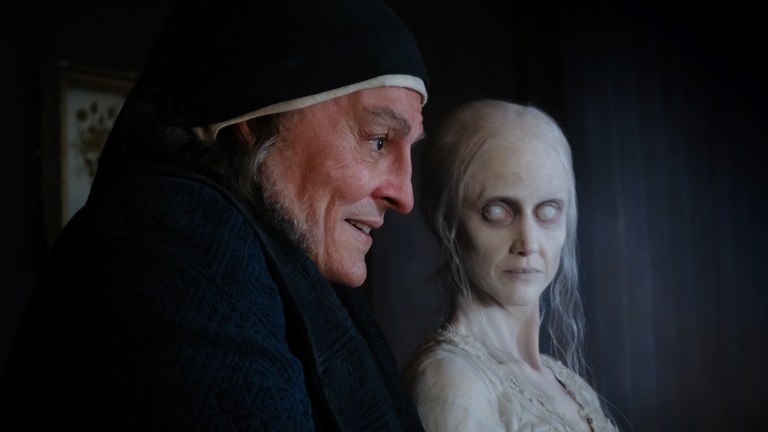
Also the visual design of the various Christmas ghosts, most particularly the Spirit of Christmas Past (Andrea Riseborough), provides the film a surprising menace, complete with spectral visions of this wraith stalking Ebenezer’s neglected hearth and halls. It’s definitely Victorian, but as mentioned, it feels more akin to Halloween than Christmas by at least modern standards, and on the whole underplays the festiveness of the material.
It is worth noting that in such an oft-told tale, fresh perspectives and canted angles should be welcome, and West definitely introduces bold flavors to the recipe. Still, the resulting taste is often so sour, and the emphasis so oblique—such as the choice to have the Ghost of Christmas Present (Tramell Tillman) only visit homes on Christmas Eve and never bask in the joys of Christmas morning—that it proves ultimately misjudged.
That might include the elephant in the room of Johnny Depp’s Ebenezer Scrooge. Rascally, capricious, and a bit more mirthful on his misanthropic path to pre-redemption than you might be used to, the performance is full of counterintuitive choices, albeit still a bit drenched in the “argh, avast” variety for a well-known movie pirate. Yet the tics are so mannered, and in a silhouette so encumbered with horror movie regalia (squint and that top hat looks a lot like it belongs in the cabinet of Dr. Caligari), that he seems less a miser in need of redemption than another eccentric character in Depp’s own cabinet of curiosities. Once upon a time, Depp knew how to imbue the most hideous of movie monsters with a soul, including the similarly Victorian-draped Sweeney Todd, but this feels less like a fully realized reclamation arc than it does a bit of whimsical mugging.
Then again it might just be hard to invest in the character’s reclamation when the movie itself seems so cautious about stating what needs to be redeemed. His suspicions of the poor are repeatedly justified by way of Scrooge spotting con artists pretending to be disabled (unlike the truly afflicted young Tim Cratchit), the poor’s advocates among the rich being corrupt fraudsters themselves, and an addition to the fate of ol’ Mr. Fezziwig, Dickens’ literal antithesis to Scrooge’s stinginess, being outright horrific.
Meanwhile subtler implications in the back half, such as just exactly who receives a lavish goose on Christmas Day, and what social-economic class has the right to criticize Ebenezer to his face, whether he’s there as a spirit or not, suggests a quietly more insidious undercurrent about the less-fortunate needing to be kept in their place. Ironically, that is a very Victorian notion as well, but it’s anathema to Dickens and the story he wrote.
Ebenezer is out in theaters on Friday, Nov. 13.