Defending Hannibal, Ridley Scott’s Gruesome Sequel to The Silence of the Lambs
Hannibal wasn't the Silence of the Lambs sequel Hollywood wanted, but it was the sequel they deserved.

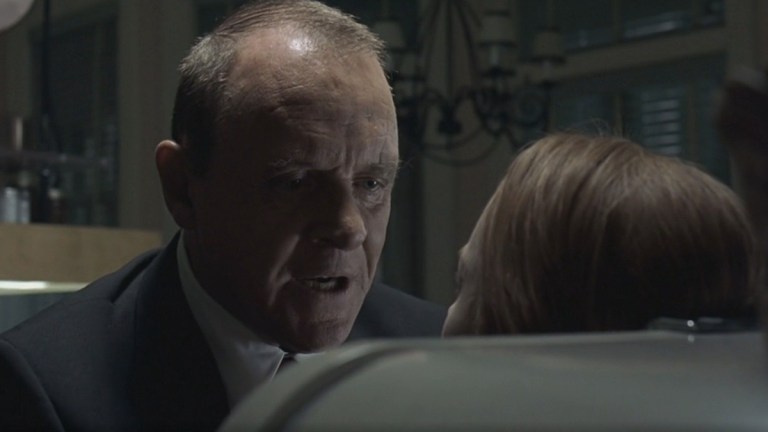
When The Silence of the Lambs won all of the big five categories at the 1992 Oscars, including Best Picture, observers had to do all manner of hand-wringing to explain why the movie wasn’t just a horror movie. One could point to Jonathan Demme’s incredible direction, which brought a level of empathy to the proceedings. One could point to the triumph of former child actor Jodie Foster‘s performance as FBI trainee Clarice Starling or to respected theater thespian Anthony Hopkins towering take on Hannibal Lecter. One could argue that the lurid stuff—the semen throwing, face eating, or frontal nudity—occurs only in flashes.
For the most part, the ploy worked. Regular people got to enjoy the story of an FBI director sending a young trainee to consult with an unrepentant cannibal to stop a serial killer from making a suit of the skin of murdered women. But that perception applied only for The Silence of the Lambs. It could not apply to the vivid, pulpy Thomas Harris novel that inspired it, nor to Hannibal, the sequel that Harris wrote—a sequel so extreme that neither Foster, Demme, nor screenwriter Ted Tally wanted to touch it. That’s where Ridley Scott came in, who embraced Harris’s excess to make Hannibal the grotesque rejoinder to anyone who condescended to The Silence of the Lambs.
Hannibal Unbound
Much of the pleasure of The Silence of the Lambs came from its restraint, keeping Lecter largely in a cell and limiting his screen time to less than 25 minutes.
Not so with Hannibal, which finds the doctor living as a free man in Florence, Italy, posing as library curator and Dante scholar Dr. Fell. However, that doesn’t mean that he lives in peace. Beyond his inclinations to continue eating the rude, Lecter has to contend with Mason Verger, a rich degenerate who survived an encounter with Lecter, but was left with a mutilated face and wheelchair bound. Played by Gary Oldman, at the height of his obsession with prosthetics, Verger has devoted his vast fortune to getting revenge, including a hefty finders fee that catches the attention of Florentine policeman Rinaldo Pazzi (Giancarlo Giannini). When Pazzi accesses FBI databases to find information about Lecter he can give to Verger, he catches the attention of Clarice Starling (now played by Julianne Moore), who has also been looking for her former contact.
The spaciousness of the plot does make Hannibal feel unwieldy. The first two acts split time between Washington, where Clarice finds herself under greater scrutiny after a drug bust gone wrong, Lecter’s adventures gallivanting around Florence, and Mason’s haunted mansion. The primary characters interact mostly on phone or by staring at screens, only bumping into one another through artless plot contrivances. The plot continues to feel clunky when they all come together for the final act, which first takes place at Verger’s mansion and then retreats to the home of Paul Krendler (Ray Liotta), the smarmy Justice Department official overseeing Starling.




Certainly, the clunkiness stems in part from the tortured production process, which itself connects to Harris’ issues writing the book. Rumors swirl around the production of the book, ranging from claims that Harris’ publisher and/or The Silence of the Lambs producer Dino De Laurentiis forced him to write the book to Harris feeling disgust over the sudden popularity of his character. Harris has never confirmed or denied these claims, but it is clear that the success of The Silence of the Lambs weighed on him.
Harris remained in contact with Demme throughout the process, as the director planned on filming the follow-up. Yet, when he read the final draft, Demme found the work too disgusting to adapt, as did Tally and Foster. In particular, the creatives took issue with the ending of Harris’ book, which saw Lecter and Clarice come together as a couple.
Scott removed the overtly romantic ending from the story (with Harris’ blessing), and the screenplay that David Mamet and Steven Zaillian hammered out does excise some other icky elements—most notably Verger’s sister, who kills him by shoving an eel down his throat—but they retain much of the novel’s icky tone. And that’s exactly what makes Hannibal great.
An Old Antagonist For Dinner
Two things are true of Hannibal: it is disgusting and it is beautiful. Everything about the film is unpleasant, especially in comparison to Silence. Where Clarice once retained her compassion, here she guns down a female criminal with a baby strapped to her chest. Where Demme put us in Clarice’s POV as men leer at her, here we look through Krendler’s eyes as he stares at her legs. Where Levine retained some sadness in Buffalo Bill, Oldman plays Verger as gleeful about both his abuse of young boys and his plans for Hannibal. Even the kindly orderly Barney (Frankie R. Faison), who seemed in Silence to win over Lecter with basic human decency, swipes Hannibal’s personal belongings and sells them to Verger at elevated prices.
Even worse are the gore moments. Editing, Dutch angles, and slow-motion blur the flashback scenes in which Verger cuts off his face and feeds it to the dogs, but other sequences are presented more clearly. We see in full when Lecter slices open Pazzi’s stomach before placing a noose around his neck and shoving him out a window, so that his entrails spill out when his neck snaps. We watch the pigs consume Verger after his physician Cordell (Željko Ivanek) shoves him into the pen.
And then, of course, there’s the infamous climax, in which Lecter captures Krendler, cuts open his head, and feeds him his own brain. It’s not just the ghastly effect, the close-up shots of Lecter cutting open Krendler’s head, removing parts of the brain, and searing them on a pan. It’s not just the fact that we watch as he spoons the brains into Krendler’s mouth. It’s the utter giddiness with which Liotta plays the drugged and anesthetized Krendler. To see someone so loathsome become, for once in the movie, likable and sympathetic only makes his fate all the more gruesome.
Yet, at the same time, Scott brings all his skills as a visual stylist to the material, making Hannibal an undeniably sumptuous movie. Of course, Scott and cinematographer John Mathieson take full advantage of the high windows and striking architecture of the Florence sequences, making the landscapes as opulent as the art and literature that Dr. Fell describes. But they also manage to make mundane spaces look glorious. The bits of light that break through the few cracks in Verger’s mansion recall the Nostromo of Aliens, that floating haunted house. Even the Washington basements where Clarice works have a soft blue glow coming from computer screens, giving it a sense of calm etherealness.
The obvious artfulness of these visuals does not undercut the nastiness of the rest of the film. Rather, they force the viewer to recognize that every part of Hannibal is the work of a master craftsman, even the gross stuff.
Back ‘Round to Horror
In one of the movie’s best sequences, Clarice comes to Washington Union Station to meet with Lecter, with whom she’s speaking on the phone. He directs her toward a carousel, and although she cannot find him in the confusion, he finds her, reaching out his hand to graze her red hair as he passes by on the merry-go-round.
Scott shoots the image of Lecter’s hand touching Starling’s hair in slow-motion, combining both the dread of her vulnerability and the romance of their connection. Furthermore, the entire sequence pays homage to The Third Man, Carol Reed’s glorious noir with Joseph Cotten and Orson Welles.
But make no mistake: it’s a scene in which an FBI agent hunts a serial killer who consumes his victims. It’s a moment orchestrated by a cackling boogeyman with a disfigured face and a blustering bureaucrat, both of whom will soon come to ghastly ends.
In other words, it is pure pulp. Beautiful pulp, expertly-crafted pulp, but pulp nonetheless. The same is true of The Silence of the Lambs, but popularity and awards wins gave people an out, a way to trick themselves into believing that they watched something other than horror. Hannibal gives them no such escape, overdoing the gruesome parts without sacrificing any of the craft, to remind the viewers that any Hannibal Lecter story must, and always will be, trashy horror.