Avengers, Dune, Odyssey and the Rejection of Digital in a Streaming World
After Odyssey, and ahead of Dunesday, a shift in audience tastes is underway, but it may have as much to do with rejecting AI as it does an embrace of IMAX.

As you might have heard, and despite a few bad actors on social media’s best efforts, Christopher Nolan’s The Odyssey was a hit in its first and second weekends. They respectively marked the biggest opening and drop of his career, in fact. So in the wake of the IMAX spectacle’s gargantuan grosses, which arrived only after a string of recent franchise flops and underachievers, there has been something of a come to Zeus moment in Hollywood with its various attempts to read the tea leaves.
One of the best takes I’ve seen is James Hibberd of THR suggesting the success of Odyssey—as well as 2026’s other biggest hits like Project Hail Mary and Obsession—prove that “audiences want movies made the hard way.” Which is to say, folks want to be able to see the filmmakers’ blood, sweat, and tears right up there on the screen, preferably with a marketing campaign emphasizing how difficult it was filming on actual longships across the Mediterranean.
I think there is a great deal of truth to this insight, although still only as part of a larger equation that’s shifting our current pop culture paradigm. While there is definitely a demand among some audiences to know Matt Damon was really strapped to a mast on floating waters during that Sirens scene, what I think is intuitively driving audiences is less the BTS gossip and more the innate understanding that it looks so unlike our current daily lives… and the “slop” polluting it on our devices and screens.
It’s impossible to prove causation, but it feels like more than coincidence that the year so-called superhero fatigue began spreading to various other genres is also the year public opinion on the alleged benefits of artificial intelligence reached a new nadir. There is indeed a deep skepticism about the coming impact of AI on daily life, and anything with a whiff of that artifice has become suspect.
Moving concurrently with these rhythms is what amounts to a curious inversion of the CGI revolution in first cinema and then television over the last 30 years. Way back in the day, after the one-two punch of Terminator 2 and Jurassic Park, nearly every summer blockbuster was sold on the novelty of computer-generated imagery. Finally visual effects could catch up to storytellers’ greatest flights of fancy: dinosaurs! Photorealistic tornadoes! Alien invasion on the Fourth of July! Even George Lucas was going to use it to “finish” his vision for the Star Wars trilogy, complete with digital Jabba the Hutt in one movie and a musical floor show in another. In that era, digital effects were the selling point. It’s what made Armageddon an infinitely bigger deal than when in the same month Antonio Banderas rode real horsies in real deserts, in the really much better The Mask of Zorro.
The advantage of astonishing digital tools took longer to leak down to the small screen, with CG in the ‘90s mostly being the province of TV miniseries like Sam Neill’s Merlin or (ironically) the Armand Assante-led Odyssey of 1997. Flash forward 20 years, though, and Game of Thrones floored HBO subscribers with sights of dragons burning armies.
For a generation, “visual spectacle” was defined by impossible things. What’s changed is the impossible has become overwhelmingly common, especially in this decade where franchises that once reserved their wizardry for the multiplex were now inundating Netflix, HBO Max, and most especially Disney+ on a weekly basis. The CG worlds of superheroes, and the Volume-created sets of a galaxy far, far away, are subsequently synonymous with the content you consume at home. Or AI Slop on your TikTok feed.
Conversely, some of the most popular filmmakers of our current era (and not just Nolan) have continued to rely on showing the sweat of their brow, sure, but also remaining committed to the fundamentals: striking compositions; a focus on performance and story structure; and spectacle captured in-camera. There is indeed something incredibly old-fashioned about Odyssey’s cast of stars and familiar faces in a sword and sandals epic. That was a trick also pursued by the likes of William Wyler and Cecil B. DeMille during the rise of television in the 1950s… or Denis Villeneuve a few years ago with the first two chapters in his Dune trilogy.
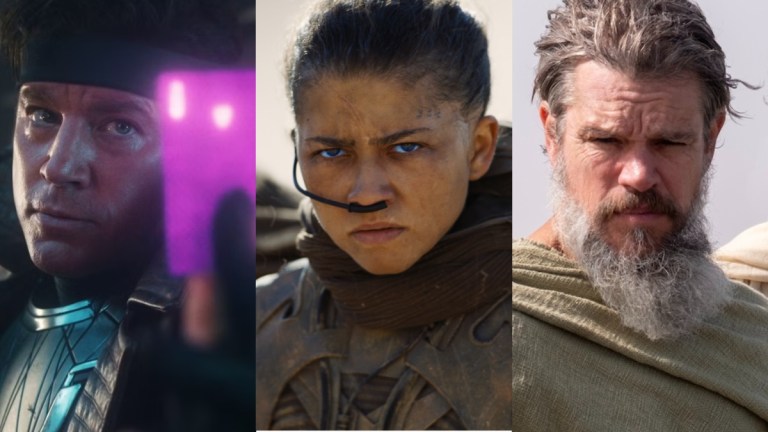
All of which makes the climactic box office showdown at the end of this year so intriguing. In the past two weeks, we’ve seen both halves of what social media has dubbed “Dunesday” release their trailers: Villeneuve’s Dune: Part Three and Marvel Studios and the Russo Brothers’ Avengers: Doomsday. Both films appear to be doing what their makers have turned into calling cards for the audience. One’s a foreboding but immersive space opera filmed in real deserts with real movie stars—although now via IMAX 65mm cameras for the first time—and the other is a massive Marvel team-up/crossover event that will, sure enough, rely on beloved characters and personas standing before oceans of blue screen digital trickery.
I will not pretend to say it’s any kind of litmus test—after all, Barbenheimer proved audiences can reward two blockbusters in the same weekend with obscene riches—but in the realm of tentpole cinema it does provide an interesting A/B comparison. I expect both movies to be monstrous hits, and Doomsday especially so. It’s already outpaced Deadpool & Wolverine in opening day pre-sales, which seems to confirm Marvel naysayers on social media could be another tempest in a teacup, not unlike the alleged backlash faced by The Odyssey.
Even so, I do think audiences are increasingly rejecting anything artificial as the deluge of disposable content on their phones, in their workplace AI toolbox, or on their streaming service reaches a fever pitch. They don’t need to see blood on the screen; just something tactile is exciting enough, whether that’s a longship, a One Wish Willow box, or perhaps a Crysknife caked in UAE sand.