Avatar Reminds Us that Hollywood Special Effects Blockbusters Don’t Have to Be Ugly
James Cameron makes Avatar look amazing, not with expensive technology but with basic filmmaking techniques.

Just a few months ago, one of the most highly-anticipated films of the year began with the desecration of a cinematic icon. Literally. Wicked: For Good opened with Elphaba the Wicked Witch (Cynthia Erivo) smashing the Yellow Brick Road of Oz, an act framed by the movie’s revisionist take as a method of superheroic resistance against a fascist regime. Whatever the political intentions behind the scene, it also signaled an affront to movie history. A classic bit of old school cinematic movie making was being destroyed by an ugly, CGI blob.
For every person who lamented the hideous visuals of Wicked: For Good, all pink and green digital effects smeared across the screen, two more defended them as just the status quo for a modern blockbuster. And they had a point. The Fantastic Four: First Steps continued Marvel‘s habit of turning Jack Kirby illustrations into flat splotches of concrete grey. Jurassic World Rebirth did away with the majesty of the Steven Spielberg‘s original film and replaced it with beasts that looked like lumps of brown clay. Even Superman, which at least had a distinct vision, became a mess of rainbow nothing during a rescue sequence.
On those grounds alone, Avatar: Fire and Ash is a welcome corrective. Pandora remains just as stunning as it was in 2009 and in 2022, thanks to James Cameron‘s ability to find new corners of the world to explore: the death obsessed Ash people, new monsters from the deep, and merchants who travel across the sky. But the most impressive thing about Fire and Ash is far more simple: it just looks good.
There’s nothing too revolutionary about the film’s alien designs. The Na’vi do indeed look like slender cat people, not that different from those you’d find in any number of sci-fi or fantasy stories. Same with its plants and animals, which mostly look like mashups of sea creatures and fauna found on Earth. However, Cameron introduces those features in a way that demands attention.
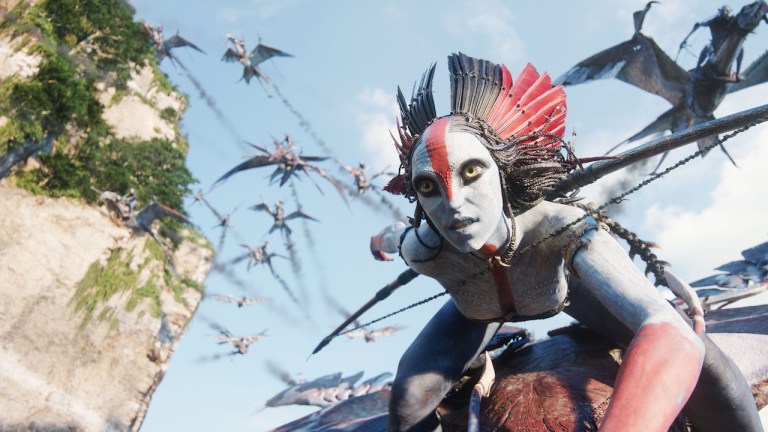
Cameron knows how to block his actors so that the action remains clear and legible. When, in a sequence toward the climax of Fire and Ash, Spider (Jackson Champion) and Jake Sully (Sam Worthington) run from a chopper by ducking through pipes in a foundry, Cameron assures that we always understand the spacial relationship between the three figures, using search lights and explosions to illuminate even the hiding characters. A very different chase sequence occurs earlier in the film, in which the Ash People chase the Sully children through the jungle. Cameron uses the red and black body paints of the Ash People to help viewers easily distinguish them from our friendly Na’vi, and contrasts different parts of the jungle to
Even better are the many awe-inspiring moments of Fire and Ash. Some may scoff at the hippie dippy ideas of Eywa, the sentient plant life running through Pandora, but Cameron gets us to believe in its power. Whenever Kiri (Sigourney Weaver) connects with Eywa, the simple decision to move the camera along bits of flora and fauna that start to glow heightens our anticipation, which eventually pays off with psychedelic shots of an illuminated face in the foliage.
At this point, some may point out that Cameron enjoys privileges others do not. After all, he’s the guy who made blockbuster classics such as Terminator 2 and Titanic. More than once, observers have mocked him for spending way too much on ideas that sound terrible, and each time, his films release to critical acclaim and huge box office payouts. Cameron can demand higher budgets and more freedom than anyone else in Hollywood, even the producers behind the MCU and Wicked.
But Cameron’s technological feats shouldn’t distract from his basic filmmaking chops, which are the real reason his movies look so good. He never forgets to communicate information to the audience in simple, visual terms. Even when indulging in the most nonsense lore, he uses familiar themes and tropes to keep the audience from getting lost: Neytiri (Zoe Saldaña) is sad because her son died in The Way of Water, and so she frowns. Varang of the Ash People (Oona Chaplin) is the bad guy, so she hisses a lot. We may not know or care about the differences between the Omatikaya, the Metkayina, or the Mangkwan, but we know what frowns and sneers are.
The unmessy fundamentals of Cameron’s approach undermines any defense of the messes that Hollywood regularly serves up to movie going audiences. It’s not a matter of needing higher budgets from billionaire-run studios, it’s not a matter of overworking your SFX teams even more. It’s just a matter of mixing your colors well, basic blocking, and foregrounding recognizable human emotions.
Any movie that puts those elements first will always look good. That’s was true in the days of The Wizard of Oz and it’s still true today.
Avatar: Fire and Ash is now playing in theaters worldwide.