John Cena: The WWE Legend Who Never Feared Risks or Failure
Before his allegedly final bout in the ring, we take a look back at the legacy John Cena leaves in professional wrestling.

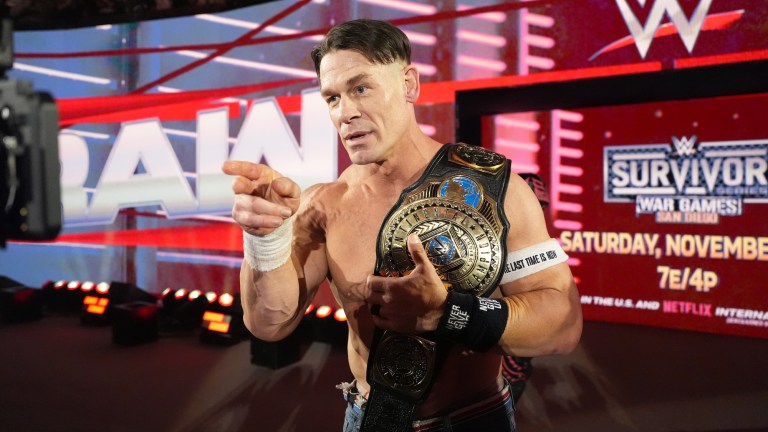
How does one sum up the career of a pro-wrestling icon like John Cena, especially when he is always claiming we can’t see him? By remembering what once was, and not by the end—which by many standards has been flat and featured unnecessarily convoluted stories for someone who was not on every TV show each week.
Cena is finishing up his legendary WWE career at Saturday Night’s Main Event on Dec. 13 in Washington D.C., his opponent still unknown. And unlike many who have hung on too long, Cena has found a viable career as an actor, showing some range, going from comedies, like Ricky Stanicky and Blockers, to action (Freelance and Heads of State), to drama, in Legendary—definitely a less mainstream movie and early proof that he could act. So it’s not as if the world is done with Cena. He just swears he is done in the ring. Though in pro wrestling, retirement rarely sticks. Just ask Ric Flair, Shawn Michaels, or The Undertaker.
The Time Is Now.
The above has been one of the multiple catchphrases / T-shirts for Cena through the years. It fits.
“I’m not going out on my own terms. If I could do this in infinity, I would do it… I made a promise to the fan base when I started that when I got a step slower, I gotta walk away,” Cena said during a WWE podcast in November 2025. At the time he was doing the media rounds, saying goodbye one city at a time. “Yeah, I could probably squeeze out more matches, but at what cost? I do harm to myself, I do harm to the product, and you as a fan—who’s allowed me the opportunity for over two decades to spend time with you—you leave feeling bad or sad. No, I want everyone to be happy.”
Certainly WWE and its owners, TKO Group Holdings, are happy. There have been plenty of moments to exploit Cena’s last ride financially, with merchandise unique to every stop alongside ever-increasing ticket prices.
If you check the closet of your favorite WWE fan, you might find lots of other Cena sayings on brightly colored T-shirts: Word Life; Hustle, Respect, Loyalty; The Champ is Here; Rise Above Hate; Never Give Up; My Time is Now!; You Can’t See Me! These were words to live by for some, and eye-rolling cliches to others.
For the uninitiated, Cena was born April 23, 1977, and grew up in West Newbury, Massachusetts, the second of five boys, but he was so heavily into football that he never really understood the love of pro wrestling that his father, John Sr., had for the performance art; John Sr. would even act as a manager at ringside in New England.
John Jr.’s rebelliousness against the traditional white-picket fence life, with his love of rap music, funky clothes, and his tricked-out Chevy Nova, forced him into the gym at age 14—and 125 pounds—just to be able to protect himself. By 18, he was entering small-time bodybuilding contests.
After graduating from Springfield College, a Division III NCAA school, where he studied exercise physiology and played on the offensive line in football, he wanted a change of scenery and took off for Los Angeles. There he landed a role in 2000’s Manhunt TV show as Big Tim Kingman, a reality show (which WWE co-produced) where the contestants were dropped off on an island and challenged to survive against hunters with paint guns.
While employed at Gold’s Gym in Venice, California, someone suggested wrestling and directed him to the LA-based Ultimate Pro Wrestling school. His sculpted look, complete with square jaw, blue eyes and blond Mohawk on his six-foot-one, 240-pound frame helped him stand out.
One of his best friends there was Samoa Joe (Joe Seanos), whom he credited as one of the grandfathers of Cena’s Thuganomics.
“Way back in the early days when we started, we would stay awake on road trips by freestyling. When we weren’t on road trips we would be at his house and his mom would cook us Samoan BBQ and we would eat so much we would pass out. We would sit around outside and freestyle,” Cena told SlamWrestling in 2005 during an appearance in Calgary.
His schooling in the WWE style of wrestling started in Ohio Valley Wrestling where he was the Prototype. It was a promising class, featuring future stars such as Dave Bautista, Randy Orton, and Brock Lesnar.
In 2002, he debuted in the WWE, initially as a clean-cut, small town hero. That morphed through a combination of his desires and his skills into the gangsta Cena with bling, throwback jerseys, and baggy pants. He admitted to Men’s Fitness in 2005 that the transition took guts.
“I’m not afraid to fail. A lot of the guys get shook up about doing things wrong. I get shook up about not trying enough shit. I’m not afraid to try something new and look stupid. As soon as they let me rap on Smackdown, I ran with it. That doesn’t mean I’m any better or smarter than anyone else—just more likely to take chances.” His rap album, You Can’t See Me, dropped in May 2005.
But the respect didn’t come his way from the look or the at-times weak-looking, hokey in-ring shenanigans that might involve rap; it came from the muscle. The visual of Cena with the 500-pound Big Show on his shoulders probably did more for his career than anything else.
“He is one of the strongest guys I’ve stepped in the ring [with],” Orton told his hometown St. Louis Post-Dispatch in 2009. “Pound for pound, I think he is the strongest. The way he trains, his discipline, he keeps getting better every year.”
Cena always maintained it is an honest physique. “I never have tried steroids, but no matter how much I say that, nobody is gonna believe it, so I’ve given up,” he said in WWE Unscripted. “I’ve been accused of taking anabolics since I was 16. As a matter of fact, I had a urinalysis in prep school because I went from about 150 pounds to 225 in a matter of like six months.”
Come 2004, Cena was in the WWE main event picture, winning the world titles on both brands on numerous occasions. In a worked sport—never call it “fake” in front of wrestling fans—he holds the most world championship title reigns at 17 (14 WWE championships and three World Heavyweight championships if you are counting), and only just became the 25th person to complete a WWE Grand Slam, meaning he’s won every title available.
In the age of sports entertainment, fans never felt obliged to cheer for the hero simply because he’s the hero—and this was in the PG era of WWE, having moved past the groundbreaking rude, crude Attitude Era of the late ‘90s and 2000s. As the villains tried so hard to be popular, and sell their own merchandise, Cena had a polarizing effect on the WWE fan base. Many women and children adored him, shrieking and celebrating his every move and catchphrase; others had a more complex reaction, often refusing to wholeheartedly support Cena.
“Any reaction is a great reaction. That’s what you’re out there for—to get a reaction, whether it’s positive, negative, or in between,” said former WWE agent Gerry Brisco. “He’s doing his job. He’s getting you involved in it, whether you boo him or cheer him.”
In 2018, Cena received the Sports Illustrated Muhammad Ali Legacy Award for his many charitable efforts, including visiting U.S. troops, anti-bullying, and fighting cancer. But the real salute goes to his neverending support of the Make-A-Wish Foundation history, and he was the first to grant 500 wishes and that number continues to climb.
In pro wrestling terms, a “babyface” is the good guy, with fans coming to support their hero against the villain, known as a “heel.”
“Babyface and heel. I hate those terms. As long as you have something that you can hold on to, people will attach themselves to that. It’s really not even a clean-cut distinction anymore,” Cena ranted to this writer in 2009.
Yet time and time again, Cena was brought up by his peers as the epitome of a babyface.
“I’m lucky enough to kind of be myself, so if it was one of those things, let’s say playing a superhero on TV, and I’m really not that way in real life,” he told me. “My work ethic, my value system, everything is pretty much as is that you see on TV, that happens off camera. It’s pretty easy, it’s not too much of a stretch for me. If you meet me outside of this, I’m pretty much the same way as I am on television.”
That quote didn’t age well, as fans are more likely to see him as the homicidal yet true-to-his-beliefs Peacemaker in the DC Universe than WWE, or in a movie playing an overprotective father (Blockers). He gained a whole different audience through Total Bellas, a reality show on E! that had him engaged to Nikki Bella.
Cena himself aged reasonably well, putting most 48-year-olds to shame. He was upfront about a hair transplant in 2024 too. “As I was trying to hide my hair loss, the audience was bringing it to light,” he told CNN. “I saw their signs that said ‘The bald John Cena.’ They pushed me into going to see what my options were.”
Since 2016, Cena has been rather sporadic in his in-ring appearances, even more in regard to actually wrestling and not just popping the crowd. As happened with Dwayne “The Rock” Johnson, there was some resentment from both fans and wrestlers about non-full-time wrestlers parachuting into WWE—in fact, that was part of the storyline between Rock and Cena for WrestleMania in 2012 (naturally, billed as “Once in a Lifetime”) and again in 2013. Cena delivered a zinger against the Rock’s periodic demands for attention: “Then he left and came back again, then he left again, then he came back again.”
Cena went bad near the start of the end run, when he turned on Undisputed WWE Champion Cody Rhodes at the Elimination Chamber special in Toronto last March. That same Rock had apparently, in storyline purposes, convinced Cena to be a villain … and then we couldn’t see Rock any longer, so the tale had no conclusion.
But this one does.
Barring a plot twist—this is pro wrestling, after all—the last time the WWE Universe will see John Cena in the ring, wrestling, is Dec. 13.