Colossal Woolly Mammoth ‘On Track for 2028’ as Perception Around De-Extinction Evolves
Exclusive: Colossal CEO Ben Lamm and lead scientists give up an update on the woolly mammoth project and discuss how the public image of de-extinction is changing.

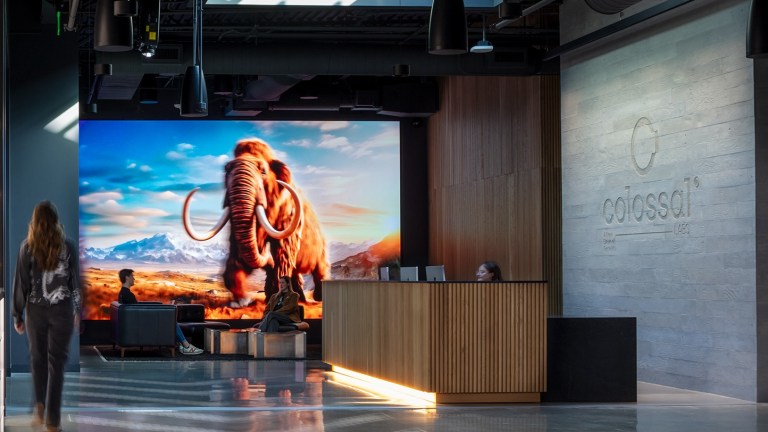
Ben Lamm, the CEO and co-founder of the technology firm Colossal Biosciences, does not want to play favorites with the company’s various de-extinction projects. One look around a newly finished headquarters in Dallas, Texas speaks volumes for how proud the company is about their dire wolf—or a functional recreation of the Pleistocene predator using the genetically-edited code of gray wolves to match the genome of the extinct creature of prehistory. And they have various projects, including the thylacine (the Tasmanian tiger), the dodo, and great moa of New Zealand, in various stages of development.
Still, at the end of the day, the one he seems most eager to cross the finish line remains the woolly mammoth, an animal which Colossal does not only wish to recreate by editing the genetics of its closest living relative, the Asian elephant, but to also rewild—returning the furry giant to the arctic tundras that mammoths once roamed.
“I think that the mammoth conjures probably the most excitement,” Lamm muses inside a dire wolf-bedecked conference room. “Of anything we’re working on, it’s like people almost put it in the Jurassic Park age. It wasn’t, but people still have this view. We were making pyramids while mammoths were still here.”
Indeed, the last known mammoth population to walk the earth died out roughly 4,000 years ago, about six centuries after the Egyptians started putting up their monuments. It is a creature in (distant) human history, but one mythical enough to trigger the imagination. That myth is also what first made Colossal a reality after Lamm got inklings in the 2010s about George Church, a Harvard geneticist who made it a life’s dream to bring back the woolly mammoth. And according to Lamm today, they’re as close as a mere two years out from having that calf in the world.
“We’re certified by the American Humane [Society], we’re certified by Global Humane,” Lamm says. And they’re more than two and a half years into the process of working on oval egg retrieval in elephants—a crucial aspect in developing the IVF process for safely birthing a mammoth calf with an Asian elephant surrogacy that will last 22 months. “We’ve made a lot of progress on that one. I’m not announcing anything today, but I think we’re going to show some really interesting progress on that this year that people will get excited about, and which has huge applications to captive breeding programs and elephant conservation. [It will] ensure that this is repeatable, exciting, and impactful in a way that has no negative impacts on elephants.”
The founder further asserts once they can 100 percent confirm the transfer process of elephant embryos is safe, it could have an immediate impact in both the mammoth project and endangered elephant populations.
“[The limiting factor] won’t be a technology factor,” Lamm says, “it will be [getting] everyone around the table, including our animal rights partners, and everyone feeling we’re okay to put these in here. So I think they will.”
While Lamm is confident they’re “on track for 2028,” already the company is preparing for where mammoths would go in two years. Matt James, Colossal’s chief animal officer, cryptically confirms that significant nature preserves have been earmarked with partners to rear mammoths.
“It’s a northern climate, not south, I can tell you that,” he chuckles. Additionally, the experience of studying the dire wolves in their own undisclosed captivity has helped James begin writing and rewriting animal care and rewilding manuals for a creature most associated with the Ice Age.
“I think a lot of the regulatory stuff has been really interesting for us, as we’re uncovering what are the regulatory pathways to eventual rewilding of a genetically modified animal,” James explains. “That’s something nobody’s ever done before, so even going through this exercise is more hypothetical with dire wolves, it has been really good about us finding the connections of the people that are sort of experts in those areas… that’s been really good for building our network of expertise, because this isn’t a thing that happens in a silo at Colossal. It’s going to take a whole village of people to help us develop these strategies.”
It’s also bringing to fruition a dream that 40 years ago might have seemed fanciful, but in 2026 is seeing opinions rapidly evolve, even within the scientific community.
Dr. Beth Shapiro would know. The evolutionary molecular biologist and geneticist has been studying Ancient DNA since her graduate school days at Oxford in the early 2000s. By then, the first academic paper on Ancient DNA was well-known, with Allan Wilson’s UC Berkeley extinct study group publishing its findings in 1984. The document is often cited as an influence on Michael Crichton’s Jurassic Park and also prompted the first question a journalist ever asked a scientist in this field: Can you one day bring back a woolly mammoth?
“My first book was actually called How to Clone a Mammoth [published in 2015],” Shapiro tells us, “which was a long-form answer to why it was really hard, and all of the technological, ethical, and social challenges one would need to solve to get to the point where you can bring a mammoth back to life. So the idea of de-extinction has been circulating in Ancient DNA, but I think what’s changed is the technology has advanced to the point where all of the foundational tools that we need to make it happen exist. Now they just need to be accelerated and be pushed to the extreme.”
Consider that one of the breakthroughs has been advancing and scaling up multiplex-genome engineering. With their dire wolf, Colossal pinpointed about 20 edits needed in the gray wolf genome to functionally recreate the dire wolf in appearance, behavior, and ecological function. Some of the other species Colossal aims to de-extinct next will demand thousands, tens of thousands, and possibly a million edits. All of it is on the table.
Such rapid advancement has led to a fair amount of skepticism, both among the press and perhaps more acutely in the world of academia where scientists like Shapiro hail. (She is technically on a three-year sabbatical from the University of California, Santa Cruz while now working as the chief science officer at Colossal.) But a colleague of hers who’s also been fascinated by the potential of de-extinction for just as long—Dr. Andrew Pask, Colossal’s chief biology officer and head of the company’s research efforts in Australia—says such perceptions are changing given recent breakthroughs in combatting the fatal EEHV in elephants and the potential of the dire wolf project offering coattails in engineering newfound biodiversity within American red wolf populations.
“This big shift has happened as we’ve also proven that we’re having real conservation outcomes,” Pask explains. “I talk at a lot of conservation conferences, and I think initially people were just really skeptical. They would always come up and be like, ‘I just don’t see how this is actually going to lead to conservation outcomes.’ And we kept on saying, ‘Here are all the things we’re projecting will happen.’ But I think now, as we’re actually achieving those goals and showing these things, people are going, ‘This is actually an important path forward.’”
Right now, Pask is helping progress a genetically-engineered quoll—a small nocturnal, and extremely endangered marsupial in Australia—into becoming the first controlled release “ambassador project” in his native country where the Colossal quoll can help introduce the attributes needed to survive a changing habitat.
“I think people are much more accepting that we do have to take these kind of measures if we want to save biodiversity on our planet,” says Pask. “We absolutely have to. There is no other technology that can bring back lost biodiversity. You have to engineer it back in. It can happen over evolutionary time, but we would need hundreds of thousands, if not millions of years for some of these populations that we whittled down to 10 individuals to become healthy again. And they won’t. They’ll go extinct before that can happen. But we can bring those things back with conservation.”
Pask claims he’s achieved more tangible results in the past three years than in the 20 that preceded them. He likens such exciting progress to the world collectively driving full speed off a cliff and, having only now noticed there’s a path off the suicide ride, folks in the backseat are shouting, ‘No, no it’s too risky!’
But as his colleague Shapiro notes, choosing not to do anything due to risk-aversion is itself a risk that will invite dire consequences.
“The idea of de-extinction is exciting,” Shapiro says. “It brings new people in, brings new money into conservation. The money that’s gone to support Colossal would have otherwise gone to something like Bitcoin. Who knows? This is not money that would’ve supported traditional approaches to conservation. So I think it’s a huge win that Ben has been able to raise hundreds of millions of dollars and push it to developing tools for conservation.”
Right now the woolly mammoth is still at least two years away, but already benefits from researching how to replicate and rewild a mammoth are being implemented in living elephant populations.
“What’s crazy is all those works are helping elephants today,” says Lamm, “but selfishly we need all that to then build synthetic herds of mammoths and rewild mammoths. So we’re learning great things and helping today, but we’re also selfishly learning for our de-extinction project.”
Life finds a way, indeed.