Why The Boris Karloff Mummy Is Still the Most Haunting
Nearly 100 years later, Boris Karloff’s The Mummy remains the only one to unnerve for a reason.

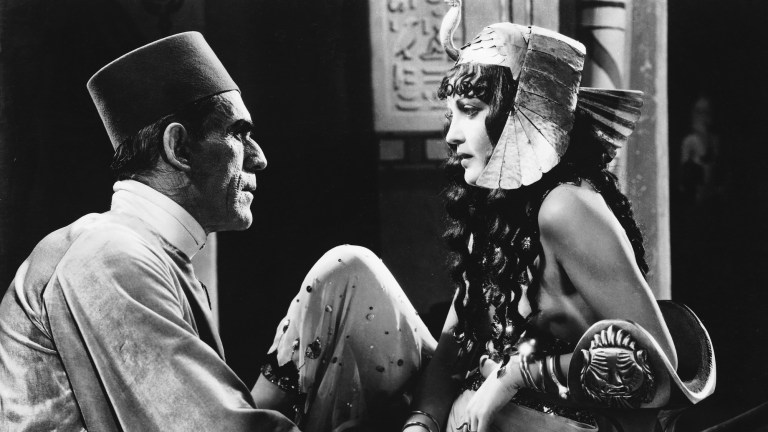
There is no music on a moonless night during a crucial scene in The Mummy of 1932. There is almost no music in the movie at all beyond a derivative, if ever effective, use of Tchaikovsky’s Swan Lake in the opening credits. But on this bleak evening in the old Egyptian Museum of Cairo, there is the ceaseless chant of Boris Karloff’s pained diction. In the shadows of gloom, he repeats breathlessly, hopefully, “Anck-es-en-Amon.”
It’s a spell, a lure, and one given menacing implications as Karloff is lit from beneath in such severe splotches of black, you can barely see the meticulously wrinkled skin of his superb makeup job. There is also something sweet about his pained inflections. The words lull and hypnotize as they draw a young woman named Helen (Zita Johann) ever closer to a desolate place where, surrounded by the last treasures of a ruined kingdom, a revenant from the past seeks to embrace her as his Anck-es-en-Amon. Together they’ll consummate a 3,000-year love story. It’s simultaneously ghoulish and entrancing.
The power of this scene like so many others in cinematographer Karl Freund’s rare directorial effort has echoed through the decades, to the point that The Mummy still influences our modern pop culture idea of Ancient Egypt and the shriveled corpses it’s bequeathed us. Nearly a hundred years old, the original Mummy is certainly a relic too. Long displaced as the Mummy film by Stephen Sommers’ direct remake of roughly the same story in 1999—where a long dead priest named Imhotep awakens in the early 20th century to search for the reincarnation of his lost love Anck-es-en-Amon—what Universal Pictures passed off as horror in 1932 is now a source of camp and high-adventure fun. These days we think less of the Mummy’s pain and more of Brendan Fraser’s not-quite Indiana Jones dueling Imhotep to save the girl.
And beyond the more staid and hushed pace, the 1932 movie has plenty of other affectations of its era that play less comfortably in the 21st century, including the grotesque implications of Imhotep being able to put Egyptians of Nubian heritage under his thrall and service.
So, yes, the original Mummy film is a product of its time. However, when accepted on its own merits and its specific context, it remains perhaps the only film about Ancient Egyptian corpses rising from the grave to set a tone that is at times genuinely unsettling, and at others eerily romantic. Not only did the O.G. Mummy set the standard for mummy movies, it also arguably shaped our understanding of vampires and Dracula as well…
Ancient Origins
When The Mummy was rushed into production by producer Carl Laemmle Jr. 95 years ago, it was viewed quite a bit like the Dracula clone. It was meant to duplicate the success of Bela Lugosi’s vehicle which also launched the original Universal Monsters cycle in 1931, as well as James Whale’s Frankenstein from the same year, which gave the world the Karloff. Initially screenwriters Nina Wilcox Putnam and Richard Schayer sought to even place the general outline of this plot into a film about Alessandro Cagliostro, a now largely forgotten 18th century alchemist, magician, and confidence man who convinced the last 18th century courts of France that he was an immortal. Presumably Imhotep’s hypnotic (and Dracula-adjacent) powers would have been more pronounced in this version of the story.
However, Laemmle ultimately found himself wanting to capitalize on the still thriving revival of Egyptomania which followed on the heels of King Tutankhamun’s tomb being discovered a decade earlier by Howard Carter. The greatest archaeological discovery in history, King Tut’s resting place was the first and still only pharaonic tomb discovered to be almost entirely untouched by looters since its sealing 3,300 years ago. It gave us a wealth of knowledge about New Kingdom culture, history, treasures… and at least one imagined superstition about the Pharaoh’s Curse, which plagued the dig following the freakish death of its benefactor, Lord Carnarvon, six months later.
The actual “Curse of the Pharaohs” was invented by the British and American press, of course. And among them was American journalist, writer, and adventurer John L. Balderston. He saw firsthand the removal of King Tut’s treasures from afar—only the UK’s Times got exclusive access to the excavation, hence a reason for embellishments about a “curse”—and lived in Egypt for more than a year. Balderston also saw its effect on pop culture, with newfound Egyptomania seeping into fashion, Art Deco architecture, and eventually the Hollywood where he landed as a screenwriter at Universal. He was at first brought out to California to adapt his own 1927 Broadway version of Dracula, which itself was a riff on Hamilton Deane’s 1924 British play of the same name. Ironically, very little Bram Stoker was involved in either.
The vampire movie proved such a success, Balderston was tapped to rewrite what became The Mummy. Producer Laemmle selected Balderston because of Dracula, and the scribe dutifully rehashed plot elements from the Lugosi classic, including a kindly old professor—now Dr. Muller and played again by Van Helsing actor Edward Van Sloan—who would dare to believe in the supernatural. There are also ancient charms to ward off evil and a living corpse obsessed with the bodies of much younger, pretty things.
Yet what Balderston also brought to the material was a genuine understanding of Ancient Egyptian culture and modern colonized Egypt, albeit from a distinctly Western, early 20th century perspective. Unlike virtually every Mummy film made after, Balderston’s script does not mix up Egyptian gods Thoth and Osiris, or Anubis and Seth. He sprinkles in a real understanding of that mythology, including by making Anck-es-en-Amon a priestess of Isis. Even the name Anck-es-en-Amon is based on Ankhesenamun, the real bride of King Tut (and his half-sister), whose fate was far more tragic than what Balderston dreamed up. Meanwhile the name Imhotep is nicked from the real priest and architect who designed the very first pyramid in the Old Kingdom for the Pharaoh Djoser.
There is a sense of respect to the past in The Mummy (1932), as well as a Western sense of suspicion of the Near East, given the white characters’ aversion to modern Egypt. It creates a mystique that is the perfect backdrop for a movie wherein Karloff plays as much a doomed lover as he does a classical monster.
A Face to Die For
Most folks who watch The Mummy for the first time now are shocked by how little we see of Karloff in the traditional Mummy makeup, complete with bandages and rotting flesh. It’s really only the first 10 or 11 minutes that open the movie on a dig in 1921 Egypt (a year before Carter walked into Tutankhamun’s tomb). It also is the most evocative sequence in any Mummy film ever made.
On a starry night in Egypt, several archaeologists, including nervous old Dr. Muller, sit in a tent basking in the discovery of the fabled Scroll of Thoth and a strange Mummy who was found with it. This Mummy, unlike any other they have seen, shows signs of having been buried alive. There’s also a foreboding curse, of course.
Director Freund’s restraint and minimalism has as much to do with the chilling success of this sequence as Jack Pierce’s unforgettable makeup design. Karloff spent eight hours in the prosthetics chair so that Pierce—the genius who gave us the still definitive Frankenstein Monster countenance—could individually place one bandage of cotton after another on his flesh, using spirit gum to hold in the shriveled skin. Apparently each piece of linen was treated with acid to give it that decrepit look.
Yet Freund almost exclusively shows Karloff motionless in this getup. There is a single shot where, as a young and foolhardy archaeologist opens a forbidden box and reads forbidden words, Karloff’s eyes open slowly. That single, weary, movement, devoid of music or any other audio harbinger, reaches into the subconscious of the viewer. It’s a manifestation of the half-dreamt fear of anyone who’s stared too long at a corpse. But even then, Freund doesn’t show Karloff walk. We see only a hand as it reaches toward a table, and a bandage as he shuffles out of the tent. Instead of the monster, we focus on a young victim’s growing madness as Dr. Norton (Bramwell Fletcher) goes the way of Renfield, laughing maniacally to the grave.
For the rest of the picture, Karloff’s Mummy is able to reconstitute some passing resemblance of normality as he goes by the name of Ardith Bay, an Egyptian whose skin knows a million wrinkles, and whose eyes burn with an intensity of rage that would be foreign to the Frankenstein Monster or even Lugosi’s Dracula.
Love Never Dies
In the end, though, the movie really belongs not to the mummy, but to Helen Grosevnor, Zita Johann’s severely underrated heroine. Barring Elsa Lanchester’s iconic (if housebound) Bride of Frankenstein, Johann enjoyed the greatest role of any woman in a Universal Monsters picture. While functionally the same as Helen Chandler’s passive Mina Seward in Dracula, Johann has a captivating sense of destiny and agency, even when under Imhotep’s sway.
Both her attraction and repulsion of Imhotep are palpable when eyes are locked with Karloff, and it is her sense of division between the modern Helen and the genuinely reincarnated Anck-es-en-Amon that informs the real dramatic conflict of The Mummy. Entire sequences of Helen’s many past lives in the Middle Ages and as a kind of Joan of Arc were filmed and deleted, as it detracted too much from the central story: a woman and her Mummy suitor whom she does not entirely dissuade. At least until the ending.
While not-Van Helsing and not-Jonathan Harker (again also played by David Manners from the 1931 Dracula) attempt to save the day again at the end of The Mummy, the men prove hapless and ineffective. What spares Helen from becoming the Mummy’s undead bride, complete with a case of human sacrifice while dressed in an entirely pre-Code, pre-censorship costume, is that Helen prays to her goddess Isis for protection. It is Isis who strikes down Imhotep, and the ancient pagan ways that win out in our Abrahamic world. There is a sense of tragedy and regret, on both Helen and the viewer’s part, for the ultimately rejected affections of Imhotep…. but he is a mummy.
A reason this dynamic works so well is the casting. Karloff is still underappreciated for his dramatic attributes. He gives Imhotep a pitifulness that might have eluded Lugosi, and which no filmmaker bothered adding to another mummy movie until Sommers and actor Arnold Vosloo 70 years later. Karloff does it better though. Meanwhile Johann was ultimately overlooked all-round Tinsel Town.
A future grand dame of the stage, Johann came to Hollywood reluctantly and purely for the money. She also came as a genuine occultist who believed in things like reincarnation. It was perfect casting. Unfortunately, despite Freund being a great visualist—before The Mummy, he DP’d Fritz Lang’s Metropolis and allegedly saved Dracula from being a complete stagebound disaster when director Tod Browning was rumored to be out to lunch—he proved a tyrannical and problematic director. He bullied and derided Johann, who soon left Hollywood for New York, never to return.
Despite their off-screen troubles, Freund’s gift for composition, presentation, and even the occasional, purposeful camera movement (a rarity in the talkies of the early ‘30s), paired exceptionally well with his stars’ presence and Pierce’s exquisite makeup designs. They made an enchantment that if you listen carefully still haunts.
Ironically, the magic was not repeated in most of the now bog-standard mummy movies of the 20th century. Freund and Balderston’s approach was too romantic, leisurely, and even Egyptian in the ancient sense for some viewers. The sequels Universal eventually made in the 1940s were dime-novel adventure stories with the shambling corpse audiences expected. Hammer Studios copied them to slightly better effect in the 1950s and ‘60s. It is perhaps not surprising, though, that the one to finally displace the 1932 film remade its doomed Gothic romantic structure, at least in the broad strokes. But even before 1999’s The Mummy, you can see Imhotep’s dusty fingerprints on so many of the Dracula movies that likewise followed.
To this day, many audiences hold the misconception that Bram Stoker’s novel is a Gothic love story between a dark prince and his lost reincarnated love. However, that image largely stems from Francis Ford Coppola, who in turn probably nicked it from Dan Curtis’ 1970s Dracula TV movie and its own daytime soap forebearer, Dark Shadows.
Yet all of the above was likely influenced not by Lugosi or 1922’s iconic Nosferatu. It comes from the structure of The Mummy, and an old wraith still calling out a lover’s name from the dark of a tomb.