The Wire: Remembering Michael B. Jordan’s First Great Role
Sinners may have got him the awards, but Michael B. Jordan has been doing great work for since The Wire.

Last night, Michael B. Jordan won the Oscar for Best Actor, beating out estimable competition including long-established greats Leonardo DiCaprio and Ethan Hawke, as well as up-and-comers Timothée Chalamet and Wagner Moura. Certainly, Jordan deserved the victory for his work in the juggernaut Sinners, which pulled in a record-breaking 16 nominations and 4 wins.
At only 39, Michael B. Jordan seems to belong more with the 30-year-old Chalamet and with Wagner, who only started making American films in 2013. But Jordan’s been doing excellent work for twenty-five years, starting with his role as Wallace on The Wire. Even as a kid, Jordan demonstrated the charisma and dramatic chops that would win him an Academy Award.
Way Down in the Hole
Created by David Simon, the former Baltimore Sun reporter who spent a year embedded with homicide detectives in the city police department, The Wire still has a reputation for being one of the greatest shows of all time. It earned such praise thanks to its realistic depiction of life in Baltimore, showing the political, social, and economic forces that drive the cops and criminals. That extends to the show’s portrayal of the drug trade, in which kids who live in project housing have little choice but to sell.
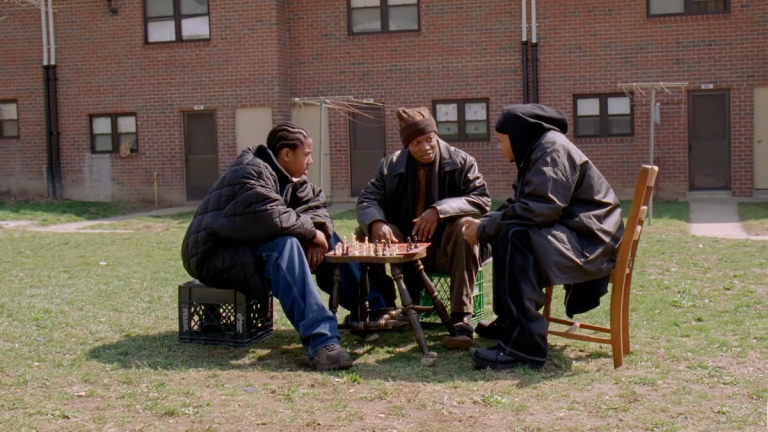
The first season of The Wire illustrated this point with three young teens, Wallace, Poot (Tray Chaney), and Bodie (J. D. Williams), all of whom work under D’Angelo Barksdale, a lieutenant in the organization run by his cousin Avon (Wood Harris). The three kids sell drugs in the common area outside of their homes in an inner-city Baltimore housing project, and the first season often blurs the line between work and play.
The trio have to adhere to the rules that allow Barksdale’s operation to run outside of police observation, observations that only become effective when the Baltimore police begin using the titular ware. If a kid makes a mistake, such as taking counterfeit bills or allowing an addict to draw attention to their drop-off spot, they are reprimanded. At the same time, the show takes time for the kids to actually act like kids, teasing one another or praising the virtues of Chicken McNuggets.
The last point is where Jordan shined as Wallace. Where Bodie presents himself as a hard man willing to do what it takes to climb the ranks and Poot is simply willing to go along with others, Wallace is a genuinely good kid suffering from a lack of options. Jordan plays him as a sweet person, a guy who loves his friends and takes responsibility for those younger than him. We see him helping younger kids with their homework, packing their lunches, and making sure that they get to school, not out of some large philosophical conviction, but just because he wants the kids to be safe.
Through Wallace, The Wire shows the tragedy of kids stuck in a system that forces them into the drug trade. Wallace works in the Barksdale organization alongside Bodie and Poot, but only because that’s what his friends and role models do. However, when Wallace identifies the boyfriend of Omar Little (Michael K. Williams), the burglar who has been robbing Barksdale drug houses, he’s sickened by the violence that flows. That disgust leaves him open to the detectives searching for Barksdale, who convince him to identify Avon’s right-hand man Stringer Bell (Idris Elba) and relocate him upstate.
But Wallace feels out-of-place and lonely in the country, and he eventually returns home to the projects, a decision that drives Stringer to order his death.
Not The Way It Should Be
Jordan plays all of Wallace’s contradictions in the character’s final scene from the episode “Cleaning Up,” in which Poot and Bodie enact Stringer’s orders to kill their friend. The scene begins with the trio heading back to the apartment where Wallace lives with the younger kids. Wallace immediately decides to check in on the kids, at first playfully calling for them and bounding up the stairs as if they’re involved in a game of hide and seek and then turning his voice stern as he becomes worried.
The tension turns when Wallace finds a walkman left by one of the kids, and picks it up to show Poot. When Wallace turns around to see Bodie pointing a pistol at him, Jordan has to embody surprise, betrayal, and fear. Wallace had been less overtaken by the fatalism that consumes many of the others in the projects, but it’s less the onset of death that shocks him and more the fact that his best friends are threatening to kill him.
Jordan has to maintain the reality of the situation, expressing that Wallace is a child who is about to be murdered by the people he trusted most. But he must also bring to life the high-concept, often poetic writing that Simon and co-creator Ed Burns brought to the series. Jordan pulls that off with the mixture of terror and defiance he puts into his readings of the lines, “Why it gotta be like this?” and “You my boys.”
By delivering those words as a scared but clear-minded boy, Jordan captures the central moral of The Wire: it doesn’t have to be like this.
Way Beyond Baltimore
Wallace is hardly the only striking death in the series, but D’Angelo’s confrontation with Stringer over the murder remains one of the most memorable moments in television history.
For his part, Jordan went on to do more excellent and varied work, even before playing twins Smoke and Stack in Sinners. With director Ryan Coogler, Jordan portrayed the real-life victim of systemic racism, Oscar Grant III, in Fruitvale Station, as well as Adonis Creed, son of doomed fighter Apollo Creed, and the fiery and principled supervillain Killmonger in Black Panther. He also had memorable turns in other TV series, as a troubled teen named Reggie Montgomery in the soap All My Children c(a role he took over from his future co-star Chadwick Boseman) and as hot-headed quarterback Vince Howard in Friday Night Lights.
Across these and other roles, Jordan showed he had the dramatic chops and magnetism to be a star. The Oscar win may have cemented his status, but Jordan had already proved he was capable, way back when he was a teen, way back on The Wire.
The Wire is now streaming on HBO Max.