Pluribus Star Samba Schutte Breaks Down Mr. Diabaté’s Reaction to That Disturbing “HDP” Twist
Samba Schutte discusses his character's surprisingly rational response to a horrible truth.

The following article contains major spoilers for Pluribus episode 6 “HDP.”
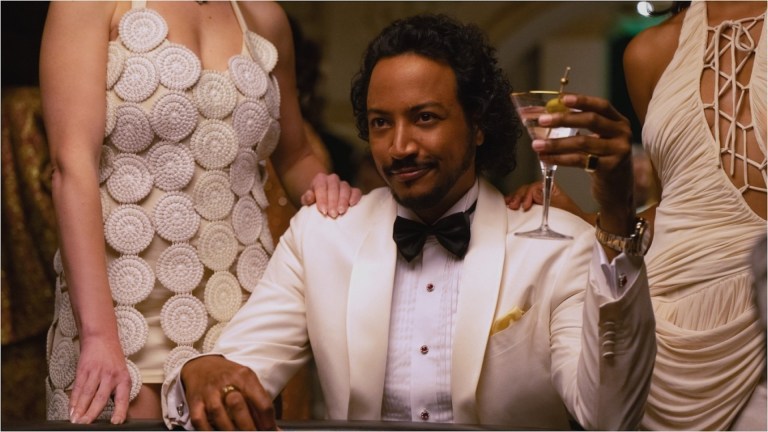
In Apple TV’s Pluribus, it’s the end of the world, and nobody’s having a good time. Well, unless they’re Koumba Diabaté (Samba Schutte), one of the handful of human survivors of the mysterious “Joining” that merged almost all of humanity into a single, peace-loving hivemind. Unlike the series’ lead character, Carol Sturka (Rhea Seehorn), who is desperate to find a way to revert the Joining process and bring back the old world, Diabaté has embraced the new reality he’s found himself in, living it up in Las Vegas, role-playing as James Bond, and partying with celebrities and supermodels (or at least members of the Joined who are fine with indulging his extravagant fantasies.)
Their two worlds collide again in “HDP,” the series’s most disturbing installment to date, which reveals that while The Joining may have brought about some admirable global developments, such as world peace and an end to racism, it’s also created some new (and horrifying) problems. We already know that the Joined refuse to kill anything living for sustenance. But this week, we find out that they really do mean anything: They won’t kill livestock or local plant life, and they refuse to pick fruits from trees, preferring to wait until they fall to the ground on their own to gather them. And the world’s remaining stockpiled food can only last several billion people so long.
Yup, the Joined are all essentially engaging in some low-grade cannibalism, using the bodies of the dead to make milk-based protein drinks that help keep them alive. Carol, who discovers this information while investigating the mysterious factory where the Joined keep a stockpile of human body parts that they use to make “HDP” or “human-derived protein, immediately races to Las Vegas and Diabaté, eager to prove to her fellow survivor that she’s been right about the Others’ nefarious intentions all along.
But what she finds there is surprising — Diabaté not only already knows the truth about how the Joined are feeding themselves, he’s not nearly as bothered by it as she (and likely also the viewers watching at home) expected him to be.
“Up to this point, all we’ve seen of Mr. Diabaté is him being a hedonist and living his best life,” Schutte tells Den of Geek. “Now, we get to see him interact with Carol on his own, and really, we get to see his true colors come out when he finally drops the gentleman act. We finally get to see how rational he is. Because honestly, he’s trying to be a humanitarian and understand both sides of the coin.”
To Diabaté’s credit, it’s not that the Joined told him the truth because they like him better than Carol or anything. He simply thought to ask them about how they survive, and has subsequently tried to understand their situation in a way that Carol has not.
“He’s done as much research as Carol has to find out how the Others work and what they’re thinking. Maybe more,” Samba said. “And he doesn’t agree with it. But he understands. For him, it’s a rational thing. He’s realized that, ‘Okay, this is the situation we’re in. If they don’t eat humans, then a billion of them are going to starve, and we’re trying to find a solution, because they can’t even pick an apple, these guys’. And a the end of the day, we don’t want people to starve to death.”
Viewers may also be surprised to learn that Diabaté is much more curious than meets the eye — and has spent his time in Las Vegas doing a lot more than simply partying. (Though, admittedly, there’s a fair bit of that, too.)
“I think Diabaté also has no hesitation to ask questions, to ask these Others about what’s really going on,” Samba said. “Unlike Carol, I think he’s very inquisitive, and he really wants to try to understand what’s happening and isn’t afraid to just try and find out [the answers]. He’s not afraid to ask John Cena why they drink so much milk. He wants to understand how this new world works. And when he realizes that they’re basically just there to make him happy or be of service to him in whatever way, I think initially he’s like a kid in a candy shop. He’s living out his greatest fantasies because he’s learned the rules of the game. He’s really observant and has learned how to make the best of this new world while he can.”
Yet, despite his frequently hedonistic behavior, Diabaté is somehow also the surviving human who’s the most sympathetic towards Carol’s situation.
“At the same time, he does see Carol’s point of view. He feels lonely, and he values his individuality as well. He doesn’t want to become one of them either,” he said. ”He disagrees with the way she’s going about things, which is to make everyone cry and possibly kill them. This, for him, is definitely not the way. So I really love that we see him trying to make a rational argument and be a straight shooter with her.”
In fact, it sounds like out of all the survivors who remain, Diabaté might be the closest thing Carol has to a friend. Or at least someone who doesn’t outright hate her.
“I think Mr. Diabaté finds something in common with Carol. I think he’s an ally. And I think out of all the surviving humans, he’s the one who can tolerate her most,” Samba said. “I don’t think he voted against her joining the group Zoom meetings! What it is… I think that there’s a side of him who sees himself in Carol, sees her desire to be an individual, and recognizes the loneliness in her. And he’s trying to help her understand that the world has changed.”
According to Samba, Diabaté understands Carol’s struggles because he himself has also experienced darkness and loneliness in his own life. And, to hear him tell it, he and Pluribus creator Vince Gilligan spent a significant amount of time hashing out the character’s backstory together.
“We filmed the Vegas episode first, before we filmed episode 2 [where everyone meets for the first time]. So I got to jump right into questions of who this guy is, really, right off the bat. Things like ‘is wrong to for him want to live out his best life and greatest fantasies while people like Carol choose to wallow in their misery?’” Samba said. “I talked about it with Vince, and we think he did not come from a life of wealth. He had not had a good life before this. He was certainly never surrounded by opulence or beautiful women. He probably experienced racism and discrimination. And, as you probably noticed, he also doesn’t have any family members — he and Carol are the only ones without family at the meeting on Air Force One. He comes on board with supermodels instead. And when the Joining happened, he must have been so confused, like everyone else.”
Samba is particularly enjoying playing “all the [various] layers” of his character, who often presents himself in different ways depending on who he is talking to at any particular moment.
“Clearly, he puts on an act when he’s with the other surviving humans, a gentlemanly act. Even with Carol, there’s a certain [persona] he puts on. But I think, at the core, he’s a very lonely man,” he said. “But unlike Carol, who chooses to be alone and who chooses to fight the change in the world, I think he’s chosen to accept it. Some people are in denial, like Laxmi, who insists that the child [living with her] is still her son even though he can perform gynecology and stuff. Some people want to join the others, like Kusimayu. Then there’s Carol, who wants to turn things around scientifically. And then there’s Diabaté, who has just, I think, embraced this new world.”
What’s perhaps most interesting about Diabaté’s choice is that he makes it in full knowledge of who and what the Joined are.
“He’s decided that what he’s going to do is surround himself with these people who clearly think they are having a good time with him. At the end of the day, what makes us human is our desire to connect and to feel connected. But it’s interesting that he still addresses them all by their individual names, even though Carol tells him things like, ‘Hey, that’s not really John Cena!’ For him, even though the world has changed, he’s still gonna address these people by their personal name. For him, there’s still some individuality to them. I think that’s really interesting, because I don’t know if that’s denial or just a way of coping with everything that’s happened.”
But for Samba, these are precisely the kinds of big philosophical questions that Pluribus is meant to raise — and to leave audiences wondering over from week to week.
“One of the biggest things the show has going for it is that it creates these discussions: Who would you be in this world? Would you be a Carol, or a Diabaté, or a Manousos? Would you be a Laxmi?” Samba said. “And I think what makes it really interesting is that — as much as we all might desire peace on Earth, I don’t think we want to sacrifice our individuality. Diabaté doesn’t. He’s so excited to tell Carol that they can’t be turned without their permission, you know? As much as he loves his life and the way it is he does not want to become one of the Others. We all long for connection, and we want peace, but we don’t want to sacrifice our free will or our innate humanness for it.”