The Bigfoot Files and the Bossburg Thanksgiving Sasquatch Revisited
As the Forest Service releases its 'Bigfoot files,' we look back at 1969's Cripplefoot case, the most famous Squatch you’ve never heard of.

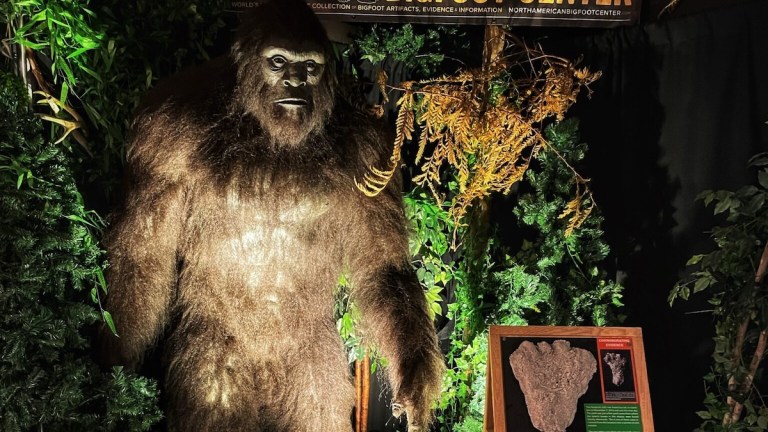
Bigfoot is back in the news. With the release of United States Forest Service records pertaining to three separate incidents of strange tracks found in Montana and Oregon, news outlets are dedicating time to the bipedal fuzzball. But it’s not the first time the mysterious cryptid has left a sizable footprint on the days leading up to Thanksgiving. For that, you’d need to look back 57 years to a small town in Washington State, and the strange Bossburg Cripplefoot incident.
Last month the USFS, an agency within the United States Department of Agriculture (USDA), released a small batch of files pertaining to Bigfoot encounters in Montana and Oregon on its Freedom of Information Act (FOIA) Reading Room page under a section titled “Frequently requested records.” These “Bigfoot files” are only three documents: One is a 1980 eyewitness account of seeing tracks in Montana in 1949; another is a 1982 USDA report on an investigation of tracks in Oregon, and a wildlife biologist’s conclusion they were not likely faked; finally there is a 2003 newspaper article from Montana’s Clark Fork Valley Press with photos of tracks, and interviews with locals. Matt Moneymaker, president of the Bigfoot Field Researchers Organization, noted on X that “There is no big Gov disclosure of Bigfoot files from the Forest Service comparable to the disclosure of UFO info” (referring to the Pentagon’s expanded release of documents related to Unidentified Anomalous Phenomena/UAP last summer).
Despite media coverage treating these documents as a shocking revelation or secretive, Cliff Barackman, Director of the North American Bigfoot Center and co-host of the Bigfoot and Beyond podcast, states, “I think it’s misleading when they say that these were classified documents. They were not.” He notes at least two of the three records have circulated publicly for decades, and one is simply a newspaper clipping.
Still, the timing of this release is fitting as it relates to a major case in the annals of Bigfoot research. On November 24, 1969, three days before Thanksgiving, a butcher named Joe Rhodes found enormous barefoot prints near the community dump in Bossburg, Washington, about 20 miles from the Canadian border. One of the feet was twisted and malformed, hence the (now-outdated) name “Cripplefoot.” (It’s a case I dug into for the Thanksgiving week episode of Talking Strange, which you can check out on Spotify, Apple Podcasts, and wherever you listen to other podcasts.)
Word spread fast, and veteran Bigfoot hunter René Dahinden drove down from British Columbia, where he found, photographed, and cast one of the best surviving prints of the malformed right foot. Coleman counts it among the best pieces of Bigfoot evidence ever found, and casts of those original prints are what later won over Washington State University anthropologist Grover Krantz. Then, on December 13, after a fresh snowfall, Dahinden, local guide Ivan Marx and a young local named Jim Hopkins found a trail of 1,089 prints along Roosevelt Lake, the reservoir on the Columbia River. Loren Coleman, in Bigfoot! The True Story of Apes in America, calls it one of the best footprint series ever found in America.
According to Sasquatch/Bigfoot, the book Dahinden wrote with Don Hunter, the right foot’s third toe was twisted under or missing, the little toe jutted out at a sharp angle, and two lumps bulged along its outer edge.
Five days later, a U.S. Border Patrol officer found what appeared to be the same malformed prints across the river, on logging company land behind locked gates, an odd place to plant a hoax few would ever see.
“He found his tracks not only upstream quite a distance, but across the river,” Barackman says, “on logging land that was behind locked gates.” The officer cast two of them, and a copy now sits at Barackman’s center.
Bossburg produced another first: casts of two huge handprints, found by Ivan Marx, which Krantz analyzed in Northwest Anthropological Research Notes. Barackman calls them “the first two casts that ever surfaced” of Sasquatch hands, and says casts found since, including his own, share the same structure. Footage of the site from Peter Byrne’s film reels also shows a knuckle print beside them, with five fingers lying parallel, a detail Barackman says few people knew how to fake at the time. “I’m compelled to think that those handprints are also real,” he says.
Why Cripplefoot Still Matters
That deformity is why Bossburg endures. As Roger St. Hilaire, a young zoologist on the hunt, put it to Coleman, there were plenty of reasons to be suspicious, but why would anyone fake a malformed foot?
Krantz arrived a skeptic and left a believer, but was also thought to believe a bit too much. In his 1992 book Big Footprints, he wrote that there was “no way that everything could have been tied together so perfectly in a fake.” British primatologist John Napier, an authority on human walking, diagnosed the right foot as a clubfoot, likely from a crushing injury in childhood. In Bigfoot (1972), he wrote that it was hard to imagine a hoaxer “so subtle, so knowledgeable — and so sick.”
Decades later, Idaho State University anatomist Jeff Meldrum — who died in September 2025 and had been a guest on Talking Strange — examined the original casts. In Sasquatch: Legend Meets Science (2006), Meldrum read the deformity as a type of skewfoot, possibly caused by a spinal injury. He argued those lumps implied a longer, non-human heel.
One rebuttal came from anthropologist David Daegling. In a 2002 Skeptical Inquirer article titled “Cripplefoot Hobbled,” he argued that no hoaxer had to invent the foot: medical textbooks had pictured clubfoot deformities for decades, and one could simply be traced and enlarged. Meldrum countered by re-measuring the big toe and finding it fell outside the human range. But 57 years later, the foot still hasn’t been explained away.
For Barackman, that is Bossburg’s real legacy. Despite the fact that “shenanigans ensued” later on (more on that in the next section), “the legacy of Bossburg unquestionably is that it started all scientific research into the subject.” It was Krantz’s first exposure to the evidence, and Krantz in turn helped set Meldrum on his path. The Patterson-Gimlin film has drawn more people to Bigfoot, Barackman says, because “we are visual creatures, but “the science started with Bossburg.”
A Big Circus of Bigfoot Characters
The trouble with Bossburg isn’t the footprint; it’s the circus sideshow that gathered around it.
The most famous, and dubious, character surrounding Bossburg was the aforementioned Ivan Marx, a bear hunter and veteran of Tom Slick’s 1960 Bigfoot expedition. He started out as “just one of the gang,” says Barackman. But his reputation as an eccentric preceded him. For instance, he had a pet cougar, and claimed he had trained talking magpies and his pet Chihuahua Finky to hunt down Bigfoot. In Sasquatch: The Apes Among Us, researcher and journalist John Green recalls that before meeting Marx, he’d heard he was the biggest yarn-spinner in California.
Then, in October 1970, Marx produced a film of the injured creature itself. Don Hunter and Dahinden report that big game hunter turned Bigfooter Peter Byrne had put Marx on a $750 monthly retainer and held the film as security. When rancher Don Byington’s children kept insisting they knew where it was shot, Byrne finally listened, and they led him to a spot on their family’s ranch, where a branch the creature brushed was less than six feet off the ground. Additionally, a garage owner who once rented to Marx later told Robert Michael Pyle, author of Where Bigfoot Walks, “I’ve seen those slabs of wood he made the tracks with.” Marx was busted.
There was also Joe Metlow, a prospector who walked into the Bigfoot hunters’ camp in January 1970 claiming he had a cream-colored Sasquatch trapped. Even Roger Patterson of the Patterson-Gimlin film was involved. The former rodeo rider, whose 1967 Bluff Creek footage remains the most famous Bigfoot film ever shot, had come to Bossburg hoping for a follow-up, with Ohio businessman Tom Page bankrolling him. Patterson’s camp and Dahinden’s bid against each other for Metlow’s Sasquatch, as high as $55,000. Metlow then claimed a Sasquatch foot was in his freezer (then said it was in his sister’s freezer, out in Portland). Nothing ever materialized. As Daegling points out, that kind of money supplied exactly the motive Napier couldn’t imagine.
Finally, there’s Ray Pickens, a Colville man who showed off carved wooden feet. Kenneth Wylie, in Bigfoot: A Personal Inquiry into a Phenomenon, credited Pickens with the Bossburg tracks. But Meldrum noted that by Pickens’s own account, he first made his fake feet in February 1971, more than a year after the tracks were found.
With this cast of characters, perhaps it’s no wonder Green, who once vouched for Marx’s film, eventually wrote off the whole Bossburg episode as entertainment.
Entertainment or not, the Bossburg incident did indeed become a part of pop culture. Marx’s 1970 footage aired in Monsters! Mysteries or Myths?, the Rod Serling-narrated CBS special produced with the Smithsonian, which premiered on November 25, 1974 (the Monday before Thanksgiving). The case resurfaced in the “Bigfoot” episode of Leonard Nimoy’s In Search Of…, which aired April 28, 1977. Marx went on to executive produce The Legend of Bigfoot for Sunn Classics, Coleman notes, and copies of the malformed footprint casts are still sold today.
Back to the Bigfoot Files
Bossburg isn’t in the new Forest Service release, but the two stories share a familiar pattern. The 1982 Oregon file covers tracks in the Umatilla National Forest reported by Paul Freeman, then a Forest Service patrolman. Wildlife biologist Rodney Johnson concluded the tracks were not made by a large, two-legged animal, but also stated, “if the tracks were faked, someone went to a great deal of trouble and detail.” Meanwhile, Border Patrol tracker Joel Hardin called them “a very clever attempt” at a hoax.
Yet Krantz called Freeman’s casts “maybe the best set of prints of a Sasquatch ever obtained,” according to Sasquatch/Bigfoot, in which Dahinden dismissed Freeman as a faker. But Barackman, who now curates Freeman’s casts at his center, sides with Krantz.
“They’re real,” he told me, arguing that Hardin, an accomplished tracker of people, judged the prints by human standards. “Sasquatches are not humans,” he said. “They don’t walk like people.” As Pyle notes, Krantz’s faith in tracks from two men that others saw as fakers, Freeman and Marx, led to charges that he was gullible.
The malformed footprint found in Bossburg remains a compelling piece of evidence for many in the Bigfoot community. But the hoaxers and opportunists cast a shadow on the overall story. Still, 57 Thanksgivings later, that footprint is still on the table, and nobody has managed to clear it.
For more about the Bossburg Cripplefoot incident, from the snow trail, to the bidding war, to the science, check out the latest episode of Talking Strange, with a Patreon bonus devoted entirely to Ivan Marx. Listen wherever you get your podcasts.
Aaron Sagers is a journalist, author, and paranormal researcher who currently appears on the Travel Channel/HBO Max series Paranormal Caught on Camera, Hulu’s The UnBelievable: Encounters with Dan Aykroyd, History Channel’s The Proof Is Out There, and Netflix’s 28 Days Haunted. He also hosts and produces the Talking Strange Paranormal Show and podcast.