Sterlin Harjo On The Lowdown Season 2 Finale, Rejecting the Idea of Being Cool
The Lowdown creator Sterlin Harjo breaks down the season 2 finale and teases what's next for season 3.

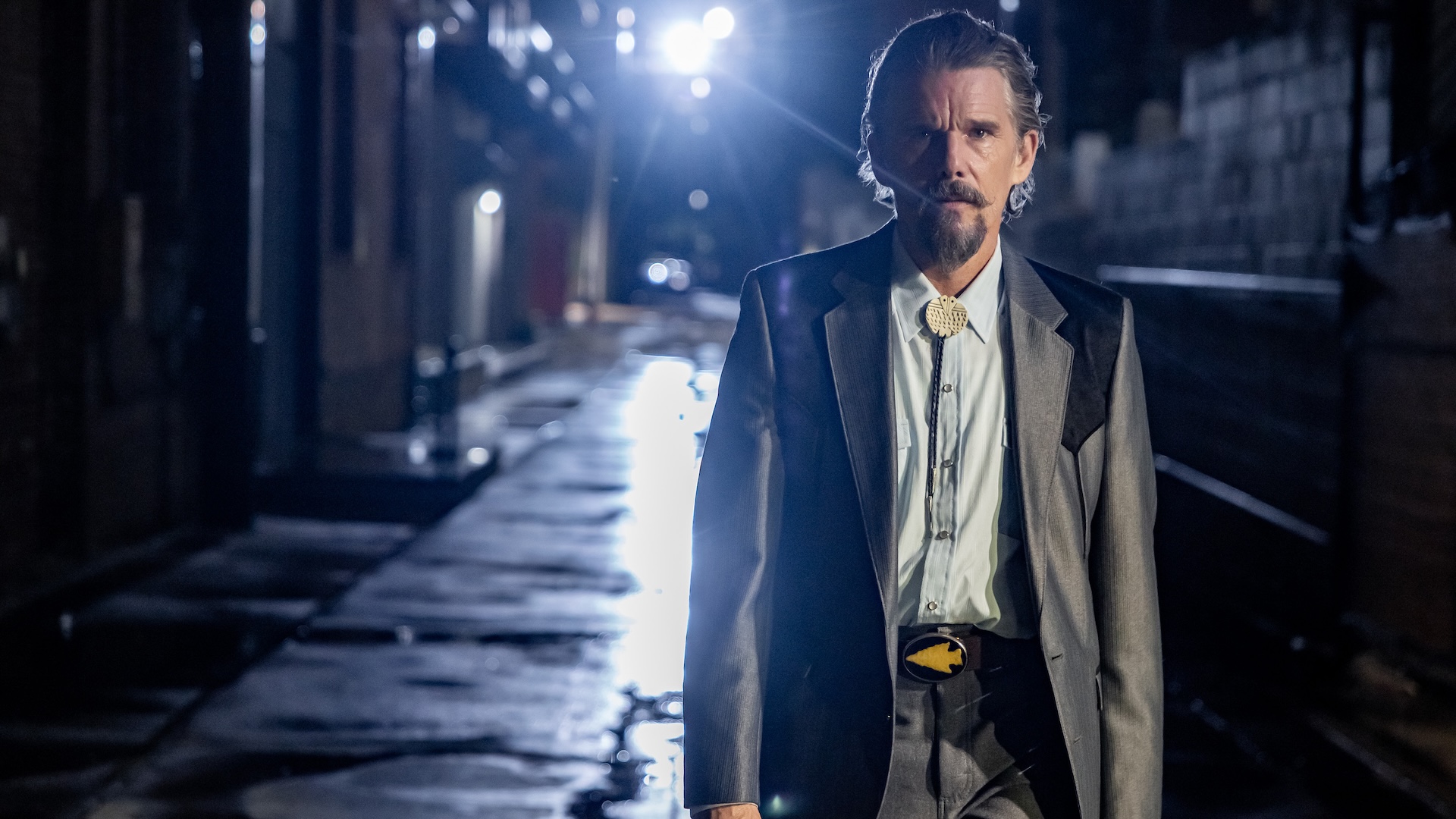
The following contains spoilers for The Lowdown season 2 episode 8.
It always feels slightly awkward to ask someone who just wrapped up a season of television if they’re ready to jump into the next one. But award-winning writer/director Sterlin Harjo is “locked and loaded” for the third season of The Lowdown as we chat about the just aired second season finale.
Harjo is ready to dive further into the criminal conspirators who hold the levers of power in Tulsa, but he’s also eager to keep exploring the evolution of Ethan Hawke’s Lee Raybon. And he already has an idea for the next time we see Lee that he says is “crazy” and which will require a lot of explaining. What he doesn’t have is a plan on how to get there… yet. But he doesn’t seem stressed. “There’s no show Bible. It’s just in my head.” he tells Den of Geek.
Harjo relishes the challenge of figuring out the journey even if he already knows where he wants to go. When asked about Juliette Lewis’ role in the next season after a key cameo in the finale, Harjo says, “We’ll figure out exactly how later, but she’s coming back.” The Lowdown exists in a world where characters come and go, as seen with the brief but notable return of Kyle MacLachlan’s Governor Donald Washberg character this season. Season 1 guest players Killer Mike and Peter Dinklage each have memorable moments as well this season. And don’t be so sure you’ve seen the last of Betty Gilpin’s public defender character, either. Harjo is hoping to work with the actress again, recounting how she would send him texts saying “#DontKillGinger” while he was still scripting the season’s conclusion.
The Lowdown is also a show led by a character whose ongoing evolution Harjo partly identifies with. While Lee is a truthstorian on the trail of shady figures, he’s also figuring out how to color in the different shades of his life. It’s a search for emotional truth that’s revealing itself to him bit by bit; influenced by his work, his relationship with Ginger, the loss of his father (Tommy Lee Jones), and how he communicates and relates to his daughter, Francis (Ryan Kiera Armstrong). The destination is one of self-acceptance and peace. The journey is still being figured out. Which is part of the fun.
We spoke with Harjo about that, the shifting definition of cool, not dealing in cliches, and the joy of writing hang scenes in the below conversation, which has been lightly edited for length and clarity.

Den of Geek: Are you actively planning for season three?
Sterlin Harjo: I am. I’m locked and loaded, so hopefully we get a season three. And I think by the end of this season, more than anything, we’re pushing towards another season to help figure out the darker conspiracy. So that was purposeful, and I’m just excited. This world’s fun to me. It’s so exciting to get these actors together and tell this story. So yeah, I’m ready to go.
Season two ends in a way that’s open toward season three. But with the scene at Sweet Emily’s with the memorial, it feels like you could have ended the show there if you had to. Was that intentional to make sure you had a satisfying conclusion?
No, not necessarily intentional, because actually the way that I cut it made it more of the end. It was actually written in a way where that was earlier. I grew up in a really big family and community. We were always at funerals, and I find it really interesting how people react to each other when someone’s passed. All of a sudden, people are more honest with each other; people who would never say, “I love you,” say I love you. There’s something really interesting to me, character-wise, about something like that happening in the middle of a story, where we have to see what happens afterward. And then seeing how they change and go back to themselves.
I’m always writing these sort of moments like that. Reservation Dogs was full of them. I’m also a big fan of Husbands, the John Cassavetes movie, and I kept thinking about all those great hangs throughout that movie. And I was like, “I want to do something like that.” That’s kind of where it came from. I mean, that’s my favorite thing. Left to my own devices, I’m just making hang movies. [Laughs] I’m just making Husbands. Plot, I don’t even know the word. That’s why I bring writers in with me to challenge me, to push me into plot.
I loved how you wrapped up the relationship between Lee and his father. There’s no cliched confrontation and embrace. It’s messy in a realistic way, but he sees him in the end. Why was it so important for Lee to have that conclusion?
I think that those characters have had such a hard time communicating and knowing how to talk to each other and express things to each other. It would feel very dishonest to have a really big cathartic back-and-forth speech between them. It needed to be messy in a way that fit their characters, and that’s what I hold myself towards the whole time I’m making something.
In the end, I think those small gestures that happen right at the end are actually pretty big, considering how hard of a time they’ve had communicating. And you sort of see these micro connections that are happening through the whole episode. When Tommy Lee Jones tells him, “It wasn’t so bad in there. I might’ve needed a break in the hospital,” I think that is such a sweet, real moment because Lee doesn’t know how to respond to that. He doesn’t even say anything. He just kind of nods and walks off.
That’s how we are as humans. We have to focus on these small connections and these stutter steps because it’s not grand, usually. It’s usually like you’re carrying all of the baggage of everything that you do into every situation, and sometimes that’s really messy and complicated. I think one of the things that really interested me and us at the beginning of this season was that you have a guy who’s obsessed with the truth. He’s obviously obsessed with the truth because he grew up with someone who lied a lot. And in turn, he lies a lot to get to the truth, which is such a fun, complicated situation. And then he finds out in the end that his father didn’t lie about being in Vietnam, and all of a sudden his perspective’s changing on his father. It becomes this lesson of like, maybe Lee didn’t listen enough in these situations with his father.
I love those moments. I could write stuff like that all day, and I very much love writing for Tommy Lee Jones. You can’t put clichés in his mouth. A) he wouldn’t do it, or B) it wouldn’t sound right. And he sort of speaks in the language of Cormac McCarthy. So I think that West Texas sort of, “I’m going to be blunt straight with you,” cuts through bullshit. And if you’re writing bullshit for him, you’ll be found out very quickly.
Lee is obviously in pursuit of truth, but I feel like it’s factual truth. Is it fair to say that he is accidentally discovering emotional truth, as well?
Yeah.
How important is it to you to evolve Lee and put him in a place where he is more aware of that emotional truth?
It’s interesting. He’s this guy who’s looking for truth in all of these external things, but the kind of beauty of the show is that he’s finding it within himself. He’s finding ways to be honest with his daughter in a way that he couldn’t be before. He’s finding ways because life is hitting him.
I think that Southern Gothic writing does that well, where it’s sort of concerned with these big questions: life, death. It’s like, how do we get mama across this river in a coffin to marry her with her people? Most people aren’t worrying about that, but actually everyone’s worrying about that because, in the end, the only fucking plot is that we die and we’ve got to deal with that stuff.
I think that watching Lee mature as a boss, as a father, as a son… all of that’s going to play a part in how he attacks – whether physically or mentally – these people in power who are corrupt. It’s a story about how we’re all sort of flawed human beings and we have the power to make change in simple words, I guess.
I feel like a lot of the character’s attitudes are rooted in him being cool and his idea of what cool is. And it feels like part of this maturation process is learning to let go of that and just be. Is that fair to say?
I think that’s totally fair. And I also think it’s a reflection of what I’m going through in life. As a flawed human being who cared about what people think. You know, I come from a small town, I’m a native kid from rural Oklahoma, and you’re always kind of figuring out your place and all of that. I think you’re speaking to something that I think about a lot, actually.
I just got through watching the Miyazaki doc, multiple docs about him just in his studio drawing and making himself some ramen, then going back to drawing and just spending so much time there. I am fascinated with that, and I feel like I am striving constantly to simplify my life.
Literally what I did last night speaks to what you’re saying. I could have went out and heard my buddy play music and saw a bunch of friends and had a drink and whatever, and I was going to. But then I pushed myself last night into going, “I’m going to stay home and I’m going to have some tea. I’m going to smoke a cigar, and I’m going to watch Wings of Desire.” And that’s what I did.
I’m constantly striving and admiring people that have rejected this idea of cool, but also there’s something in the calmness of just being. And I think that Lee is doing that, and I think that we still haven’t seen Lee more domestic as far as getting a regular home and all of this stuff.
He seems to want it, obviously, from the finale.
Yeah, he does. I think all that stuff’s really on the table, and I think Ginger helped change this stuff. It’s one of my favorite moments. I was trying to write a breakup differently. I just love this, and I love how Ethan did it where he’s yelling from the shower, “Wouldn’t you like some dogs?” He’s like, “I just want to sit on the porch and crush books all day and just live in the country.” Literally, that shit comes out of my mouth constantly. So what you’re talking about is exactly what I’m going through in life. And it’s obviously reflecting on this character’s life.
All episodes of the first two seasons of The Lowdown are now available to stream on Hulu.