Victorian Psycho: How Maika Monroe Drew on Ted Bundy and Nicolas Cage for That Scary Smile
Exclusive: Maika Monroe and director Zachary Wigon talk going the full Bundy while developing a movie maniac all her own in Victorian Psycho.

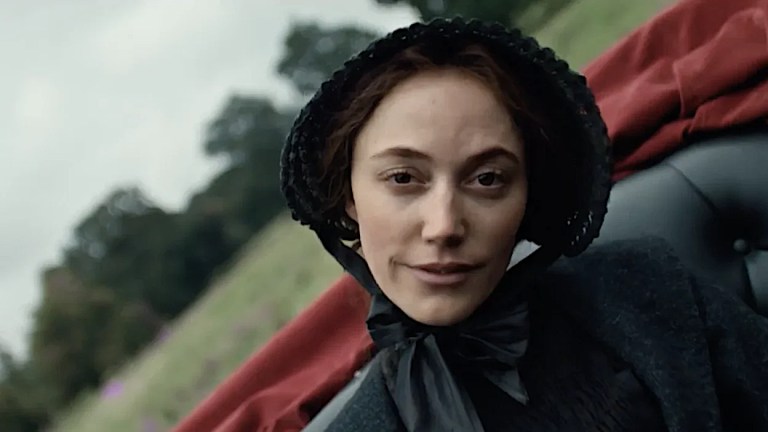
Director Zachary Wigon was already in Ireland scouting locations when Maika Monroe was cast in the role of Winifred Notty, the eponymous (and positively deranged) protagonist of Victorian Psycho. As befits her film’s title, Winifred is doleful in that way distinct to 19th century literary heroines; she has a penchant for walking along English moors and woodlands; and she’s absolutely, deliriously batshit unhinged when she gets her hands on axes, knives, or just an earnest young charge who she warns should call her Fred.
“Fred is not a lady’s name!” the child incredulously replies to his governess. “But Fred is the name of the demon that lives inside me,” she sweetly answers back before snuffing out the lad’s lonely, flickering candle.
For Monroe it’s one of the most daring high-wire acts of her career thus far, a character she describes as miles away from many of her traditional protagonists and real-life inclinations, perhaps better represented by the resolute and haunted FBI Agent Lee Harker in Longlegs, or the seemingly doomed, sensitive soul who contracts a supernatural disease in It Follows. And as she tells us on the eve of Victorian Psycho’s release, “A lot of the roles that I have done in the past are a bit more internal, and this was really having to go for it in a very external physical performance. So that was nerve-wracking, for sure, because it was absolutely out of my comfort zone.”
Hence the Zoom calls with her director, which led to the pair workshopping facial tics, frenzied movements, and the type of bold choices that harken back to an almost silent, expressionistic era of acting. “We had so much fun because we would be doing different crazy faces and body [contortions],” Monroe adds. “And then there was the one look I had where my eyes are rolled back, and I just remember, Zach went, ‘That’s it! That was it!’”
If you’ve seen the Victorian Psycho trailer, you already know the countenance: a slanted posture, a lowered brow, and a crooked smile portending ill intent.
“She was cycling through,” says Wigon with a wry smirk of his own, “She was like a slot machine, and Maika’s face would suddenly be like this and then that, and I’m watching [before saying] That one! Stop!”
It’s a big swing and one that pays off in the way certain movie maniacs of yore have entered the public consciousness. Victorian Psycho is not shy about its influences either, with a title echoing Anthony Perkins in Alfred Hitchcock’s Psycho (1960) or Christian Bale in Mary Harron’s American Psycho (2000). It was one of the initial appeals for Wigon when author Virginia Feito sent a first draft of her Victorian Psycho manuscript to Wigon to read. He agreed to give notes on it as a favor for a friend, but he proved so captivated by the novel that he encouraged Feito to also turn it into a screenplay, not least of all because it offered a female performance the fun of cinematic madness.
“One of the pleasures of the movie is being able to see a character who is typically in a caretaker role,” says Wigon. “You think about the governess role and obviously you think about The Innocents. It’s this woman’s role to take care of these children—one of the pleasures of the movie is the kind of intense, unnerving quality you get from recognizing that this character, who is serving that function, is actually the threat this time.”
Even the outre nature of Monroe’s choices echo the type of real-world horrors that are usually associated with men.
Wigon notes, “There was this video I sent Maika where this forensic psychologist is breaking down an interview that Ted Bundy gave, and basically the forensic psychologist will pause the video every minute or a couple of minutes, and they’ll talk about what he’s doing with his facial tics and expressions and gestures, how these things are cutting against what he’s actually saying in the course of the interview. We had these kinds of conversations that maybe was the germination of what Maika was then able to embody in all these wonderful, physical ideas that she brought to the table.”
It’s a choice that has earned Monroe raves out of genre-leaning festivals like Fantastic Fest, and comparisons to another actor who draws heavily on silent and expressionistic cinema, her Longlegs co-star Nicolas Cage.
Says Monroe, “He’s one of my favorite actors because I think all his choices are so interesting. You even see him in a rom-com, and I can’t take my eyes off of him because he’s so intriguing, and that was a definite influence for this character.” The star even seems to take special pleasure in comparisons to her performance and what Cage did in Vampire’s Kiss nearly 40 years ago.
Still, it’s a film designed to reflect the era it is set in, and the tension between expectation and being true to thine own (dark) self.
“So many of the beliefs of that era are so wild to think about now and were widely accepted at the time,” Wigon considers. “The first thing I always think about is that the Victorians believed that women couldn’t exercise too much because if they did, their uterus might fall out. That was one of the beliefs that they held at this time.” It’s a notion his leading lady mirthlessly chuckles “really sticks with ya.”
But in that context, the movie’s dark comedy becomes about a friction, or as the director says, “a dance between two aspects that’s essential to every moment of violence: you feel her trying to hold back the tide before it unleashes.” That delayed release, and the gratification that comes afterward, is its own kind of psychotherapy.
Victorian Psycho goes berserk in cinemas beginning on Friday, Nov. 13.