The 13 Coolest Looking Werewolves in Movie History
It’s the spookiest week of the year, and we’re counting down the werewolves who wore their fur—and fangs and frenzied rage—best.

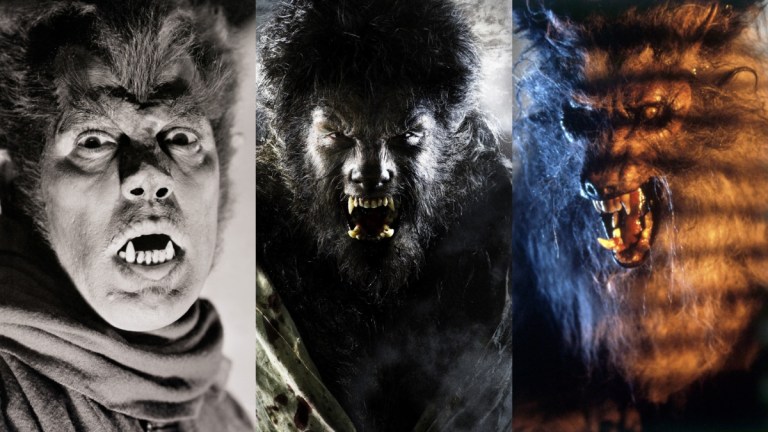
There are certain rules you need to know to survive a horror movie. Jamie Kennedy’s Randy Meeks codified them for a post-slasher world in the 1990s via Scream. But if you’re a fan of far more classic cinema—or the lore that inspired it in the case of Robert Eggers, director of this Christmas’ Werwulf—then there are even more foundational commandments that should be obeyed: Beware the moon, stick to the road, and whatever you do, don’t go investigate that howling out on the moors.
More than any other mythical creature of legend this side of vampires, the werewolf is the monster we most associate with spooky season and Halloween. The concept goes back to the Ancient Greeks if not further, with the dread of transforming into a beast tapping into something literally primal… and perhaps seductive to a certain point-of-view. In the last century of moviemaking, the canon has been especially crystallized: the silver bullet (or weapon), the fear of wolfsbane, and of course the full moon. And yet, despite that general universality, the look of the werewolf has evolved and changed through the decades, with bipedal and quadruped lycanthropes alike earning their fans and detractors. But which is, purely aesthetically speaking, the coolest looking furry monster?
This Halloween, we’re going to determine exactly that with the below ranking of the fiercest, scariest, or just outright fun werewolf designs to bare their fangs on the big screen…
13. Bram Stoker’s Dracula (1992)
We start this one with a cheat since, technically, Gary Oldman plays a vampire and not a werewolf in the misleadingly titled Bram Stoker’s Dracula. However, at the same time, Francis Ford Coppola was faithful in acknowledging that Irish author Stoker really did conflate vampirism and werewolfism as one in the same in his book, as did some folklorists before him. On the page, the literary Count Dracula would seem to turn into a literal wolf from time to time. But in this film, Coppola being Coppola, means Oldman’s Count turns into a bestial horndog.
The makeup team of Greg Cannon, Michele Burke, and Matthew W. Mungle won an Oscar for a reason on this movie, and there is something appropriately retro in the modern age of prosthetics and dawning CG that Coppola essentially did a throwback design to Jack Pierce and The Wolf Man, except he covered Gary Oldman head-to-toe in fur since this monster is as much a lothario as he is lethal. Fun fact: he’s also the werewolf design that most haunted modern horror director Eggers, who said “I saw him ravaging Sadie Frost on that bench, and I was way too young to see that, and it was pretty scary.”
12. Van Helsing (2004)
For readers who were an impressionable age in 2004, we suspect this could be the gold standard. There’s no denying that the general design of the Wolfman in Stephen Sommers’ Van Helsing is fun, combining the far more lupine features of modern movie werewolves with the bipedal posture of its namesake.
That blend of old and new earns Van Helsing a place on this list, but honestly the creature is just a little too garish in its CG appearance to be higher up in the ranking. Whether it’s the early Wolfman that Hugh Jackman puts down in the movie or the midnight-hued iteration our heroic Van Helsing in turn becomes at the end, both look more like cartoons than creatures of terror.
11. Cabin in the Woods (2012)
Here we admit is a deeper cut considering how minor the werewolf is in the absolute monster mash madness of director Drew Goddard’s Cabin in the Woods. Beginning ostensibly as a satire of the “deviltry in the wilderness” branch of horror—think Evil Dead or The Hills Have Eyes—the film, which is co-written by Joss Whedon, turns into a cacophony of every trope and cliché in horror, complete with killer clowns, unicorns, and even an honest to Cthulu merman.
In this context, the werewolf gets both a small but pivotal role, as it and not-Pinhead are the third act creature reveals that let our surviving heroes realize how doomed they are. The werewolf also gets to be the beastie that later seals that fate when it mauls Kristen Connolly’s not-so-nice Final Girl in the movie’s blood-soaked climax. And as realized purely with prosthetics and animatronics, it’s pretty badass. Pity it’s not in the movie more.
10. The Werewolf of London (1935)
If we were ranking purely based on iconic status, Henry Hull’s grandaddy of Hollywood lycanthropes would be closer to the top. There is something, indeed, unforgettable about what Jack Pierce admirer Rick Baker calls “the Elvis of Werewolf Designs” because of the monster’s widow-peak rising back into a quasi-pompadour. This is apparently because actor Hull did not want to sit in makeup artist Pierce’s chair for as long as Boris Karloff did to become the Frankenstein Monster or the Mummy a few years earlier.
Furthermore, the screenplay of Werewolf of London is also a curiosity. Before its far more famous Universal Pictures stablemate redefined the werewolf archetype six years later, this film points to how nebulous the mythology around werewolves still tended to be. So Hull’s lycan can (at times) speak and otherwise strategize when he dons a cap and scarf to conceal his furry intentions. He’s more Jack the Ripper or Mr. Hyde than a bestial id, more man than wolf. But that adds to his charm as being a kind of outlier in the subgenre to this day.
9. Curse of the Werewolf (1961)
Did you know Oliver Reed was a werewolf? Of course you did, but we mean he played a literal one too for Hammer Studios! Curse of the Werewolf is a strange work. It’s loosely adapted from the far better (if still grotesque) novel The Werewolf of Paris by Guy Endore, but its medieval concerns about generational evil and the sins of the father being passed down are turned mostly into misjudged Hammer titillation mingling with stories of rape and incest.
Be that as it may, this was Hammer’s one stab at the werewolf movie, and when it finally gets to the moment where Reed wolfs out, it is indeed a B-movie delight with Roy Ashton’s more barbaric makeup design vaguely evoking Lon Chaney Jr. while adding sharper fangs, heavier fur, and of course brighter red blood, as is Hammer’s wont. It’s an iconic look for the bipedal wolfman that needed to be in this movie more.
8. Dog Soldiers (2002)
What if we did Aliens but with werewolves in Scotland? That very well could have been the elevator pitch for Neil Marshall’s Dog Soldiers, a movie where elite British soldiers attempt to get a little practice done in a remote corner of the Scottish Highlands, and instead find themselves trapped in a house surrounded by lycanthropes. There is just a bare minimum of emphasis on transformation or the tragedy of becoming a monster. Otherwise, this is balls-to-the-wall, guns blazing action-horror.
That remove from typical werewolf movie tropes is perhaps why the monster designs are so joyfully gnarly. With a minimum of fur on the legs, but a maximum amount on prosthetic masks that look as if a horse joined a glam metal rock band, these things are devoid of all humanity or reality. They also look sick as all hell when trying to burst through a window like a full-moon xenomorph.
7. Underworld: Evolution (2006)
If we’re being honest, the Underworld movies haven’t aged great. Definite products of a mid-2000s, post-Matrix and concurrent nu-metal leather aesthetic, they’re a ridiculous product of their time—although one with a bemusing sense of commitment to them, with the casts being littered with Shakespearean thespians spouting pseudo-Shakespearean nonsense. And the early installments at least remembered their first and most important edict: it must all look kewl!
The werewolf designs in the original Underworld by Patrick Tatopoulos are the more original, with these lycans (and henceforth only “lycans” since someone at Screen Gems apparently deemed the term “werewolf” to be goofy) looking closer to hairless cats than canines. But it’s in the sequel film Evolution that we get the best of both worlds. The main lycan in question, a tundra-hued polar bear of a menace named William, is nothing short of fantastic in appearance. In the same era as Van Helsing and Twilight’s all-CGI werewolves, here was a throwback to ‘80s prosthetic mastery; a beast purely defined by wolfish features that can switch between two and four legs depending on the situation. If only the rest of the movie could’ve been just lycan this.
6. The Company of Wolves (1984)
Admittedly this one is another bit of a cheat where we’re ranking for the extended, mid-transformation appearance more than the final shape, which in this Neil Jordan cult classic essentially becomes just a gray wolf. Nevertheless, entire scenes are played out before that moment, particularly near the end with Micha Bergese’s worldly French traveler revealing what big, lustful eyes he really has for Sarah Patterson’s young Rosaleen and her little red-riding hood.
All unsubtle Freudian metaphor for the dangers of dawning desire, particularly for young women raised in a patriarchal society, there’s something simple but psychologically profound about the werwolf in this film being a bare-chested predator with long hair, preternaturally luminous eyes, and very, very big teeth. It might not win an Fangoria award, but it is perhaps the most threatening silhouette on this entire list.
5. The Wolfman (2010)
Rick Baker might just be the Michelangelo of werewolves. He certainly designed the definitive transformation for one in the unforgettable An American Werwolf in London. He also riffed on his idol Jack Pierce’s “Elvis Werewolf” design when he lightly turned Jack Nicholson into a furry via Wolf (1994). Baker even gave us Michael Jackson’s were-cat in the “Thriller” music video! But it was right before retirement that he returned one more time to the screen for the most pure tribute to Pierce in his career, The Wolfman (2010).
A flawed but, we’d argue, fascinating movie, this troubled production featured an absolute flawless throwback to early and mid-20th century werewolf movies when Baker turned Benicio del Toro into an even hairier monster prowling the streets of Victorian London. It is probably the most sophisticated iteration of the classic movie monster silhouette. The claws are longer, the fangs scarier, and the clothes far more ripped and bloodied. Yet it is perhaps so well-done—and also so clearly a mask near the end when del Toro needs to emote more than pure rage while circling Emily Blunt—that we keep it a little lower than its paterfamilias namesake.
4. Ginger Snaps (2000)
Curiously there are not a lot of female werewolves in fiction. Be it movies, TV shows, or books, even subcultures of lycanthropes are typically depicted by male-dominated demographics. Think Twilight, Underworld, Van Helsing. That makes Ginger Snaps doubly special considering it not only centers on a she-wolf of the Great White, Canadian North, but it uses the concept as a coming-of-age allegory for young women in general and those who might identify as queer or LGBTQ+ in particular.
It is probably for that reason the designs in Ginger Snaps are so outside-the-box. We admit we’re ranking more for the mid-metamorphosis appearance of Ginger Fitzgerald (Katharine Isabelle), who spends most of the film becoming her bloody best self after being mauled by a werewolf that scented out her first menstrual cycle. Midway through the film, Ginger embraces her bad self with a monstrous face and ghostly white-streaked hair cascading in waves down her face. Later on, she is replaced by a full bear-sized quadruped which also is pretty damn nifty as well as it tries to spread the liberation.
3. An American Werewolf in London (1981)
If we were ranking werewolf transformations, this would be number one with a bullet, silver or otherwise. In fact, it is! But if we are ranking purely based on the scientific metric of “what looks coolest,” we suppose we have a bit of a bias for bipedal beasties, as we’ll get to in a moment. Nevertheless, there is no denying that Rick Baker and John Landis’ vision for a four-legged “hound from hell!” is the definitive rendition of a quadruped werewolf.
Entirely the creation of animatronics and creature-shop design in his final form, this culmination of David Kessler’s carnivorous lunar activities is a tour de force in the golden age of horror movie special effects—as well as the first film to win a competitive Oscar for makeup, albeit more so for the aforementioned transformation sequence. Once David (who is played by David Naughton) is fully wolfed out though, his eyes glow with yellow anger, a single fang is big enough to crush an entire jugular, and the way the creature is only teased while stalking down a tube station at midnight is the stuff of nightmares. By the time he is turning Piccadilly Circus into a slaughterhouse, we view the creature in all its glory. And you know what? It still holds up.
2. The Howling (1981)
Here is what I’m sure is a controversial take. While An American Werwolf in London is the winner in terms of transformation sequences and arguably quality between 1981’s two seminal lycanthrope flicks (or three if you count Wolfen), Joe Dante’s The Howling is still a hair-raising triumph. And… if we’re being honest… the werewolves are kinda cooler looking.
That might be sacrilege around some parts, but Rick Baker’s protege Rob Bottin did a phenomenal job in his own right staging the second best transformation sequence in cinema history. Also by nature of Dante going for bipedal werewolves, Dante/Bottin’s have a more classical appearance, even deliberately evoking the Walt Disney design of the Big Bad Wolf from 1933’s “Three Little Pigs” short, which Dante uncomfortably makes explicit by intercutting the cartoon with a sequence of his own Big Bad Wolf brutally murdering the film’s most proactive character. Furthermore, we get two radically different werewolf designs for the price as one when Dee Wallace’s heroine also transforms in the movie’s final scene into the most teary-eyed tragic riff on the famed Jack Pierce Wolf Man design out there. Speaking of which….
1. The Wolf Man (1941)
This will undoubtedly earn ire from some corners, but sometimes it’s a classic for a reason. Jack Pierce’s legendary application of yak hair to Lon Chaney Jr.’s face, hands, and feet is not the scariest werewolf we’ve ever seen, nor the most ferocious. But for the better part of a half century, it was the yardstick they were all measured against. From Oliver Reed to Michael Landon in I Was a Teenage Werewolf (1956), to the entire cottage industry Paul Naschy created in Spanish Wolf Man knockoffs, this was the gold standard.
So when it comes to spooky season, there remains little as charming or seasonally appropriate as the shots of Chaney in his full furry regalia, stomping through fog-choked soundstages and their spray painted trees, looking for a throat to rip. By maintaining Chaney’s physical form, eyes, and even his clothes, we see both the actor’s humanity, as well as the tangible rage only someone familiar with losing himself to demons can conjure. There’s a devilish sense of fun to this werewolf, as well as a crueler energy, both pitiable and perilous. Nearly 90 years later it still shapes how we hear the call of the moon.