Christopher Nolan’s The Odyssey vs. Homer’s Epic Poem: What Are the Differences?
We unpack the biggest changes and most seismic tonal shifts from Homer to Christopher Nolan in The Odyssey.

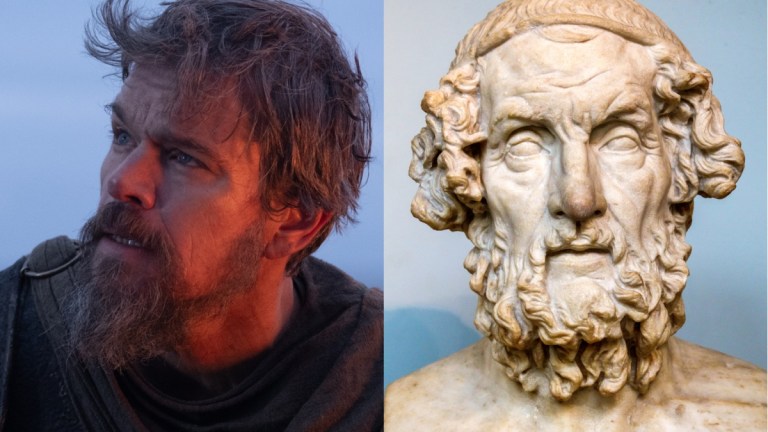
This article contains major The Odyssey spoilers.
In more than a few ways, The Odyssey feels like a film Christopher Nolan has been working up to his entire career. At least three of his most popular movies are the story of a husband or father trying to reclaim their idea of home after leaving for long stretches in order to do great, terrible things. And what is Batman but a guy unable to find a domestic peace, whether in Gotham or far from it, after his family was stolen?
So Homer’s epic poem Odyssey (or Odýsseia in the original Ancient Greek) proves not only foundational for Western literature writ large, but also the very intimate muses that drive Nolan. What might surprise viewers who never read a translation of Odyssey—or only have dim memories of the cyclops and Sirens from early school days—is that right down to Homer’s original structure, the story intrinsically lends itself to Nolan’s instincts.
Like many of the director’s films, the epic poem from the 8th century BCE is a nonlinear tale that begins near the end, with Odysseus long absent from his throne on Ithaca and his beloved wife Penelope (Anne Hathaway on the screen). Meanwhile the Greek king has for years lived lost in a kind of delirium on a remote island with the sea nymph Calypso (Charlize Theron in the new movie). Odysseus (Matt Damon) is then forced to relive his memories—although the circumstances of why changes radically in adaptation—and revisits his past in order to return home, much the same way that Leonardo DiCaprio’s Cobb confronts what happened in his own life during Inception.
In retrospect, it probably shouldn’t have surprised us so much that Homer and Nolan fit each other. Even so, changes were made, characters omitted, and paradigm-shifting subplots added. So what are the major differences between Homer and Nolan’s tale of one man’s voyage after the Trojan War? Well…
The Islands Not Visited
It would be impossible to list every minor shift made by Nolan in the adaptation process, not least of which includes far more modernized dialogue, but there is also a danger of taking a too sweeping overview. From a gods’ eye vantage, The Odyssey (2026) is remarkably faithful to the basic plot credited to Homer. Still, there remain acute changes with profound ripples.
In terms of the overall structure, nearly every island Odysseus visits in the poem appears onscreen, as do most of the key threats: the cyclops named Polyphemus, the alluring Sirens who draw men to their deaths, the sea monsters Charybdis and Scylla—the whirlpool and multi-headed beastie that devours six of Odysseus’ crew—and even a detour to the edge of the world and mouth of Hades.
Yet there are a few exceptions that even Nolan couldn’t squeeze into his swiftly edited three-hour epic. The most notable is the Phaeacians from the island of Scheria. In Homer’s text, it is on their shores, and not Ithaca, that Odysseus washes up after abandoning Calypso to travel by raft. This actually occurs near the start of the narrative since a beaten but apparently quite sexy Odysseus charms the Phaeacian princess Nausicaa, who takes him home to her parents. They wine and dine Odysseus and after hearing a poet romanticize the fall of Troy, he weepingly reveals his identity and then tells the story of his misadventures at sea. This is how the reader/listener learns of most of the misfortunes, from giants to a sun god’s cattle.
It is clear why Nolan cut this: it would be yet one more stop on an already long journey. Furthermore, this one seems to exist so Odysseus has a great banqueting hall to recount his story of monsters and gods before. In Nolan’s film, Odysseus is instead forced to painfully remember these details to Calypso as a kind of detox from the Lotus flower. Nonetheless, its inclusion in the poem is key to the larger theme about guests’ rights. The Phaeacians treat Odysseus with hospitality and are the ones to eventually sail the forlorn Greek back to his homeland with treasure to boot—an act that angers Poseidon so greatly that their island is cursed for helping Ithaca’s rightful ruler.
Similarly missing is Odysseus’ crew having a run in with the Lotus flower at the start of their travels. Its omission is perhaps to spare a certain redundancy with Odysseus’ own later addiction to the plant, but before even the cyclops, Homer briefly acknowledges the crew arrived on Djerba where they met the famous Lotus-eaters, who drift through eternity with empty heads while eating a flower as sweet as honey. At the time, Odysseus does not partake and admonishes his crew for doing so and forgetting their home. Just as he must later reprimand them when Aeolus, King of Aeolia, gifts Odysseus’ fleet a bag containing such strong winds that it would carry them all the way to Ithaca, defying the gods’ wills. Alas, his crew opens the bag when Ithaca is within sight and they’re blown wildly off course.
In the same vein, the exploits of Telemachus, Odysseus’ son played by Tom Holland, are condensed with the young man simply meeting Menelaus and Helen in Sparta in the new movie. In Homer, he first meets with the far wiser King Nestor in Pylos, who advised Agamemnon during the Trojan War and was second only to Odysseus in wits, before traveling on to Sparta (which, for the record, is landlocked and not on the water).
What’s in a God or Monster?
The perhaps biggest visceral change, then, is not the overall plot or scope, but how Nolan interprets ancient mythology for a modern audience. In other words, how his film tellingly begins with the words “In a time of apparent magic.”
There is indeed just enough wiggle room to suggest plausible deniability for much of the magic and “supernatural” elements we see in the film. While there is a cyclops and all the rest, we only learn of this from Odysseus as he is trying to mend his shattered mind with Calypso. An interpretation could be made that he is an unreliable narrator. We certainly can confirm that the version of Athena, goddess of wisdom and strategic warfare, is a manifestation of Odysseus’ own guilt. As revealed at the end of the movie, the goddess, whom only Odysseus can see walk by his side, is a projection of a young Trojan woman played by Zendaya. She is also the woman Odysseus witnesses being murdered by his countrymen on the night Troy fell, and right at the moment a statue of Athena is desecrated.
Personally, I reject this Rashomon-like interpretation. Every time justice is threatened or meted out in the “present” of the story, an approving rumble of thunder bellows from Zeus’ sky. It is the same thunder on a cloudless day that causes Calypso to accept she needs to stop feeding Odysseus the Lotus, meaning she only lets him go because Papa Zeus commanded it.
With that said, the gods are very real in Homer’s Odyssey and frequent supporting characters. Right down to being able to survive fighting the 108 suitors almost single-handedly (though in the original, Odysseus’ son and loyal swineherd slave also helps out), Odysseus is blessed with Athena’s company and aid. Athena is also visible to mobs who want Odysseus dead at various points, as well as to Penelope and Telemachus at times (though she takes different forms as disguise). The raging Poseidon and the largely apathetic Zeus appear frequently in the text.
Furthermore, the fantasy elements that Odysseus recounts in both versions of the tale are far grander and/or weirder in Ancient Greek. Not only can the cyclops speak like the movie, but he has jaunty conversations (at least in his view) with Odysseus. His name is Polyphemus and he likes to ask the Greeks he eats over his roaring fire, including when he asks Odysseus his name. Odysseus, ever the trickster, says, “I am called Noman.” So when Polyphemus is blinded, his cycloptic neighbors living further up in the hills of that island come to his blocked cave dwelling to answer his screams. “Polyphemus, who has hurt you?” they ask. He shrieks, “No-man has hurt me!” So they shrug and leave.
Ain’t that Odysseus a stinker? (His real mistake is then boasting after his escape to the blinded giant that he is actually Odysseus! Son of Laertes!! King of Ithaca!!! Oh, dear.)
Calypso lives in far grander luxury as a divine sea nymph, as does Circe. In fact, one of the years Odysseus loses is because he spends 12 months making love to a far more comely Circe in her palace after she turns his men back to humans. Frankly, I prefer the folk horror nightmare version played by Samantha Morton…
The Women of Troy and Greece
The change of Circe from seductive, if dangerous, goddess to brooding witch belies one of the larger and most intriguing thematic shifts in Nolan’s vision of the tale: an emphasis on the tragedy of women living in Ancient Greece (or really any location and time in history). Homer’s Odyssey is relatively progressive for its era when compared to the all-male and hero-worshiping The Iliad (leading to theories they were written by different poets or based on different oral traditions), with the plight of Penelope front and center throughout Odyssey.
Even so, Penelope is glorified purely on her ability of being a true and faithful wife despite the temptation of her many suitors, just as Circe’s magic seems tied to her divine allure. By contrast, Nolan’s Circe is a woman who has clearly been wronged by soldiers and warmongers, insisting her magic doesn’t turn men to pigs but rather reveals their true nature. Others become deer or lions, but the men who sacked Troy transform to swine, and Odysseus doesn’t seem to dispute the point when she calls them murderers and rapists. This ties into Odysseus’ greater shame when he recalls the death of “Athena” before his eyes in a sacking that ancient Greeks like the poet we call Homer glorified as a conquest of many women taken into bondage and as prizes.
This is most amplified by the depiction of Helen in the film. Despite what Wolfgang Petersen movies tell you, Helen did not escape the fall of Troy and was instead taken back by her estranged Greek husband Menelaus. Other ancient storytellers acknowledged the tragedy of this, with Helen being one of the many doomed titular characters in Euripides’ The Trojan Women, written some 400 years after Homer. But in Homer’s Odyssey, Helen is a dutiful wife to Menelaus who refers to the war as a fight by Greeks “on account of my most shameless self,” and furthermore tells Telemachus she felt great gladness when Troy was sacked because she yearned for home after the “wrong that Aphrodite had done me in taking me over there, away from my country, my [daughter], and my lawful wedded husband, who is indeed by no means deficient either in person or understanding.”
Helen is, in other words, happy to again be Helen of Sparta and an apparent victim of the gods’ meddling in mortal affairs, condemned to love a Trojan prince only because of a spell cast by the goddess of love. In Nolan’s movie… not so much. Helen is obviously a captive in a hateful marriage with a spiteful husband who intentionally beat half her face to ruin. She also begs Telemachus’ forgiveness for all the horror that was wrought in her name.
Speaking of Agamemnon, as in all versions of the Trojan War—except bizarrely the 2004 movie—the great king of the Mycenaeans is among the first to return home… where he is promptly murdered by his wife Clytemnestra and her lover Aegisthus. In Homer, it is Aegisthus who does the final deed, but only with Clytemnestra’s approval and aid. Yet the way Homer and almost every ancient Greek text writes about the event sounds much more similar to Jon Bernthal’s Menelaus than the horror most modern readers/viewers have toward a Greek king who sacrifices his daughter for favorable winds. In the ancient mind, it’s an act of justice when their son Orestes killed his mother, as well as Aegisthus, in revenge for the death of a father.
Homer was not alone in this opinion. Sophocles’ Electra play positions the titular character and daughter of Agamemnon and Clytemnestra as a tragic but dutiful daughter who also rightly slaughters her mother—the fact that her “dear” father sacrificed her sister to the gods never even really enters the equation. In the ancient view, Clytemnestra is “the slut of a murderess” (as per the Samuel Butler translation of Odyssey). Conversely, in Nolan’s movie, it is the fact that Agamemnon murdered his own daughter which horrifies Odysseus and Penelope into accepting that he must go to Troy. Both are disturbed by the lengths this man will go to conquer the rival city-state. They also implicitly value women more than Agamemnon or his brother Menelaus. They certainly have a happier marriage.
The Legacy of the Trojan War and Odysseus
It is on the point of Odysseus’ values that we mark the greatest differences between text and screen. While in all tellings, Odysseus is the cleverest and most cunning of the Greeks, it is how he lives with that burden of greatness that strikes a far more poignant tone in the movie. The literary Odysseus is heartbroken and pained by his inability to get home, often lamenting his lot as a victim of the gods. But there is little in the way of introspection about his past deeds beyond mistakenly revealing his name to the cycloptic son of Poseidon. Whereas the core tragedy of Odysseus in Nolan’s movie is the bitter shame he feels over unleashing the beastliness of men onto Troy, particularly the dead city’s women and children.
Odysseus hides himself in disguise from Penelope and Telemachus when he finally returns home not to test Penelope as the ghost of Agamemnon suggests (and which his literary counterpart intends), but because he also wants to make sure he is not too much changed to be unworthy or unrecognizable to the wife he abandoned. It is only by her side he admits that by engineering his greatest trick, the wooden horse, he unleashed a new world of carnage and horror.
It doesn’t take much squinting to recognize the film as a companion piece to Oppenheimer, or even a sequel. Both star great men who are lionized for their brilliance and ability to win grueling wars, but the consequences of that victory are devastating and worldending. That is literally so in the case of Oppenheimer, even if no one has pushed “the red button” since 1945, but in this new Odyssey, the Trojan Horse and subsequent sacking of a civilization shamed the Greeks, making them crueler and more savage than when they left their homes 10 years prior. It is rather awkwardly posited by Odysseus to Penelope that the horse alone turbocharged the fall of their Mycenaean world.
The latter is based on real matters of antiquity, but not Homer. At the end of the Bronze Age, there was indeed a mysterious group called “people from the sea” by the only civilization to successfully resist them: the New Kingdom Egyptians. The Ancient Egyptian chroniclers didn’t know where they came from, although some were likely Greek, many more might have been from the Levant (modern day Lebanon, Israel, and Jordan), or perhaps Etruscans (Italy) fleeing famine.
What we do know is they sacked and slaughtered numerous Mediterranean ports and towns, including felling the Hittite Empire, who counted among its vassals the city-state of Troy. Ergo, Nolan is blending the real collapse of the Bronze Age into his story, suggesting the Greeks who came home from, or were inspired by, the Trojan War and the murder of that civilization were the “Sea Peoples” who wiped out neighbors, including fellow Greeks, casting civilization back centuries to a world of intellectual darkness and ignominy.
One need not strain to see the implications for our own decay of institutional virtue and civic empathy for our fellow man. Perhaps there’s a lesson in Odysseus’ guilt?
A Bloody Homecoming and Final Exit
The Ithaca side of Nolan’s Odyssey also mirrors Homer in many ways, albeit with cosmetic changes in the margins. Odysseus’ beloved dog Argos, who only appears right before his death after 20 years of waiting for his master on the page, becomes a genuine supporting character appearing throughout the narrative as the much abused punching bag of the suitors. (In both versions, Odysseus finds Argos wasting away on a dung heap.) We similarly have more flashbacks introducing Odysseus’ history with other characters he meets on his return, including most fatefully Antinous (Robert Pattinson’s snide ringleader of suitors).
Antinous is also the worst in the original text, however other than the suitor admitting to seeing Odysseus hunting once as a boy, he has no backstory with the Greek hero. In Nolan’s film, we learn that not only is Antinous a coward, but he literally bought his way out of a proverbial draft lottery by getting his shepherd’s son to take his place in sailing off to Troy. (To my knowledge Elliot Page’s character Sinon does not appear in mythology until Virgil’s The Aeneid 700 years after Homer, where he is the Greeks’ other great liar who knows very well that Greeks are in the horse but manipulates the Trojans.) One of the most satisfying elements of the film is Odysseus returning to Antinous his shame, which feels like it might have pointed meaning for real-life tough-guy strongmen who avoided drafts and civic duty in their youth…
Also shifted in the finale is the addition of Odysseus saving Telemachus from a trap laid by suitors near the strait of Ithaca. In the poem, it is at sea and Athena does the saving, but in the film we get a pretty satisfying if obligatory fight scene. Shortly afterward in the poem, Odysseus straight up admits he is father to the boy. Telemachus does not figure it out on his own, nor does Penelope who speaks with her husband in disguise as a beggar but fails to clearly recognize him, as she does in the film. (There is some scholarly debate on that last bit, but Penelope seems so shocked by the news of the suitors’ death when a servant wakes her from her sleep on the page that I don’t believe she knew.)
Furthermore, the literary Penelope decides to test Odysseus to make sure he is not a god in disguise after all the bloodletting, proving perhaps why she is a perfect match for this man. Her test amounts to her asking him to move their bed into the hall, which he says cannot be done since he carved it with his own hands from an olive tree that grew from the base of what is now their house. It’s honestly a cute bit of domesticity… but it only comes after horrible violence.
Much like the film, the climax is a total bloodbath that begins after every suitor fails to string Odysseus’ bow and fire an arrow through 12 metal axes, albeit on the page Antinous is the first to die instead of the last. Additionally, Telemachus and the loyal slave Eumaeus (John Leguizamo), as well as another servant, help fight and slaughter every single last suitor. They even take it further and hang by the neck each slave girl who lay with one of the suitors, killing 12 in all in the most agonizing and humiliating method Odysseus could conceive. In Nolan’s film, only one enslaved woman, Mia Goth as a nameless servant, is presumably killed in the melee, although we never see it.
What is strikingly different is the aftermath. In the poem, murdering these suitors becomes a mild concern: Odysseus should face judgment from his neighbors and subjects since many of the lads were Ithaca’s sons and brothers. So after reconciling with his father Laertes—who is also cut from the film in favor of only Penelope and Telemachus—all three generations of the island’s royal men proudly stand against their subjects, debating who shall be manlier in facing the mob. Luckily, Athena intervenes at Zeus’ behest, forcing all sides to make peace.
Even so, Odysseus confides to Penelope that after their reunion, he must soon leave again, as Tieresias foretold, and sail west until he finds a land so far from the sea, the people know not even how to mix salt in their food! There he must make a sacrifice to Poseidon to receive full clemency from the gods and the vouchsafe to live peacefully into old age by Penelope’s side on Ithaca.
In Nolan’s movie, Penelope joins Odysseus on his final journey west with the knowledge they will never return. This is because the father violated Zeus’ law by murdering the suitors, and many times more by conceiving of the Trojan Horse. It is thus his penance that, like Moses from a different mythology, he will never get to enjoy the promised land of home. Instead he and Penelope will live in exile and their son will assume his rightful place as king and heir. Meanwhile Greece will fall into the historical dark age we know came shortly after this story is set. It combines the history of the Bronze Age collapse with Nolan’s sympathy and judgment of great men who do terrible things.
Still, unlike the literary Odysseus, one senses he’ll never leave his wife again. And as far as Nolan movies are concerned, that is the happiest of endings. Maybe they’ll even end up drinking wine by the Arno River in Italy.
The Odyssey is in theaters now.