VisionQuest Explores the Tension Between Marvel Magic and Marvel Science
VisionQuest makes magic and science messy again in the MCU.

This article contains spoilers for VisionQuest season 1 episodes 3 and 4.
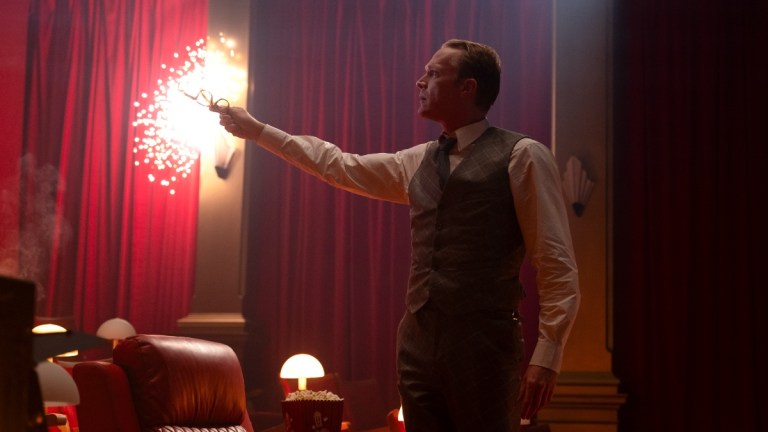
The third episode of VisionQuest ends with the titular synthazoid possessed. On a literal level, some aggressive program has hacked into his system and taken control of him, overwriting his code. Figuratively, however, the attack is depicted through classical horror movie tropes, with Vision floating in the air and wearing a look of shock, as if a demon has taken hold of his body. The next episode takes it even further, with F.R.I.D.A.Y. grabbing a Bible-like book off the shelf and reciting something that might be a ritual, and might be a reboot procedure.
The implication of anything magical comes as a surprise for a series about robots. Sure, there’s more fiction than science in Vision’s transformation from Tony Stark‘s AI J.A.R.V.I.S. to the self-aware superhero we know today, but he and Ultron have always presented themselves as logical and material. But VisionQuest is also the third part of a trilogy that began with WandaVision and included Agatha All Along, both shows mostly about magic. So by transitioning to the world of machines and artificial intelligences, VisionQuest reminds us that the worlds of magic and technology aren’t so far apart, at least in Marvel‘s eyes.
Science and magic have always been siblings in the Marvel universe, if not identical twins. As soon as the Asgardian gods were established as aliens in Thor, as soon as the Tesseract in Captain America was presented as a sort of distant science, magic and technology were treated as equals. Doctor Strange brought the point home with the explanation of the Mystic Arts that the Ancient One gave to Stephen Strange, then an avowed man of science. “The language of the Mystic Arts is as old as civilization,” she explained. “The sorcerers of antiquity called the use of this language ‘spells,’ but if that word offends your modern sensibilities, you can call it a program; the source code that shapes reality.”
Unsurprisingly, given Doctor Strange and the Ancient One’s foundational place in the MCU, the rest of the franchise more or less followed that explanation. When Strange or Thor or any other magic user cast a spell, they were basically accessing the source code of reality, changing that reality in the same way a technician would alter a program.
The world of Marvel Comics, however, has been much less defined. The Marvel Age of comics began in the shadow of the atom bomb and in the light of the Kennedy Administration, and thus, its original heroes featured scientists who used their intellect to advance the common good: Reed Richards, Tony Stark, Peter Parker, Bruce Banner, etc. However, when Steve Ditko introduced Doctor Strange in 1963’s Strange Tales #110, he threw much of that out of wack by making a character who walked between the two worlds, science and magic.
Strange is hardly a stranger in this regard. Several characters move between science and magic, none more so than the greatest villain in the Marvel Universe, Doctor Victor Von Doom. Doctor Doom came from a family of mystics, and studied under his powerful mother, Cynthia. As a young man, Doom rejected his mother’s ways to become a scientist, which is what brought him to the US, where he studied alongside Reed Richards. But when an experiment went awry and his face was damaged, Doom realized his mistake and embraced magic as well, drawing from both disciplines to achieve his ends.
Perhaps counterintuitively, people like Doom and Strange actually emphasize the separation between magic and science, rather than bring it together. Yes, characters can sometimes approach magic like a science and vice versa, as Reed Richards recently did in Ryan North’s excellent Fantastic Four run. But true mastery of the disciplines requires understanding their specific and very different needs. That’s why the Marvel Universe has two separate titles for the greatest masters, the Sorcerer Supreme for the one who has mastered magic and the Scientist Supreme for the one who has mastered science.
For the most part, the MCU doesn’t make those distinctions. That is, until WandaVision. Wanda Maximoff has always been an oddball, in both the MCU and the comics, because her powers never really made sense. In the comics, it took until the mid-2000s for someone to explain that she’s effectively changing reality when she casts a hex. In the MCU, Wanda started out with mind-control abilities in Avengers: Age of Ultron and now has reality-warping powers.
In WandaVision, and then in Agatha All Along, magic users disrupt technology and operate according to rules that make no sense to someone on the outside. Even if the shows don’t explicitly state it, the magical spells cast by Wanda and Agatha don’t feel like accessing the source code of reality, as the Ancient One said. They feel like something unknowable and strange.
Believe it or not, VisionQuest is only reaffirming this difference, even through its focus on AIs and machines. When F.R.I.D.A.Y. performs her exorcism in the latest episode, it’s very clear that she’s not actually using magic. She just makes it look like she’s using magic. And through that simulacrum, VisionQuest establishes that she and the machines are working in the world of science, a world that the MCU is finally making distant and unique from science. Well, that is, until Doomsday…
VisionQuest streams new episodes every Wednesday on Disney+.