VisionQuest Doesn’t Address the MCU’s AI Problem
In the Marvel Cinematic Universe, the only thing that can stop bad artificial intelligence is good artificial intelligence.

This article contains spoilers for VisionQuest season 1 episodes 1-2.
With few exceptions, the primary appeal of a new Marvel property is the way it expands the shared universe, bringing back old favorites with new characters. VisionQuest follows suit by giving Vision the spotlight and pairing him with his creator and arch-enemy, the evil robot Ultron. But VisionQuest also puts a twist on the formula by bringing back names we know with faces we’ve never seen before.
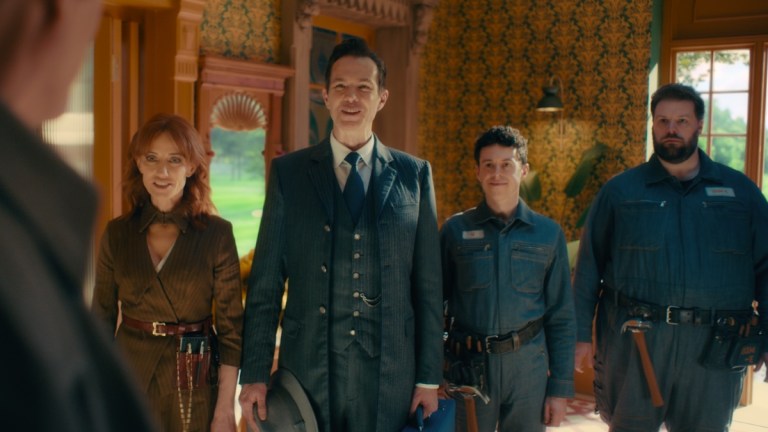
D.U.M.-E. And U, robotic arms who have lived in Tony Stark’s shop since the first MCU movie Iron Man appear as handymen played by Henry Lewis and Jonathan Sayer. Tony Stark’s second AI assistant, F.R.I.D.A.Y., originally voiced by Kerry Condon, appears as Orla Brady, while E.D.I.T.H., the glasses at the center of Spider-Man: Far From Home, is now a spunky security chief portrayed by Emily Hampshire. Even James D’Arcy returns as Jarvis from Agent Carter, though now as an AI butler. Fun as it is to see all these actors on screen together, the reunion has another, more chilling effect, reminding us that the MCU is filled with AI—and it’s becoming more of a problem each year.
Not-So-Marvelous Optics
The problem of Marvel’s addiction to AI was particularly evident in the biggest movie of 2026, Spider-Man: Brand New Day. Director Destin Daniel Cretton and star Tom Holland touted the movie as a return to Spider-Man fundamentals, bringing Peter Parker back to the low everyman he has been in the comics, now separated from his friends and Stark’s fortune. But as much as Peter broods in a dingy (but really spacious) New York City apartment, he’s never really alone. He has AI E.V. (Naomi Watts) to talk with and offer advice.
Brand New Day isn’t the first time that ol’ Pete has had to fall back on an AI. In Spider-Man: Homecoming, he had a nice, long heart-to-heart with Karen (Jennifer Connelly), and he bickered with E.D.I.T.H. (first voiced by Dawn Michelle King) in Far From Home.
Although most egregious when applied to Spidey, AI use appears all throughout the Marvel Universe. Whether it’s T’Challa or Shuri, Black Panther relies on Griot (Trevor Noah). Before he became Vision, Paul Bettany played Tony’s closest confidant, J.A.R.V.I.S. The Life Model Decoys of the comics become fully synthetic AIs in Agents of SHIELD. Ironheart recovered her best friend via AI, when her operating system N.A.T.A.L.I.E. took the form of her late pal Natalie Washington (Lyric Ross). Heck, She-Hulk: Attorney at Law revealed that AI is even at the center of the entire franchise, when she went face-to-face with K.E.V.I.N., the “true” face of Kevin Feige.
Occasionally, the MCU does recognize that AIs aren’t perfect. The Hydra agent Arnim Zola corrupted SHIELD from inside when he became an AI in Captain America: The Winter Soldier. The cheery Miss Minutes went mad when defending the sacred timeline in Loki. And then there’s Ultron, who, of course, tried to wipe out all of humanity.
In short, the MCU thinks that AI can do great things, sometimes bad things and sometimes good things. And that’s the problem.
Artificial Integrity
But Ultron highlights the MCU’s overall approach to AI. AI is capable of great things, in the MCU’s imagination, both good and bad. But whenever the AI goes bad, there’s always a good AI there to stop it. Even better, the bad AI can be reformed, made better, and turned into a force for good.
We can see that tension at work in the two main characters from VisionQuest, Vision and Ultron. Obviously, Ultron tried to destroy humanity nearly immediately after his creation in Avengers: Age of Ultron. He was built to protect the world and, after studying the history of mankind, determined that the greatest threat to humanity was humanity itself.
Yet, even in those initial scenes, the good AI J.A.R.V.I.S. saw what he was trying to do and attempted to dissuade him. When that failed, J.A.R.V.I.S. became the Vision, and took more drastic steps. Age of Ultron made us believe that Vision took the ultimate approach to stopping Ultron by destroying him. But VisionQuest reveals that Vision merely destroyed Ultron’s body, and saved some of his code.
VisionQuest seems to want to tease out the reasons for saving Ultron’s code (beyond the very obvious reason that it’s fun to watch Paul Bettany and James Spader chew the screen together). However, even in these early episodes, we can tell that Vision wants to save Ultron, to reform him and turn him into a force for good. On the surface, we support that decision. Heroes constantly try to redeem villains and get them to help society. But Ultron isn’t a person; he’s an AI, which suggests that the MCU believes even when AIs go wrong and, say, try to kill every single human being on the planet, that’s just a bug, something to fix in the next iteration and update.
A Lack of Vision
Marvel Comics became huge in the 1960s because their heroes lived in New York City, not fictional towns like Metropolis and Gotham. They existed in what Stan Lee called “the world outside your window,” as if you could see the actual Spider-Man and Hulk in your city streets if you looked at the right time.
The more the MCU embraces AI, the more it turns away from the world outside our window. As much as executives love the idea of getting Claude and Gemini to write emails instead of paying someone to do it, and as much as your weird aunts and uncles enjoy making AI pictures of themselves hanging out with George Washington, the fact remains that the larger public is deeply skeptical, if not outright hostile toward the use of AI.
Marvel should know this, as they’ve been at the receiving end of some of that hostility. Amidst complaints about the unfair treatment of special effects teams, reports leaked that Marvel used AI to create the opening credits to its show Secret Invasion. Just months ago, people took to the internet to complain about “AI slop” in the art book for Spider-Man: Brand New Day.
Yet, VisionQuest seems blissfully unaware that anyone would think of AI as anything other than a cute lil’ helper, here to help you fulfill your dreams. And it’s making the MCU seem increasingly out of touch.
Apropos of the thoughtful hero at the center, VisionQuest raises big questions about identity and family and purpose. And, as a superhero show, it’s fundamentally concerned with right and wrong, good and evil. But the show’s stubborn refusal to direct any of those questions at the function of AI, something that is no longer a cute sci-fi fantasy, removed from actual existence, makes VisionQuest feel outdated, obsolete, and fake.
VisionQuest streams new episodes every Wednesday on Disney+.