VisionQuest: Paul Bettany and Terry Matalas Talk Ultron’s Return, Mindspaces, and Robot Families
VisionQuest showrunner Terry Matalas and star Paul Bettany discuss concluding Marvel's unlikely TV trilogy.

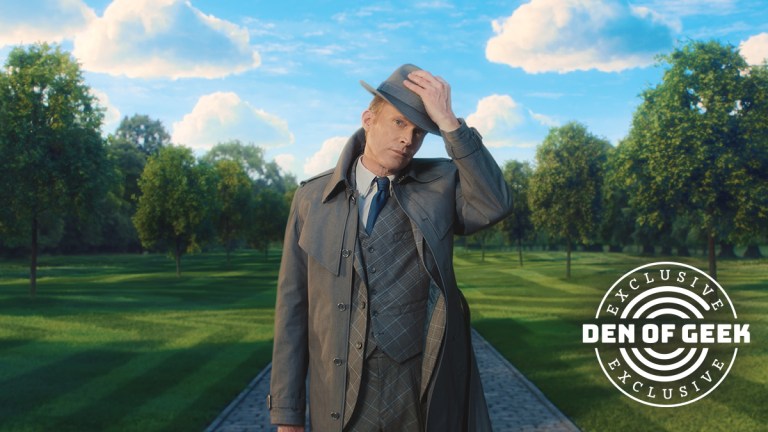
This article appears in the new issue of DEN OF GEEK magazine. Find out how you can subscribe to get the full physical copy right here!
The last time audiences saw Vision and Ultron together, the two of them disagreed. Convinced that humanity was doomed to destroy itself, Ultron (a synthetic big bad voiced by James Spader) tried to save the world by starting it over. Conversely, Paul Bettany’s altruistic Vision saw something beautiful in humanity despite—or due to—our failures. When Ultron sneers, “You’re hopefully naive,” Vision responds, “Well, I was born yesterday.”
Many days have passed since that conversation at the end of 2015’s Avengers: Age of Ultron, but that question lingers over Vision and Ultron’s reunion in the Disney+ series VisionQuest.
“That conversation is very much the launching point for the show,” series creator and showrunner Terry Matalas tells us. “In Age of Ultron, Vision wanted to be ‘a real boy.’ In VisionQuest, he’s not so sure it’s a good idea to be a real boy.”
The star, and a steward of Vision’s journey for more than a decade now, would agree. “VisionQuest is a mash-up of the Pinocchio and Frankenstein stories,” explains Bettany. “Vision’s having an existential crisis at the beginning of the show. He’s asking questions like, ‘Who am I? What am I for? What is my purpose? Who made me?’”
Set after the events of WandaVision, VisionQuest finds Vision (still Bettany) unsure of who he is. He was killed by Thanos, rebuilt as a mindless automaton by S.W.O.R.D., and received the memories of the Vision conjured back to life by the magic of Wanda Maximoff (Elizabeth Olsen). But this new Vision doesn’t feel like his old self. Hence the journey to determine a different identity. Helping him along is a collection of AIs he keeps in his Mindspace, a virtual mansion where he lives with the butler J.A.R.V.I.S. (James D’Arcy), personal assistant F.R.I.D.A.Y. (Orla Brady), security expert E.D.I.T.H. (Emily Hampshire), and handymen U (Jonathan Sayer) and D.U.M.-E (Henry Lewis).
And then there’s Ultron (James Spader), whose consciousness Vision has been keeping in the Mindspace since the events of Age of Ultron. Why does Vision keep Ultron around, and why does he consult the supervillain when going on his journey of self-discovery?
“Ultron’s been imprisoned for a long time and has been consuming humanity’s artistic efforts. He has a slightly different perspective,” points out Matalas. “But he’s also considering that maybe burning everyone to ash is still the best call.”
“Vision just thinks Ultron is interesting,” Bettany adds. “Vision is fascinated by Ultron’s chaotic impulses.”
As much as VisionQuest involves sentient robots, relentless bounty hunters, and the spirit of a magical boy possessing a speedster, at the center it’s about a guy trying to figure out his identity, all while dealing with his tumultuous father. In other words, VisionQuest is a very human story.
Pre-Visions
Fundamentally, every Vision story is a human story. Created by Roy Thomas and John Buscema for 1968’s Avengers #57, Marvel Comics’ Vision was an update of the Golden Age Human Torch, an advanced android that burst into flames when exposed to oxygen. When the evil robot Ultron wanted to emulate his creator, Dr. Henry Pym, a.k.a. Ant-Man, by making his own robot, he repurposed the Human Torch’s body into the red-skinned Vision.
Moreover, Ultron copies the “brainwaves” of the fallen Avenger Wonder Man, giving Vision the capacity to feel emotions. Of course, the plan backfired, and Vision turned against his creator, becoming a mainstay among Earth’s Mightiest Heroes.
Vision’s MCU origin more or less follows the same structure, just swapping out Hank Pym and Wonder Man with Tony Stark and J.A.R.V.I.S. 1.0. In both comics and live action, Vision is a thoughtful, inquisitive synthezoid… whatever that is.
“A synthezoid is an artificial human being!” Bettany declares with confidence. Matalas would agree with some added context.
“A synthezoid means that he’s not just a robot. There’s a consciousness and self-awareness to him that goes beyond your typical android,” the creator affirms. “He’s a self-aware artificial intelligence with a quantum computer for a brain, but he had human parents in some ways, with Stark and Bruce Banner. He also has a robot dad in Ultron. It’s a complicated question, which is the point of our show. He’s a character who is trying to decide how human he is and how much he’s still his older versions.”
It’s a question that Matalas has dealt with before, having come to VisionQuest from the highly successful third season of Star Trek: Picard, which brought back the android Data (Brent Spiner) and his positronic brain.
“I started having meetings at Marvel because Kevin Feige’s a huge Star Trek fan. It set up a great back and forth that continues to this day. Same thing with Brad Winderbaum [head of Streaming, Television and Animation at Marvel Studios],” notes Matalas. “Star Trek is your way into so many kinds of stories, because it offers reference points to big ideas.” That said, he does distinguish differences between each brand’s synthetic lores. “Data wasn’t a big influence on VisionQuest because, in a lot of ways, Vision is the anti-Data. Data always wanted to be human, whereas Vision’s a little bit more uncertain about it, especially when we meet him.”
Vision may be uncertain about his own humanity, but the person who plays him is not.
“I haven’t really troubled myself with trying to play a robot because they give me a costume and prosthetics that make me look like a robot. I’m quite lazy, so if the job’s done for me by the costume and makeup, then I get on with the stuff I have to do,” Bettany laughs.
Bettany makes that job sound easy enough. But then you remember his work involves going toe-to-toe with James Spader, and you realize the daunting task before him.
The Second Age of Ultron
Much of the first episode of VisionQuest involves Vision once again facing off with Ultron. But where they previously argued about the relative merits of mass genocide, Ultron and Vision now disagree mostly about the latter’s tendency to shut himself off from the world.
“You’re meeting the two characters when they’re on the fence about humanity. And Ultron might have a better perspective than Vision on what it means to be human at this point,” Matalas teases.
For that reason, Ultron had to be the central antagonist of VisionQuest, at least as far as Matalas was concerned. “I really didn’t know what else it could be,” he admits. “It was vital that Paul have someone of equal adult stature to play off against, and we didn’t have Elizabeth Olsen’s Wanda. So the only answer was Ultron.”
However, to get Ultron, Matalas had to get Spader, the performer who brought him to life 11 years ago but hasn’t returned to the MCU since.
“I flew to New York to have lunch with James and tell him this gonzo idea. I was told that I would be met with reservations about him returning,” Matalas confesses. “Whether or not that was true, I did go in with the fear that I could easily screw this up. But I just gave him my honest enthusiasm and started pitching some scenes. James immediately jumped into the process and started adding ideas. We immediately hit it off, and by the end of the lunch, he wanted to do it.”
Matalas’ commitment to bring back Vision paid off as soon as Bettany and Spader got on set together. “This show is a delivery system for everything you love about Paul Bettany,” Matalas promises. “Paul is a highlight in everything you see him in, and it felt so natural putting him front and center. It’s about time he’s been the focus, because he wears the hero’s cape so well.”
Indeed, Bettany has been part of the MCU since the very beginning, voicing Tony Stark’s original AI J.A.R.V.I.S. in 2008’s Iron Man. Yet Bettany’s characters have always been in a subordinate or supporting role, whether that’s advising Iron Man, standing alongside Wanda, or serving with the Avengers.
However, Bettany sees the Vision of VisionQuest as a new person with a different relationship from his previous incarnations. “Vision was really a big reset from J.A.R.V.I.S., because there was a birth in Age of Ultron,” he explains. “VisionQuest feels like a major reset too. When Vision was first born, he was both omnipotent and entirely naive, like a sort of omnipotent ingénue. That was fun to play, yet this is something different,” he observes. “I did go back and watch Vision’s previous appearances to remember his mindset.”
VisionQuest also offers a new challenge for both Bettany and Spader since Vision and Ultron often take human form, allowing the actors to share the screen without capes or robot prosthetics.
“There is a significant amount of time in the costume, and with new costumes and new makeup,” Bettany points out. “But it is more comfortable to play the part without the costume, and I think it’s a big part of Vision’s quest in the series. He’s trying to figure out who he is and to understand human beings. It makes sense that he would move through the world incognito, disguised as a human to further that quest.”
“You’ll definitely see plenty of robot action,” Matalas concurs. “But I just love it when you get to see Vision look like Paul Bettany. It’s a way to access the human side of these characters. There’s a story reason for Vision and Ultron to look like people, but ultimately I wanted to watch Paul and James chew the scenery, so that’s what we did.”
In fact, that desire to let his actors show off informed many of Matalas’ creative decisions. When it came to writing Ultron’s dialogue, the showrunner asked himself, “What do I want to hear James Spader talk about?” He adds with a laugh, “The best part of a James Spader performance—whether it’s Boston Legal, The Practice, or The Blacklist—is hearing him monologue about humanity and the things that plague us. [He] has a relentless enthusiasm for stirring the pot. I was ready for grenades, but he always had a ‘yes, and’ spirit of improvisation. James, Paul, and I never had a real, strong creative disagreement.”
Joining the Quest Party
It’s a good thing that everything is so copacetic behind the scenes of VisionQuest, because on the screen it’s all turmoil and chaos. Vision’s attempts to hide out and define his identity on his own terms get disrupted by the arrival of the relentless mercenary Paladin (Todd Stashwick).
Matalas promises, “Paladin’s going to be a really interesting point-of-view character because he allows us to consider what it means to be a bounty hunter in the MCU. It’s not an easy life, so we want to know what makes him tick.”
Joined by his sarcastic assistant, played by Diane Morgan of Cunk on Life fame, Paladin has potential to be a comedic buffoon, but Matalas insists that’s not the case. “He’s a guy with his own code. He’s committed to this bounty hunter life, for better or worse. But he doesn’t know how many years he has left to do this, and he’s thinking about what he wants to be and what he wants to pass down.”
Paladin actor Stashwick previously worked with Matalas on 12 Monkeys and Star Trek: Picard, and was the only choice to portray a morally complicated tracker. “Todd can play a monster, someone ruthless and by-the-book,” Matalas adds. “But he can still be likable and maybe even understandable. He has a dry sarcasm that grounds big ideas about hunting a robot, and that makes him easier to write.”
Further complicating things is the arrival of Thomas Shepherd (Ruaridh Mollica), a.k.a. Speed, a.k.a. Tommy Maximoff. Like his twin brother Billy, Tommy was created by Wanda’s hex to be her son with Vision. As we saw in Agatha All Along, when Wanda’s hex dissipated and the twins disappeared at the end of WandaVision, Billy’s soul entered the body of young William Kaplan, who became the superhero Wiccan. A similar thing happened to Thomas Shepherd in VisionQuest, something the show addresses head-on.
“We lean into the zaniness of Thomas’ story. It would be pretty screwed up to have the soul of some made-up entity drop into you,” Matalas observes.
More than just a matter of canon-keeping and faithfulness to the source material, Thomas’ plight ties into the central themes of VisionQuest. “This show has a lot of characters going through identity crises,” the showrunner notes. “You have Vision asking if he’s who he used to be, or if he’s something new. You’ve got Ultron wondering if he really wants to destroy the world, and you have this kid, Thomas Shepherd, who suddenly has all these memories of a life he didn’t live. I think that gives you a great family that’s trying to find itself.”
According to the writer, those questions of family, identity, and especially maturity drew Spader back into playing Ultron again: “James’ perspective was that the Ultron of Age of Ultron was a bit of a teenager, wrestling with others and petulant. The Ultron of VisionQuest is slightly older and wiser. That doesn’t mean he’s any less villainous, but it does mean that he has a more erudite and sophisticated take on humanity than he had previously.”
For Bettany, those themes also give VisionQuest a pressing urgency, especially to adolescents and young adults in the audience. “Vision has all these memories and no ability to connect them to himself. He feels alienated, and I think that’s what makes him interesting to young people. When you’re a kid, it is urgent business to discover who you are. Vision’s always in the process of change because of his super-intelligence and having a dizzying array of options. Young people today are faced with a dizzying array of options for how they identify themselves. So the major contract with the audience that the character of Vision makes is that he must always be in a moment of decision.”
That contract with the audience matters because VisionQuest doesn’t just set out to be a simple superhero story; it wants to tackle the ultimate mystery of what it means to be human.
Envision the Big Picture
Even though the series involves AIs figuring out how to be human beings, VisionQuest isn’t going to grapple with the real threat of artificial intelligence in our current society.
“This isn’t really the show to debate whether or not AI is going to take our jobs or siphon off our creativity,” Matalas says. “We’ve been working on this for almost two and a half years. By the time you write something, it’s immediately obsolete by the technology that’s come out. Just look at the advances in artificial intelligence in the last week. We would never be able to keep up, so it was never going to be that show.”
He continues, “VisionQuest does focus on our role as parents of this creation, and how it’s up to us to bring them into the world in the right way. There’s a family tree here from humanity to AI.”
Bettany also keys into the familial connection of this whole unlikely trilogy as one of its greatest appeals.
“This is a show about grandfathers, fathers, and sons,” the actor muses. “It asks big questions about identity and purpose in a really fun, adventurous way.” For him, the appeal of the MCU has always been balancing the big questions with the fun.
He adds, “I often think about the big swing that Captain America: Civil War took, asking whether the Avengers needed a governing body like the United Nations or if they had the right to unilaterally decide to invade another country and affect its political outcome. As we were going around the world doing press, Robert Downey Jr. would always come out on stage and ask who was Team Cap and who was Team Iron Man. Everywhere we went in America, two-thirds of the crowd were on Cap’s side. They believed we absolutely have the right and, indeed, we have the onus to police the world. And everywhere else in the world, it was two-thirds on Iron Man’s side. That’s fascinating. Of course, these are entertaining movies, but they also are a really broad church to have these kinds of discussions, in a fun way that I think was quite revealing.”
As Bettany’s observation reveals, messiness and complexity are essential parts of his character. Vision and Ultron may not know how they feel about themselves, each other, or humanity, but such disagreements aren’t flaws. It’s just who they are.
The first two episodes of VisionQuest premiere Wednesday, October 14 on Disney+.