Monarch: Legacy of Monsters Stars Kurt and Wyatt Russell Break Down Their Time-Bending Moment
The father-son duo talk getting to act together in Monarch season 2, even though they're playing the same character.

The following contains spoilers for Monarch: Legacy of Monsters season 2 episode 7.
Monarch: Legacy of Monsters has what is probably the best stunt casting on TV right now. This isn’t an insult, by the way. And not even entirely accurate; it’s actually more like a very human sort of special effect. The sci-fi series, which revolves around the titular organization that tracks the movements of Godzilla and other prehistoric Titans, spans two time periods and features several generations of a family whose origins are tied to its founding. And at the center of all of this is Lee Shaw, an Army officer who plays a key role in both of the series’ timelines, as the show explores questions of legacy, regret, loss, and sacrifice.
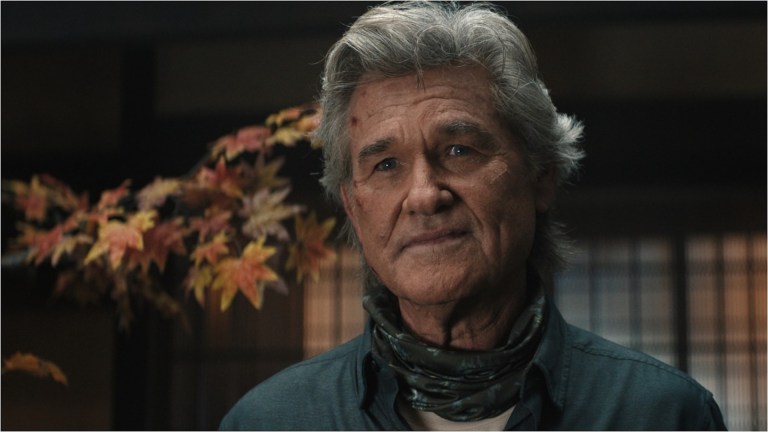
Father-son duo Kurt and Wyatt Russell play the character at two very different stages of his life: Wyatt as a younger Lee during the 1950s-set portions of the story, and Kurt as an older version forced to live not only with the consequences of his younger self’s actions, but the world that the Monarch he created has helped to make. The show has, obviously, leaned into the remarkable physical resemblance between the two Russells, but, and perhaps most importantly, it has also used their dual performances to craft a shockingly layered portrayal of a complicated man who sacrifices much of his life for the benefit of others.
The obvious downside to the fact that the Russells are playing the same character is, of course, that it means they can’t act opposite one another at any point in the show. Or, well, that would be the case if Monarch weren’t a series that’s proven itself willing to play fast and loose with the rules of time, space, and even physics at various points. In season 2’s seventh episode, “String Theory,” both versions of Lee manage to cross paths across multiple decades, and the older man must stop his younger self from rescuing Keiko (Mari Yamamoto) when he discovers that she, too, is trapped in the interdimensional portal realm known as Axis Mundi along with him.
“It was something we discussed even before we started shooting the first season. I was adamant about wanting something like this to happen,” Kurt Russell tells Den of Geek. “We actually tried something in the first season that was so powerful that they called me and they said, ‘We can’t do this. It just takes the whole show into a whole different direction.’ And then in season 2, I was once again immediately like, let’s make this happen. So we started talking about possible ways to do that, and the way they… what they came up with to do that was really right in the zone of what the show is. In the end, I really liked everything that episode 7 has to offer.”
“Sting Theory” takes full advantage of Legacy of Monsters’ time-bending premise to pull off a twist that would, on almost any other show, be impossible. While testing out his machine to summon Titans, Dr. Suzuki and the 2017 edition of Lee accidentally manage to contact the time-displaced version of Shaw’s younger self. Trapped in the mysterious portal realm after Monarch’s failed Operation Hourglass mission — the one we saw take place during the show’s first season that would ultimately cost Lee 20 years in the real world — the younger Shaw initially assumes he’s talking to his superiors before learning he’s speaking to his older self.
“We knew Kurt and Wyatt had always wanted to work together, and I think that this show was a really exciting opportunity for them in that regard,” Monarch executive producer Tory Tunnell says. “I don’t think they anticipated playing the same character, and they’ve had so much fun with that. You see Lee getting a scar in the past timeline, and then Kurt having the physical scar, of course. But you also see the emotional scars born of the past tense that carried into the present tense. We also knew that we wanted to get them onscreen together, which is a challenge when they’re playing the same person. So that was something we were thinking about. What do we have in our toolbox? Is there a way to achieve that? And [still] have it be something that doesn’t just feel like it’s a trick or an event for an event’s sake? But [this] actually feels really baked into our storyline; it feels inevitable that you would need a moment like that.”
And while their two versions of Lee are technically separated by both decades and an interdimensional rift, the actors playing the character still found a way to tie their performances together on set.
“It was cool,” Wyatt Russell says. “The way we did it was, I was there when he was doing his part, and we had this command trailer where you could see and watch, because it was important for us that we were in each other’s ear. Having nothing against the set PA was who was reading, but obviously it’s not the same. It doesn’t elicit the same responses. We had a lot of fun being there for the other while we were doing our respective lines.”
While the duo’s unexpected interaction is entertaining enough for fans from a meta standpoint, it’s equally important within the emotional context of the series’ second season, which shows us a Lee who not only acknowledges his love for Keiko, but recognizes that he can’t risk the future — not to mention the existence of her grandchildren — by interfering with the established timeline to to save her. (And prevent her from missing over fifty years in the real world.)
“It was one of my favorite moments, getting to work with Wyatt in that regard and also getting to connect that character to itself,” Kurt Russell says. “That’s one of my favorite moments of the whole season, and it’s when he’s running down the three things about why not to [interact] with Keiko. And his [younger] character is still struggling with the impossibility of this all taking place. It was three things, but instead of saying “and what’s the second one?”, he says “What’s behind door number two?” And it works because only Lee would say that. So when he hears that, he remembers so many more things, and it’s [confirmation] that this is actually taking place, it’s not some wild screw-up. It’s happening, and it has to be dealt with perfectly. Otherwise, it’s all over.”
The anguish inherent in this interaction — in which younger Lee must leave Keiko behind, and his older self must essentially force him to do it, despite knowing what she has meant and still means to him — is a lot. But it’s also the kind of storytelling that makes Monarch unique in both Legendary’s Monsterverse and TV’s larger sci-fi landscape.
“I think one of the things we were most proud of in season 1 is when people would say to us, ‘I came to watch a really fun monster show, and I didn’t expect to have a moment where I was almost crying,” Tunnel says. “I think having that tenderness is something we’re always looking to achieve, these really tender moments like this that will break your heart.”
New episodes of Monarch: Legacy of Monsters premiere Fridays on Apple TV.