Sinners Is More Than a Horror Movie, But its Not Less Than a Horror Movie
Sinners is a great horror movie, but it is a horror movie.

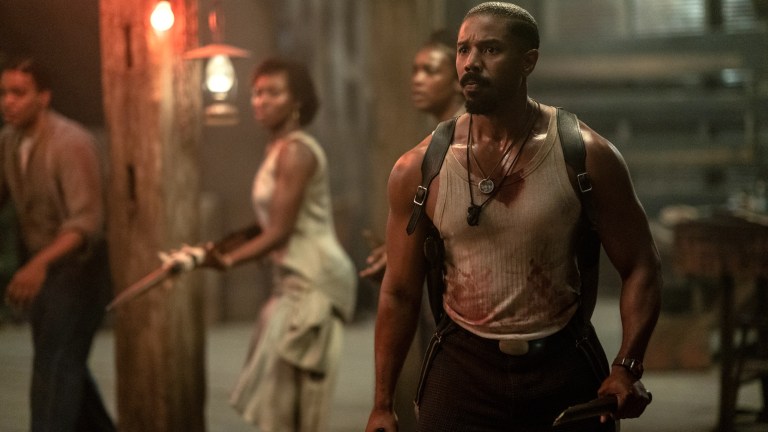
With a record-breaking 16 Oscar nominations under its belt and certainly some wins in its near future, Sinners has been at the center of cinephile discussions. As moviegoers think about what the movie means for the past and future of the medium, some have resisted the temptation to describe the film as a “horror movie.”
That group includes star Delroy Lindo, who earned a Best Supporting Actor nom for his turn as bluesman Delta Slim. “The vampire aspect is only one of [the various narrative strains in the movie], albeit a very fundamental and necessary component,” he told EW. “But I felt that the vampires represented outside forces infiltrating a community, and we see what happens as a result of that infiltration.”
Certainly, Lindo’s not wrong in his assessment. But horror movies have long used monsters to represent some sort of outside force or deeper issue. Sinners does it exceptionally well, but that doesn’t mean Sinners isn’t a horror movie.
Written and directed by Ryan Coogler, Sinners tells the story of twin brothers Smoke and Stack (both played by Michael B. Jordan), who return from Chicago to their Mississippi hometown in 1932 to open a juke joint. On its first evening, the juke is beset upon by vampires led by Irishman Remmick (Jack O’Connell), turning a night of musical celebration into a fight for survival.
As Lindo correctly notes, Remmick and his undead are just one of the threats that Smoke and Stack must deal with. Even before the vampires arrive, Smoke and Stack must deal with unscrupulous white people who, despite the insistence to the contrary, are indeed members of the KKK. Young Sammie Moore (Miles Caton) struggles with his father’s religious beliefs, alcoholism and war trauma wracks several of the characters, and that’s beyond the systemic racism that affects them all. Moreover, the opening sequence and the film’s standout musical scene frames artistic work as a cosmic, spiritual battle.
Coogler and his co-creators deserve all the credit they’ve earned for taking those themes and more and turning them into a wildly entertaining picture, a rare case of a Hollywood blockbuster that’s smart, relevant, and a ton of fun to watch. And part of that fun comes from the fact that Sinners is a horror movie.
All of those various threats come to a head when Remmick and his thrall come knocking on the juke joint door. While he wreaks havoc on Smoke and Stack and everyone around them, Remmick isn’t pure evil, as Coogler takes time to acknowledge that he, as an Irishman, is also victim of oppression, an oppression that he repeats after being turned. Sinners visualizes that turning and repeated oppression with Remmick’s glowing eyes, with the sharp teeth that he sinks into the necks of his victims.
It’s scary stuff, which hits viewers on an immediate, gut level. Horror can get a quick reaction out of viewers, and filmmakers have been taking advantage of that fact to churn out cheap, disposable horror entertainment for as long as Hollywood has existed. Horror has a stigma around it as some lesser form of movie making, so even incredible films and performances get overlooked.
With that history in mind, it makes sense that Lindo and others would want to keep Sinners from getting lumped in with Friday the 13th or Saw. But like those movies, Sinners deals with monsters. The fact that those monsters reflect monsters in real life doesn’t make Sinners any less of a horror movie. It just makes it a rich, powerful, and excellent horror movie.
Sinners is now streaming on HBO Max.