Mortal Kombat II: Exclusive Inside Look at ‘The Best Version of MK Ever Made for Cinema’
Exclusive: Karl Urban, Adeline Rudolph, Tati Gabrielle, Martyn Ford, and more take us inside Mortal Kombat II, a film which Urban describes as so magical that it needed to become a summer blockbuster.

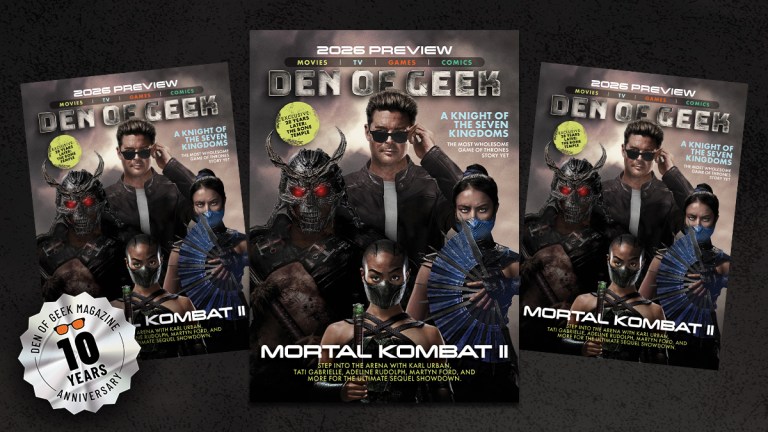
This article appears in the new issue of DEN OF GEEK magazine. You can read all of our magazine stories here.
The day that Karl Urban most anticipated and dreaded on the set of Mortal Kombat II is one and the same. Along the desolate plains occupied by Outworld’s nomads and outcasts—or at least a dizzying replica of their Tarkatan Colony built by an armada of moviemakers and artisans living in Australia’s Queensland—Urban’s fast-talking wiseacre, Johnny Cage, is going face-to-face with Baraka (CJ Bloomfield).
In the context of the film, it is an important moment for Urban’s newcomer antihero. A washed-up, has-been actor of 1990s glory days gone by, this Johnny has long given up on his movie star dreams when he is recruited into the titular life-and-death tournament that will decide the fate of Earthrealm. Furthermore, Urban recognizes that this mid-movie sequence is the turning point for Johnny, the human being. He needs to “give himself over to believing in the character of Johnny Cage.” The man must become the myth.
All of which is fine and good, but after nearly half a year of preparation, this is finally, and perhaps most crucially, the setup where Urban will perform Cage’s iconic, nether-region-obliterating fight move… And the hamstring-straining split that goes with it.
“The thing that I most looked forward to doing was the classic nut punch,” Urban says with a wry chuckle. “Johnny Cage has got this great fight with Baraka, and a little spoiler, there may be a nut punch involved. It was a lot of fun to do but also very tricky because it required an extraordinary degree of flexibility to pull it off.” The New Zealand actor, in fact, prepared meticulously with his stunt double Garreth Hadfield for the day. “We worked for months on basically stretching and training, and developing the muscle set needed to be able to execute the nut punch correctly and, most importantly, not damage myself.”
It’s a punchline with countless hours of setup, and its flawless delivery, like much else in Mortal Kombat II, seems designed to leave longtime fans and newcomers alike giddy with the strange, brutal world of Mortal Kombat. Indeed, when we catch up with Urban for the second time in as many months, the veteran actor of franchise darlings like The Lord of the Rings trilogy and the Star Trek reboot films, plus Amazon’s The Boys, still appears high off the early reception of what he considers to be “the best version of Mortal Kombat” ever made for the cinema.
“The scale of the production was as big, if not bigger, than anything that I worked on in Lord of the Rings,” Urban observes. “When you walk onto the set of [alien realm] Edenia, and it fills the largest soundstage at the Village Roadshow Studios in the Gold Coast, and you see the quality of the craftsmanship, you’re under no illusions that you’re in a film that’s as big as it gets.”
It seems the studio agrees. Despite Mortal Kombat II initially being slated to release earlier this year on Oct. 24, Warner Bros. surprised the industry and anxious fans both by delaying the movie after it played extremely well in front of audiences. What once was a fall genre gamble is now a bona fide summer movie event, occupying the second weekend in May and the season’s first action spectacle.
While allowing some sympathy for diehards who have to wait a tad longer, the picture’s star delights in the 2026 shift.
“The reality is if we had opened up on the original October [date], the next weekend would’ve been Halloween, there would have been a massive dropoff, and the perception was it might have had something to do with the film, and that couldn’t be further from the truth,” Urban says. “The studio recognized they really have a magical film here, it’s tested through the roof, the response to the trailer has been phenomenal, and they want to get some breathing space, so I was very happy with the move.”
As it turns out, even this ‘90s throwback character and characterization can still get that summer blockbuster moment when the movie hits—and splits— hard enough.
Choose Your Fighter
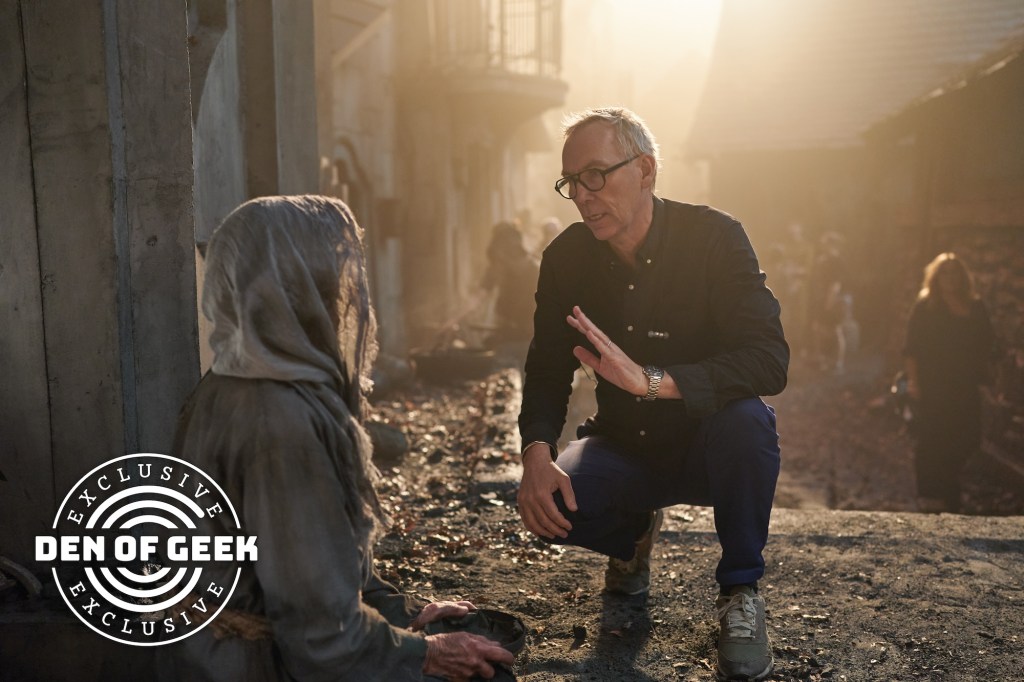
Helmed by returning director Simon McQuoid, who made his feature debut in 2021’s Mortal Kombat, and penned by new screenwriter Jeremy Slater (The Umbrella Academy), Mortal Kombat II is as much a second stab at reinventing the franchise as a continuation of that 2021 picture.
“What was so great about the first one was that it really showed what was working, what wasn’t, and what the fans really responded to and loved. So we very much had our marching orders on this one,” Slater says about what he found while coming into the project. He and McQuoid were especially taken by the prospect of expanding on the first film’s universally praised wuxia opening sequence, wherein legendary Hiroyuki Sanada’s Scorpion enters into a life-altering blood feud with Sub-Zero (Joe Taslim), both of whom return in the sequel.
Says the director, “My goal was the next film to feel like a full feature [version] of the first film’s opening scene… let’s just let it rip and swing for the fences in this one.”
A major factor in that swing is being allowed to explore the element fans craved last time but which had been kept off the table in 2021: filmmakers would at last introduce the central tournament between colliding worlds. For those without an encyclopedic memory of 1990s brawlers, those worlds include our own dimensional reality—the Earthrealm—and its confrontation with the invading forces of Outworld, a hellish land which has already conquered other planes of existence like the once bucolic (but now occupied) Edenia.
The differences of these interdimensional disputes are decided each generation by the Mortal Kombat tournaments, fateful struggles which implanted the terms “fatality!” and “flawless victory” into the nerd lexicon. They’re also tournaments that invite eclectic heroes and villains from all sides into the arena, which is perfect for building up fighting-game rosters and old-school martial arts movie ensembles alike.
“Sonya Blade and Raiden are the ones that find Johnny and bring him into the world of Mortal Kombat,” Urban says of how his character is partnered up with returning fan faves played by Jessica McNamee and Tadanobu Asano. “So obviously there’s a massive culture shock and a head spin for Johnny, who suddenly comes out of the real world into a reality that blows his mind.”
Unlike other modern Hollywood franchises, however, by design Mortal Kombat must constantly be widening and winnowing its cast of characters.
“The tricky thing is because it’s Mortal Kombat, the fights are to the death,” Slater points out, “and that makes any tournament very complicated when you have a lot of good guys, a lot of bad guys, and are figuring out the calculus of who needs to fight who at what point in this movie. Who needs to survive, and who is sadly not going to make it out?”
Even Mortal Kombat co-creator Ed Boon was surprised by who died and who survived. While likening reading the various drafts to watching Game of Thrones, Boon cryptically smiles, “There were some choices that they made and then later changed that I was really glad about. I was thinking, ‘Oh, I don’t want to see this person die!’”
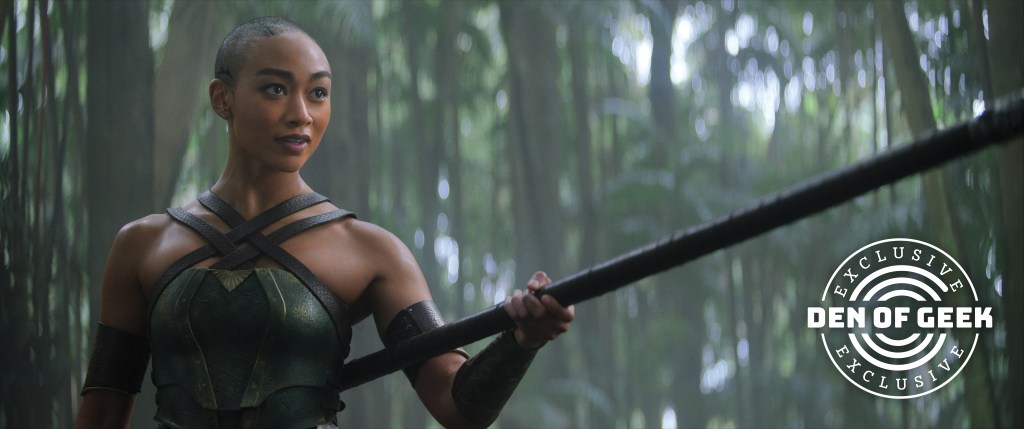
That might also be because like the tournament structure, another core demand from longtime MK fans is being met because many more characters from the various other realms in the games are making the jump to the big screen, including franchise big bad and Outworld Emperor, Shao Kahn (Martyn Ford), and several key Edenians whom he earlier displaced after a previous round of Mortal Kombat: the Princess Kitana (Adeline Rudolph) and her childhood friend Jade (Tati Gabrielle).
“There are the trials and tribulations of any sisterhood and fights between our loyalties and our values,” Rudolph teases of the particularly fraught dynamics between Kitana—who becomes an unlikely ally to Earthrealm in the games—and Jade, who is now a ninja assassin of ambiguous allegiance. Crucial through it all was the actresses’ ability to approach these heightened and operatic narrative arcs with what Rudolph deems genuine empathy. It probably didn’t hurt that the duo also worked together for years on Chilling Adventures of Sabrina.
“When you know someone so well as a person, and you adore them like with Tati, it’s nice to be on set and feel free to not be hesitant about any notes or things you might need, or things you want to give,” Rudolph says. “Having that chemistry there already was nice because we got to skip the building chemistry and go straight to building character.”
Meanwhile, Gabrielle fulfills a childhood dream since not only did she select Jade while growing up with Mortal Kombat games, but she also emulated her in real life.
“Jade [was my favorite] since I was a kid,” Gabrielle says about her fandom for this world. “When I was young, I would always play as Jade, because, one, I saw myself in her, and two, I’m a Black woman who does karate. I did karate for 12 years, and I also used the bo staff, that was my weapon of choice.”
Towering at six feet and eight inches, Shao Kahn actor Ford also grew up a fan of the classic Mortal Kombat II game, albeit perhaps more for Baraka than the Outworld emperor. Nonetheless, he found it strangely easy to get into character.
“Four hours in the [makeup] chair and you see yourself training, and then you put the costume on, it almost became a cheat code to be honest,” Ford says. “Being in prosthetics, and having the hammer, and the weight? … that was something you couldn’t replicate in the training rooms.”
Enter the Cage
While every Mortal Kombat character is some fan’s preferred fighter, be it icy-gloved Sub-Zero or obscure D’Vorah, there is a reason Mortal Kombat II has reframed itself around Johnny Cage, an O.G. avatar back when Mortal Kombat was associated with blood-drenched sprites in arcade cabinets. But for director McQuoid, the secret to casting an actor like Urban was his ability to make someone initially created to be a quipping homage to Jean-Claude Van Damme feel sincerely human.
“Look at what he did with Bones in Star Trek,” says McQuoid. “You could say that Bones was one of the broader characters in Star Trek, always one-liners and jokes and such, and the way Karl sort of kept a lid on that made it funny, made it a joy to watch, but it felt like it was a real character. He’s done the same thing with Johnny.”
For Urban, the appeal for taking on the role was seeing what McQuoid was developing—a vision he suggests is far above what has been delivered by any Mortal Kombat movie to date—as well as Slater’s screenplay, which imagines Johnny being of a certain age and past his expiration date.
“The point where we find Johnny in this movie is very relatable to everybody, because he’s on the back foot in life,” Urban considers. “His career is in the tank, the world’s forgotten him, and he’s at a real low point. His confidence has been knocked, and it is at this very juncture that he is called upon to be at his best and to use his skillset to defend Earthrealm.”
It is a universal fear of obsolescence that allows the quips, flips, and splits to shine brighter when Johnny rekindles his old smartassery. According to the actor, this vision of Cage is a guy who was almost another Schwarzenegger or Stallone but never quite made it. As an actor who came up in the ‘90s working on television productions in New Zealand, the setup allowed him to similarly indulge fantasies of being a Hollywood action star back in the day.
Says Urban, “I feel like I really benefited from the tail of the ‘70s and the ‘80s, and the ‘90s of having these iconic actors, whether it be the Eastwoods or Paul Newman, or Harrison Ford or Stallone or Schwarzenegger… all these guys. And as it pertains to Johnny Cage, you also see specifically Van Damme, who in my opinion was phenomenal, and Jackie Chan, who I drew huge inspiration from for the tone of some of Johnny Cage’s fights.” The aforementioned Baraka sequence specifically harkens back to the humor and devil-may-care conviviality of Chan’s best choreographed work.
There are even several films-within-films shot for Mortal Kombat II, which became so infamous on the page that co-stars rolled up on their day off to watch Urban film scenes of the aptly titled Uncaged Fury.
“There’s an air of ridiculousness about it because you know I turn up on set and I’m wearing this preposterous ‘90s MC Hammer-esque wardrobe, and all of the cast had turned up to watch it because on paper it read like it was going to be something special. And the way that the fight coordinators had choreographed it was just 100 percent accurate to low-budget ‘90s action movies. There’s definitely splits in there, and splits in the air too, I believe.”
Continue?
When Mortal Kombat mastermind Ed Boon steps into our studio, it’s been 33 years since the original game hit arcades. In the interim, he’s seen the brutal, crazed universe grow exponentially. But perhaps a bit like Shao Kahn, the creator still has bigger realms left to conquer. The game-maker tells us he hopes that Mortal Kombat can one day become a “forever franchise” in the same way folks think about Marvel Comics’ or DC’s roster of characters.
Mortal Kombat II’s ascension to R-rated blockbuster status is a big step in that journey, but for the people making it, the film remains a specific creative endeavor for the here and now.
“I feel like I’m a caretaker for Johnny Cage,” Urban muses. “Johnny Cage is a legacy character, and by that I mean Johnny Cage, and the roles of Kitana and Liu Kang have been played by other actors previously, and they will be played by other actors in generations to come. That’s what is gonna give it its longevity. The popularity of the games and what they mean to people is far greater than any one interpretation.” That might be, but like a caffeinated kid with a roll of quarters, Urban and company seem ready to hit that continue button, as this game is only beginning.
Mortal Kombat II opens on May 8.