Marty Supreme Is the Quintessential American Story for Its Creators
Exclusive: Writer and producer Ronald Bronstein opens up about the American iconography and self-mythology of Marty Supreme, as well as comparisons to Uncut Gems.

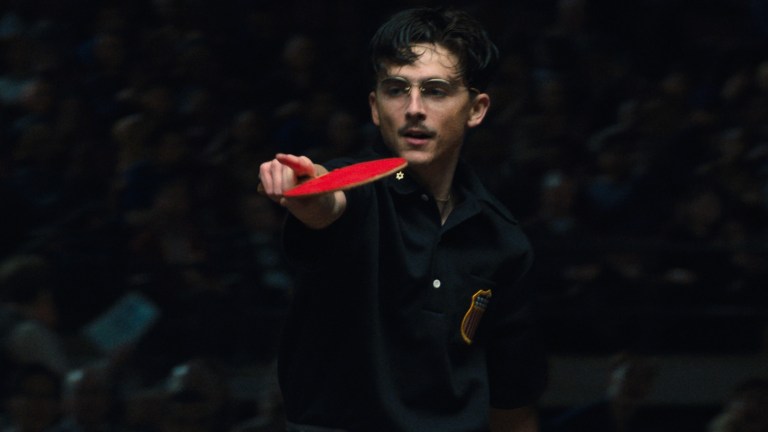
For screenwriter Ronald Bronstein, the scenes where Timothée Chalamet picks up a ping-pong paddle are among the most moving and pure in all of Marty Supreme. That is saying something since by his own admission, Bronstein was never an athlete. In fact, the filmmaker—who also co-edited and produced the table tennis epic—concedes he was that “obnoxious kid” growing up, the kind who “made not being interested in sports into a part of my identity.”
Even so, when he witnesses Chalamet become ping-pong prodigy Marty Mauser, and his co-writer/editor Josh Safdie step fully into the director’s chair, Bronstein is awed by what he describes as an Olympian elevation of a sport. “I find the actual table tennis playing in the movie itself to be, for me, the most beautiful passages of the film.”
Compared to Bronstein and Safdie’s previous collaborations, which include the grim and cynical Uncut Gems and Good Time among their ranks, there is indeed something euphoric and faintly giddy to Chalamet finally facing his rival (at least in his own mind) in war-torn Tokyo circa 1952. Yet in the minds of the men who made the 150-minute ping-pong portrait that’s become the indie blockbuster of the holiday season, the film is about more than just a sport or the athlete winning.
Marty Supreme can, quite literally, be surmised by that climactic silhouette: the lone American, standing loud and proud on a stage in the ruined lands of a former rival, proving something to his own sense of self-worth, even when the rest of the world stares in apprehension or insists he should sit down.
“To me, it’s [about] the America that emerges as victors after World War II,” Bronstein considers, “and all of this political rhetoric from that era which just insists on the greatness of the country, and that greatness is predicated on individual initiative and personal freedom. I was like, ‘Wow, I see Marty as a sort of inflamed, Kabuki Theater version of that rhetoric.’ Like how you can take the myth of rugged individualism, and the myth of the individual, and the myth of personal freedom, and turn it into its most extreme, dangerous version of itself?”
The climactic table-tennis match of the film is even only a slight artistic liberty. While the character Chalamet plays is ultimately a fictionalized epitome of the American dreamer who refuses to stop striving and trying, despite it damaging every meaningful relationship and opportunity in his life, he is heavily inspired by the real-life Marty Reisman, a mid-20th century hustler from the Lower East Side’s ping-pong halls of yore. Similarly, the antithesis of Chalamet’s Marty, Japanese champion Koto Endo (played by real table tennis champ Koto Kawaguchi) is a fictional character who represents the polar opposite of Mauser: he’s quiet, shy, literally deaf, and humble enough to keep his day job as a factory worker helping rebuild his country. However, he is also based on 1952’s men’s singles champion, Hiroji Satoh.
“What is true is that Japan came out of the war and came out of the occupation—meaning the first time that the travel ban was lifted, and the Japanese culturally re-entered the world stage—through table tennis,” Bronstein explains. “That happened in India, where the world championships were that year. So we’re again not being historically accurate. But that idea is very attractive to me in a kind of Adam Curtis-ian way where you find these footnotes in history, or footnotes of footnotes, and you zoom in on them and take a sort of worm’s eye view on how these individuals either represented the flow of history or changed history in some way.”
Penning a Legend
Zooming in has, of course, been a crucial part of Bronstein’s creative approach with Josh Safdie over the years. The way Bronstein tells it, Josh is more of the historical and research junkie of the two, whereas Bronstein sees himself as “a brooder by nature” that’s better drawn to the virtues and vices of human nature. So while Marty Supreme is the pair’s first outright period piece film with a setting of more than a few years in the past, the scribe is quick to point out “human beings, in terms of our emotional capacity for feeling and our intellectual capacity, stopped evolving [about] 60,000 years ago.” The crucial thing, then, is the micro-scaled chaos and ecstasy of being alive, whether that is as a middle-aged gambling addict in Manhattan’s 2010s Diamond District, or as the world’s best (and most overlooked) table tennis player of 75 years ago.
The latter nonetheless marked something of a surprise for Bronstein when it became the subject matter of his next movie. The shock began when Safdie dropped a copy of Marty Reisman’s obscure 1974 memoir, The Money Player, The Confessions of America’s Greatest Table Tennis Player and Hustler, on Bronstein’s desk in 2019.
“When Josh sort of burst into the room and said we have to make a movie about the world’s greatest table tennis player, I was just like [huh?!],” Bronstein recalls with a slight smile. At the time, he obviously knew about ping-pong, but only insofar of it being a “basement activity.” Meanwhile the years-long process of making Uncut Gems alongside Josh and Benny Safdie, the latter of whom also co-directed and co-wrote that picture, left Bronstein spent.
“When we finish a movie in general, we treat these projects like existential receptacles, like body bags that you can just throw any life experience into. And when we’re done with them, we don’t even have two ideas to rub together. So I just go into a completely dormant state, and I kind of rely on Josh and his sort of natural exuberance to kind of body-check me out of it.”
Still, for the non-athlete, and non-research-fixated Bronstein, the access point into Marty’s story was the widespread indifference for what many consider to be a frivolity; a child’s game; a basement activity.
“I thought I could just lean into the lack of seriousness of even the word ping-pong,” Bronstein remembers. “Ping-pong just as a name seems like it was designed to humiliate somebody who would be enthusiastic about it. It’s almost like if you think of the word ‘movie.’ That’s been grandfathered into our consciousness, so we don’t think about just how stupid and silly any kind of onomatopoeia is. But I could just lean in and double down on how frivolous and trivial sounding it is, at least in the popular imagination.”
They would make a movie about a guy who won the lottery of genetics for being the best in the world at a sport that no one around him respects, and that the greater international community of said sport might likewise not respect his arrival in. Says Bronstein, “What a great conduit to explore all of the costs that would be associated with any pursuit where one’s identity is fused with the pursuit.”
The writer cannot estimate how many drafts he and Josh ended up tackling for Marty Supreme. The process was iterative and continuous, even after it was almost scrapped in the early 2020s.
“We started writing right after Gems and we wrote for a few months, and we knew what the story should be—like you could squint at it and you could see it—but it wasn’t coming out right. It was actually coming out way too close to Gems in very specific ways. So we put it aside and we wrote something else, a massive script [that was] like a three-part, 700-page story that we ended up not making, partly due to the writers’ strike. At some point, we just looked at each other and were like, ‘Marty is the one to return to.’”
One of the keys to why Safdie and Bronstein appear to work so well together as both screenwriters and editors is an appreciation for capturing a mania and chaos that feels as spontaneous as it is scripted.
“We’re trying to create work that feels like it’s being written while it unspools in the projector while it’s playing,” Bronstein explains. “So when you’re writing dialogue down, I’m trying to capture the way people speak. It’s a completely artificial thing. But I want it to feel like the universe is giving those ideas to me so I can take them for granted, and not as something I mandated and stamped onto the universe. Anytime a performer brings a piece of themselves to the dialogue, changes the syntax and grammar just enough to heat it up, it feels like it didn’t come from my brain or Josh’s brain, but it came from them and came from the universe.”
The process continues all the way into the editing suite where Bronstein and Safdie get one more go at essentially revising their own work. Says the former, “The beauty of being both a writer and an editor is that when you get into the edit, you don’t have to have any respect for the writer or the writing, and you can just really use it as an opportunity to completely rewrite the material as if you were trying to impose intentionality onto found footage.”
The Uncut Gems Comparison
The result is a movie that, similar to Good Time and particularly Uncut Gems, has a pressure-cooker sense of tension placed on its protagonist. But Bronstein is wary to dwell too heavily on comparisons or similarities within the works.
“Out of all the things that I respect or look for in an artist, probably range is pretty low on my list,” says Bronstein. “You look for range in the full gamut of human beings out there, but each individual has a narrow set of preoccupations that defines them. So when I think of my favorite artists, whether it’s a Lynch or Robert Crumb, I’m not really looking for range. I assume that there’s going to be overlap from work to work that’s going to connect them. In a sense, each work is just them narrowing in on those preoccupations like a shark circling its prey. So how this movie connects to Gems, and how it doesn’t connect to Gems, is a negotiation that I’m trying in my life to avoid thinking about.”
With that said, the filmmaker does allow himself to note one crucial distinction: “The main difference between Howard and Marty is, Howard is more [suffering from] a disease. He’s a gambling addict, right? That’s pathology. While there are obviously pathological components to Marty that are fueling him to make the decisions he’s made… he feels this obligation to see this god-given talent through. I think there’s something much more positive at the core of Marty, because he has that talent.”
The core is to be able to again zoom in on that person, in all their talent and pathology, and as the scribe puts it, “Get enough of a sense of what their circumstances are and how those circumstances are affixing them into a position, so that it’s hard not to just sob your heart out.”
Marty Supreme is in theaters now.