Godzilla Minus Zero Review: Bigger, Grander, and Double the Kaiju
Godzilla Minus Zero is a more visually ambitious and muscular spectacle that turns a “let them fight” daydream into grand tragedy.

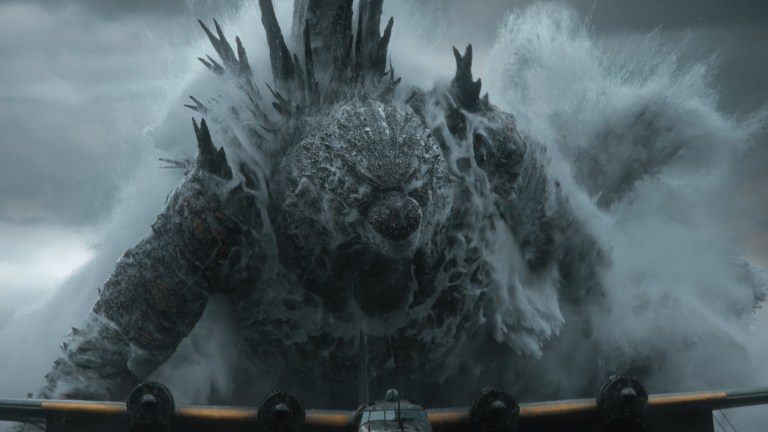
This article reconfirms who the second kaiju is in Godzilla Minus Zero, which neither we nor the filmmakers consider a spoiler. But just in case… here’s your warning.
When Godzilla Minus One released three years ago, it was remarkable for a multitude of reasons. While there have been other great kaiju movies that took the Big G seriously, including the slyly satirical Shin Godzilla about a decade earlier, none before writer-director Takashi Yamazaki came along had ever made its central human characters so compelling. The plight of Kōichi Shikishima (Ryunosuke Kamiki), the kamikaze pilot who lived, is as dramatic a hook as any giant monster tearing up downtown Tokyo, and indeed the mortal-sized story of that film works as its own intimate melodrama.
Then on the grander scale of the rampaging lizard, it was also the first Godzilla movie since the 1954 classic directed by Ishirō Honda to address the post-World War II landscape and atomic horror that shapes Japanese identity to this day. Godzilla is a child, and child’s nightmare, of the nuclear age. Minus One confronted that head-on in a movie that’s equal parts warm and wondrous. It also just looked unbelievably stunning considering its reported VFX budget was somewhere in the neighborhood of $5 million. Without any sense of hyperbole, Minus One is among my favorite movies of this decade.
Which makes Godzilla Minus Zero a monumental proposition. Toho Studios might have built an empire off its beloved Gorilla-Whale, but there has never been a Japanese sequel following the same human characters, or one that attempted to broaden and expand on the post-Hiroshima and Nagasaki allegory that was already thickly pertinent in the original. Godzilla Minus Zero does both things in ways subversive and fascinating, and it achieves this with more muscular (and expensive) filmmaking. There is a sequence that sent hushed chills through the opening night audience of the New York Film Festival that involves the Statue of Liberty. In terms of pure action spectacle, there isn’t anything more awe-inspiring coming out this fall, and certainly not tied to a movie that will challenge, and perhaps even unnerve, some Western audiences.
With that said, Godzilla Minus Zero does not fully achieve the haunted poignancy of its 2023 predecessor. There is a simple elegance to that earlier film that in another world could have simply been about Kōichi and the surrogate family of orphans he built in the ruins of Tokyo beside Noriko Ōishi (Minami Hamabe) and the little girl they take in as their daughter Akiko (Sae Nagatani). It doesn’t need Godzilla.
Minus Zero, by contrast, absolutely does. This is a pure kaiju movie about the same collection of resilient survivors and heroes being forced to confront a new world order where there is more than one giant monster on the islands of Japan, and the only path forward is to Let. Them. Fight. Yet never have the stakes of such a delightful cinematic conceit seemed so deeply tragic. While offering popcorn, Minus Zero still explores an earnest existential dread that is foreign in multiple ways to American studios.
That dread has a name, too: it’s Ghidorah.
As has been confirmed in multiple interviews, press releases, and even on the film’s Wikipedia page—so please understand that the filmmakers do not construe this as a spoiler—the big bad of Minus Zero who is introduced in the first scene is the multi-headed dragon that first squared off against Godzilla in Ghidorah, the Three-Headed Monster circa 1964. Unlike Godzilla, though, Ghidorah originally arrived to cinema at a simpler time for Toho’s giant monster movies. It was a period of high fantasy and tongue-in-cheek camp. So the fact that Yamazaki does in 2026 much the same thing with Ghidorah that he did with Godzilla, making the hydra-adjacent kaiju the stuff of post-World War II trauma, is quite the feat. One sequence in particular involving Ghidorah’s gravity-altering powers earns the movie its R-rating, a first for the franchise in either hemisphere.
It also triggers the plot, causing Japan and the Cold War powers circling the Pacific in 1949 to respond. In this context, Hidetaka Yoshioka’s Kenji Noda, the kindly if mysterious naval scientist in the first film, is as much a main character as the Shikishima clan. It is an endlessly empathetic Mr. Noda who now oversees the Japanese government’s Large-Scale Disaster Response Bureau, which is on the lookout for new monstrous threats. And it is Mr. Noda who reluctantly must return to the services of Kōichi and Noriko, who are now married and trying to put the events of the first film behind them—at least as much as Noriko can after surviving Godzilla’s atomic breath cost her an eye in the last movie.
Alas, despite Noda’s ingenuity and that of his new right-hand-woman, meteorological prodigy Makoto Aoyama (Masami Nagasawa), Ghidorah will prove more than capable of handling Japan’s best efforts—never mind the occupying American military, who seem more intrigued about testing Ghidorah’s capabilities against Japanese lives than actually felling the kaiju. All of which makes this the worst possible time for Godzilla to reemerge from the seabed floor.
At the premiere screening for Godzilla Minus Zero, director Yamazaki confessed that Ghidorah was his favorite adversary for Godzilla while growing up, and that he always thought if he ever made a sequel, he would tackle the golden-scaled dragon. After all, Yamazaki noted, Christopher Nolan went “straight to the Joker” when he made The Dark Knight.
That comparison does not seem coincidental. Much in the way Nolan attempted to ground American superhero mythology in an early 21st century psychology that felt “real”—read: visceral and thematically urgent—Yamazaki has returned to Godzilla’s mid-20th century roots to plant the monster back in its native soil, and to contextualize the big guy in a way that filmmakers during the actual American occupation of Japan would never dare. The way the screenplay and the director’s own visual instincts draws on the legacy of Hiroshima and Nagasaki is at times genuinely upsetting, shrinking the thin veil of metaphor to the wispiest of fig leaves. One long tracking-shot flashback of a doctor treating the dead and dying on the day Godzilla landed in Ginza in the last movie is as harrowing as anything since real post-war footage was used in the original ’54 picture.
Yet this worldbuilding is about more than establishing the Cold War realpolitik ambiance of the film’s 1949 setting; it frames the plight of our heroes in a reality where the ramifications of monster-hunting has micro and macro knock-on effects. On the most human level, it rekindles the melodramatic angst of the last movie with the Shiishima clan put through an emotional ringer that’s frankly cruel. There are more than a few sequences designed to pull on the heartstrings and that will leave a few viewers’ eyes moist.
Ultimately, however, the approach mostly seems aimed at undergirding some of the best giant-monster sequences ever committed to screen. Clearly working from a larger budget and more confidence than the 2023 movie, the filmmakers upscale the VFX wizardry. There are about a half-dozen breathless, gee-whiz sequences designed to leave the audience either cheering; my favorite involves an aerial dogfight with Kōichi and a band of fellow monster slayers going up against King Ghidorah in a scene that is a bit like if Luke Skywalker and the X-wings took on Cthulhu. In terms of crowdpleasing action, it’s a triumph, building to the inevitable clash of kings.
It also feels far more in line with the Toho kaiju movies of yore than its predecessors. This is a film about human characters coming up with a rational reason to pit Godzilla against another giant monster, and then working tirelessly to make that fight night happen. What elevates Minus Zero is the stress and psychological turmoil the mission piles onto Noda, Kōichi, and Noriko, with Kamiki and Hamabe especially rising to the occasion in any sequence that involves these young parents having to explain to wee little Akiko why daddy needs to walk out the door again.
When coupled with a fiendishly twisty third act, it turns monsters putting on their boxing gloves into an epic soap opera. That achievement does not quite stand on its own as a familial drama about regret, trauma, and the guilt that comes with surviving a war, but it does make Godzilla throwing down opposite a triple threat some kind of cathartic treat. For kaiju fans, it’s an escalation that seems destined to bridge a genre-defining trilogy.
Godzilla Minus Zero opens in Japan on Nov. 3, and in the U.S. and UK on Nov. 6.