Godzilla Minus Zero: Exploring the Ending and the Nuclear Destruction of Ideals
We examine the power of Godzilla Minus Zero’s ending and what it says about living in the shadow of nuclear war, be it 1949 or 2026.

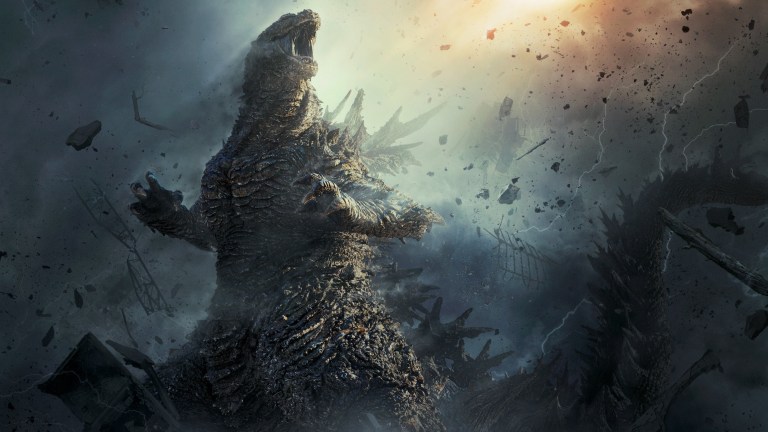
This article contains major Godzilla Minus Zero spoilers. Our spoiler-free review is here.
Have a safe trip.
Rarely has such a sweet, innocuous phrase carried such devastating power in a movie as when Akiko (Sae Nagatani) stands atop a lonely slide and cries it again and again. It’s a chant, a prayer for safe passage, but also an agonized outpouring of grief over the soon-to-be absence of her adopted parents Kôichi Shikishima (Ryûnosuke Kamiki) and Noriko Ôishi (Minami Hamabe). In the scene, the loving, doting parents feel compelled to leave, for the good of Akiko they tell themselves, and certainly for the good of the world.
While Noriko continues to live—which by all accounts may not be for much longer—her blood holds the secret for summoning and controlling nuclear-powered monsters. As Japan knows all too well, it’s the power of gods in a human’s hands. Also specific to that island nation in these bitter postwar years in which Takashi Yamazaki’s Godzilla movies are set, is an appreciation that such awesome power is not a natural thing.
It can change one’s priorities, their ideals, and even their souls. But it doesn’t mean it should cause one to forsake their humanity. Indeed, there are few more emotionally sentimental, and satisfying, endings than when Kôichi and Noriko hear the cry of their child, who they have convinced themselves they must leave behind. Earlier in the movie, Noriko explained “have a safe trip” is like a spell said by one loved one to another as a form of protection. It’s an act of love, which might be the only ideal worth preserving when the world ends.
How facing such apocalypse can shift your perspective and ideals is at the heart of Godzilla Minus Zero’s ending, as much as the undeniably stunning work that Yamazaki’s special effects team dreams up when kings clash. So let’s explore the full fallout, radioactive and otherwise, that occurred when Godzilla and Ghidorah met…
Sparing the World Another Oppenheimer
Despite 70 years of kaiju movies already on the books, the first teaser of Godzilla Minus Zero proved to be faintly shocking in its subversiveness: the Big G makes landfall on Liberty Island in New York Harbor, dwarfing in scale above the Statue of Liberty herself. It promised menacing things for the American city that never sleeps.
The finished film delivers them with fire and fury. There have been other Godzilla movies that have seen a kaiju take a bite out of the Big Apple, both Japanese and American, yet none so provocatively or framed through the wanton destruction of a nuclear bomb. But when Yamazaki’s monstrous lizard opens his yawning mouth and blasts lower Manhattan with a mushroom cloud, there wasn’t a single drop of laughter or popcorn munching at the New York Film Festival premiere I attended. There wasn’t even a fig leaf of allegory in the text: this sequence is the fantasy of a survivor of Hiroshima, Dr. Kanji Murakami (Min Tanaka), who is dreaming about one day visiting upon the American superpower what the U.S. brought to Hiroshima and Nagasaki.
In 1949, when Godzilla Minus Zero is set, this kind of quiet daydream might have faintly reflected the time. While Yamazaki’s film is undeniably a work of fantasy, imagining an alternative reality where in the rebuilding years following World War II, the Japanese government allocated massive amounts of dwindling resources to researching and fighting giant monsters who are beginning to make stomping Tokyo Bay a seasonal event. (It’s also a bit incredulous to believe the U.S. government would allow Japan to rebuild its navy and air armaments so soon after the war, Godzilla or no Godzilla.)
Nonetheless, Japan was very much in the midst of an American occupation that lasted from 1945 to 1952, and which has lingering effects to this day that extend beyond U.S. military bases. Consider that during the same period this movie is set, the Civil Censorship Detachment—a department among the Allied Powers—censored any reporting in Japan or abroad about the horrifying side effects of radiation poisoning left by the atomic bombs.
It’s the kind of denial that can breed resentment, especially from those who lived through the horror, such as Dr. Murakami in the movie. Not since the original Godzilla of 1954 has a Toho kaiju movie so explicitly drawn the 1:1 lines of allegory between the psychic and physical scars of nuclear war and the cinematic image of a giant lizard making buildings go boom-boom.
The sequence where a doctor remembers how Noriko was saved from the wreckage of Ginza in the last Yamazaki Godzilla movie, Godzilla Minus One, might be the most horrifying beat in the whole film. In a long tracking shot, doctors, nurses, and victims scramble across rivers of blood in what once was a hospital corridor. The aftermath of terror and carnage overtly echoes many tableaus of suffering and loss in the Second World War. The once censored documentation of Hiroshima and Nagasaki, yes, but also the firebombing of Tokyo—or for that matter the many Chinese and Korean victims of the Empire of Japan in the 1930s.
It is this sequence, along with a flashback of Murakami remembering Hiroshima that likely got Minus Zero an R-rating, a first for a Godzilla movie. But it also lays the stage for the anger of characters like Murakami and his dream of exacting a bloody revenge by way of unleashing Godzilla like a nuclear weapon on the United States.
That thirst for vengeance becomes just as much the dramatic heft behind the third act of Godzilla Minus Zero as the spectacle of the Big G and King Ghidorah trading blows in the ruins of Ginza. Perhaps more so. While there has never been a more satisfying “let them fight” matchup in a Toho film than the grounded stakes of Kōichi, Noriko, and my favorite character, naval genius Kenji Noda (Hidetaka Yoshioka), sifting through the rubble while gods spar in the heavens, the fight is still fundamentally like so many others in Godzilla movies. The humans are hoping the enemy of their enemy is their friend, and that despite past differences Godzilla will save them.
What gives the sequence more ominous weight is the idea of how we got here: Dr. Murakami has figured out a way to summon Godzilla and, essentially, convince him to attack at our behest by using his technological innovations… and the blood of poor Noriko. For in the other chilling echo of real-world nuclear horrors, we learn that those who survived the last film’s Ginza slaughter were touched by the backhand of God(zilla). Noriko lived, but her blood is irradiated. One day it will kill her, but not before leaving physical and mental scars, including a gnarly reptilian eye beneath an eyepatch that seems like an homage to Dr. Serizawa in the original ’54 Godzilla.
In this way, Noriko’s irradiated blood poisoning and Dr. Murakami’s tech become two halves of the same super weapon. When combined, they allow human beings the ability to turn Godzilla into their personal nuclear arsenal. It would essentially make Japan, or at least a grieving grandfather, a nuclear power able to start the war again against an occupying force.
This is the true “sin against nature” that Godzilla Minus Zero’s screenplay dances around when Kōichi and Mr. Noda debate the ethics of using Noriko to summon Godzilla. And it is the power Noda dreads Murakami clinging to beyond Ghidorah. He would seek to use it to destroy New York City and bring about a new era of war and suffering, and death at the magnitudes that took away Akiko’s biological parents, or Murakami’s granddaughter.
But it also would make Murakami another J. Robert Oppenheimer, the father of a technology that could reshape the world. Hence the U.S. government so aggressively wanting to take control of Murakami’s work and Noriko’s literal body…
A Change in Philosophy
Yet it should be noted that neither of Yamazaki’s Godzilla movies act as some kind of revisionist fantasy of a post-Second World War history. Like so much of modern Japanese media, it’s a reevaluation of the mindset that made such a cataclysmic event possible.
Consider Godzilla Minus One, a film that is a repudiation of both the government and the philosophy that led young men like Kōichi Shikishima to be strapped into kamikaze planes and sacrificed by the thousands at the altar of empire and conquest. The privates, the sailors, the cannon fodder like Kōichi who were considered too expendable to implement ejection seats during the war are the heroes of both Godzilla Minus One and its sequel. And like so much of Japan after living through loss, and perhaps more specifically being the only country to endure nuclear holocaust, they ultimately reject the old ways of doing things, including the martial values that were so highly prized for centuries in this country.
In Godzilla Minus Zero, Mr. Noda vocalizes that shift to Dr. Murakami when he visits him the night before the final confrontation with Ghidorah. He pleads with his friend to let go of his anger and hate, and his murderous dream of unleashing Godzilla on the U.S. It would just start up another war, and another grinder to chew up and spit out Japanese youth.
On a surface level, the dialogue between them is a standard “revenge will not free you of your grief,” but in the context of the film’s setting and worldview it continues Kōichi’s own journey: let go of the mindset, the dogma, the very philosophy that shapes your life. In 1949, Japan was very much in the midst of this exact journey. The fierce nationalistic militarism and imperialism that put young men in kamikaze planes—and also unleashed hell on Nanking, the Philippines, Singapore, and much else of East and Southeast Asia—was supplanted within a generation in favor of a nationwide embrace of antiwar pacifism.
There were no giant lizards or three-headed dragons, but the Mr. Nodas of the world extracted a promise from future generations, and even those grieving in the current one, to find a different path.
The Only Thing That Matters
It is worth pointing out that Godzilla Minus Zero’s great ethical debate—should mankind hold the power to control a creature like Godzilla, and then use it—is not the first time one of the movies in this series created a metaphor for nuclear power. The good Dr. Serizawa in the original 1954 movie similarly invented a world-ending technology to kill the O.G. big lizard. He called it “the Oxygen Destroyer.”
At the end of that movie, Serizawa succeeds at using it to kill Godzilla, but then he ultimately makes a decision that likely tracked for many Japanese audiences in 1954, not even a full decade removed from World War II. He killed himself and destroyed his research, ensuring his work never fell in the hands of any government or superpower that could use it to kill thousands.
The characters of Godzilla Minus Zero face a similar conundrum, even after Murakami agrees to not force Noriko into being a Godzilla whisperer. The superpower that dropped two nuclear bombs in wartime is still in control, and they still want this newfound power that Noriko’s blood unlocks. Hence the final, painful ending of the movie. For Murakami, it means refusing to share his research after he is arrested by the U.S. military. For our heroes, Kōichi and Noriko, it means a life of self-sacrifice and loss, not too dissimilar from Serizawa’s final choice. Which brings us back to poor little Akiko, standing atop a slide begging, pleading with her parents to have “a safe trip.”
… And they don’t leave her.
In what is sure to be a movie moment that lives on for years to come as a meme and coda, Kōichi, Noriko, and their daughter all cram onto a single motorcycle, attempting to make a run for it from the U.S. and the world—an attempt to spend as much time together as they can as a family before Noriko succumbs to her fate. And yet, despite those grim parameters, this is as happy and a feel-good ending as you can imagine. It’s like if The Dark Knight ended with none of the good guys dying, and them all stuffing onto the same motorcycle to ride into the dawn.
It’s a reversal of Serizawa’s choice and the original Godzilla movie, just as modern Japan seems to have removed itself from more ancient notions about warrior codes. In the aftermath and fallout of nuclear war, of ungodly and unnatural power raining down from the sky, previous priorities can seem trivial. All that matters are the family and friends you can hold, and maybe the better future you can squeeze onto the bike right next to you, journeying out in search of safe harbor and another safer trip.
Godzilla Minus Zero is in theaters now.