Meet the Archaeologist Changing What We Know About Ancient Egypt
Exclusive: Zahi Hawass opens up about his new documentary, the latest discoveries changing what we understand about the family religion of King Tut, and why folks keep falling for conspiracy theories.

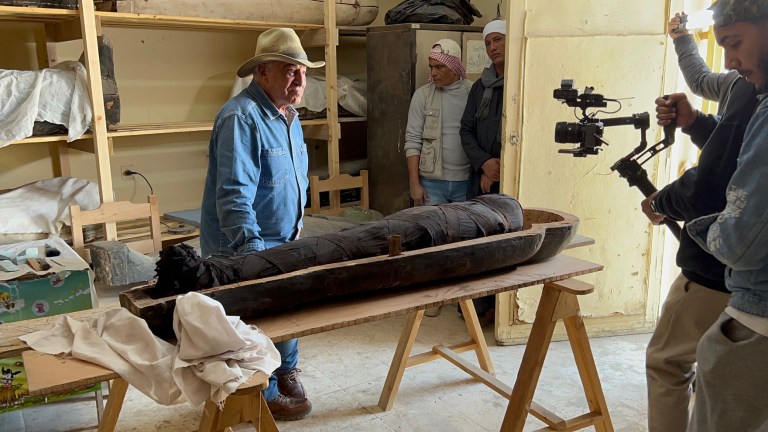
Archaeologist, lecturer, and a former Minister of Antiquities in Egypt, Dr. Zahi Hawass has spent a lifetime digging through the sands of his native homeland and traveling the world to explain what treasures remain hidden within. He is a scholar, yes, but also a recognizable, oft-hatted silhouette to anyone with a passing interest in the land of pharaohs and pyramids. Whether in the pages of National Geographic, on the Discovery Channel, or along Oxford’s hallowed halls, Hawass has been a fixture, outspoken and still animated more than 50 years since his career began, ready to debate the glories and ruins of a distant past.
Yet when we meet him on a brisk January morning in Manhattan, he admits he’s in town and experiencing something altogether new—winter in New York—to discuss a history that’s a little more recent: his own.
In The Man with the Hat, which premieres later this week on PVOD around the world, filmmaker Jeffrey Roth turns the camera on Hawass to discuss an Egypt of the Old and New Kingdoms, definitely, but also a lifetime in an archaeological field that’s changed dramatically since Hawass first became an associate director of excavation at the ruins of Hermopolis in 1968.
In the intervening years, the Egyptologist was on the ground when secrets of the Pyramids of Giza’s construction were unearthed; present as new computed-tomography (CT) and DNA-scanning tech answered a century-old mystery about the mummified remains of Hatshepsut, the Woman King; and even there, holding a very large stick by his own account, outside of the Cairo Museum after looters were repelled away from broken glass during the 2011 Egyptian revolution.
The Man with a Hat gives an intimate portrait of those events from Hawass’ perspective, as well as insights down to that titular hat he’s worn in enough documentaries across enough decades that some have incorrectly mused it was an inspiration for Indiana Jones.
“When I started in archaeology, I used to wear a white hat that the farmers in Egypt wear, but this hat never protected me from the sun,” Hawass confides between sips of a cappuccino. “So as I was visiting Los Angeles, I entered a hat store and I found this hat, put it on my head, and a friend of mine beside me said it looks good. I said, ‘Okay, this can protect me from the sun.’ But this is why this hat began to be connected with every discovery that I made.”
While Hawass does not suggest it informed an iconic archaeologist of the screen, he does tell us George Lucas once asked him over dinner why he doesn’t wear a fedora like Indy. “I told him that my hat is a real archaeology hat, and the Harrison Ford hat is the fake one.”
If that’s so, the real thing seems more than ready for its close-up.
New Discoveries Reshaping Old Heresies
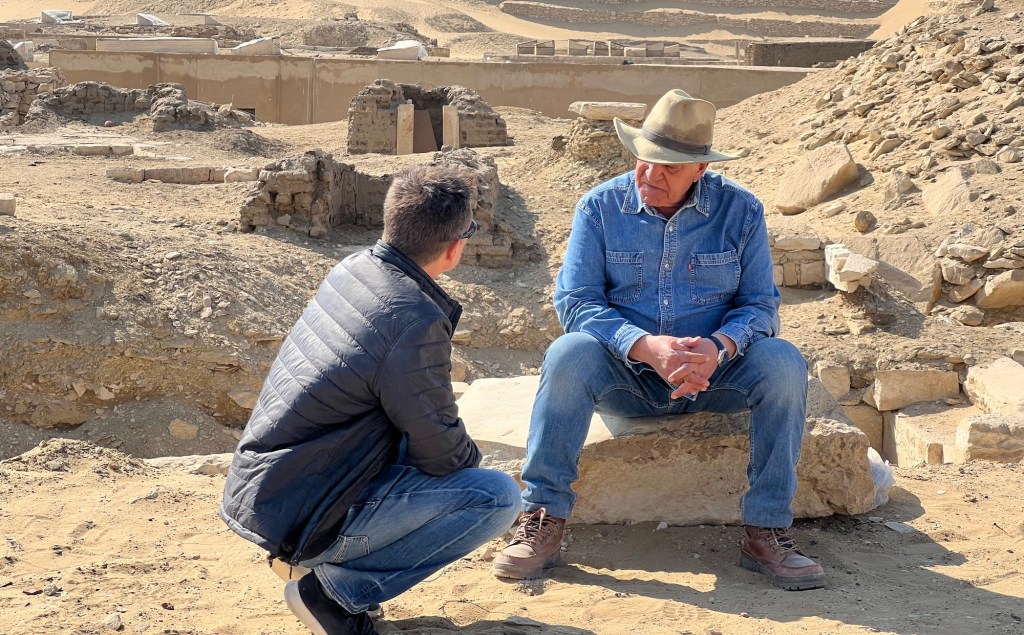
When filmmaker Jeffrey Roth first approached Hawass, the archaeologist was not pursuing a documentary about his life. In recent years, Hawass has taken to the habit of traveling frequently—to as many as two countries a month, he tells us—while lecturing about breakthroughs and discoveries still being made in Egypt, as well as debate the occasional conspiracy theorist convinced about aliens or power conductors beneath the sands of Giza. Yet the archaeologist wasn’t necessarily looking for a starring role of his own. He was, however, eager to speak on-camera about new details archaeologists are unearthing with his support and guidance.
“For the last three years, we made major, important discoveries in Egypt: in the Valley of the Kings, in the West Bank of Luxor, and in Saqqara and the pyramids,” Hawass says. “So I thought maybe it’s time to make a film so that the people could really see all of these major discoveries.”
Without taking a moment’s pause, Hawass asserts the most significant of these lies along Luxor’s West Bank and what has been described to the press as a “lost golden city.” Dated to about 3,400 years ago, during the reign of New Kingdom Pharaoh Amenhotep III, this golden city made waves when it was first revealed to the world in 2021. After all, it was constructed by what many Egyptologists, including Hawass, argue might be Egypt’s greatest pharaoh (with all due respect to Ramses II, the self-styled “Ramses the Great”).
And what might really intrigue Egyptian scholars are the latest revelations from the site, which Hawass suggests could rewrite what we think we know about Amenhotep III’s infamous and much debated son and heir, Amenhotep IV, aka Akhenaten. The Heretic Pharaoh.
“I was searching for the funeral temple of Tutankhamun to the north of Medinet Habu, and by accident we found the city,” Hawass explains. While he believes they have only excavated maybe a third of the city in the last four years, already teams have discovered fascinating insights into the daily lives of workers and servants from the 18th Dynasty.
“This city contains the living areas for the artisans, about nine royal workshops to make children’s toys, textiles, and clothing for the palace,” Hawass says. “And what’s really amazing is we found a lake to provide the city with water.” Curiously though, in an administrative building belonging to a high-ranking priest and official working under Amenhotep III, Hawass asserts that scientists have found evidence that “Amenhotep III called his palace the dazzling Aten and also this city the dazzling Aten, and he called himself the dazzling Aten.”
For a little historical context, “Aten” is the name of a sun disk and its corresponding deity that became the epicenter of a religious upheaval which informs much of what we know about Ancient Egypt today. Aten, or Atenism, grew into what some believe to be a monotheistic religion developed and spread by Amenhotep III’s son (hence Amenhotep IV changing his name to Akhenaten). Akhenaten eventually turned his back on the old gods and built a new capital along the Nile called Akhetaten (modern day Amarna). There he and his wife Nefertiti, as well their royal family, worshipped the single deity without interruption, triggering a religious and artistic revolution that ended in catastrophe, and with Akhenaten’s orphaned, boy-king heir pressured by the priests of old to abandon his father’s city and reopen the temples of the old gods. The boy’s name was Tutankhamun. King Tut.
“When Akhenaten, the son, went to Amarna, he said, ‘I built this city for my father Aten,’” Hawass says. “We now think that Amenhotep III could be the god Aten himself. And that’s why the city itself has changed a lot about history, about religion, and about Amenhotep III.”
There is still much left to unearth in this golden city, but its secrets could rewrite what we know about the origins of what some claim to be the world’s first monotheistic religion, changing its worship possibly from that of a sun disk to a deceased father and king. Although Hawass seems wary to make that claim just yet, either about Amenhotep III being fully the Heretic Pharaoh’s Aten or the world’s first monotheistic deity.
“There is some evidence [of monotheism] before that, but this is the time, the clear time, that the people began to announce the one god, and no other gods,” Hawass says. “Amenhotep III, I think, respected the other gods, but Akhenaten did not. He built a temple for Aten in the temples of Amun, and that’s why he was the enemy of the priests of Amun.”
Fictional Undead Mummies vs. Real-Life ‘Nonsense’
Interspersed throughout The Man with the Hat are clips of Universal Pictures’ 1932 classic The Mummy horror movie starring Boris Karloff, plus a few of its lesser sequels from the 1940s. This cycle of films began a century of cinematic superstitions that runs the length from Christopher Lee to Brendan Fraser. And, as one might imagine, none are particularly accurate to history or even mythology. Nonetheless, Hawass does not mind their inclusion in his documentary. In fact, he confesses to being something of a fan.
“I loved them, of course,” Hawass says of seeing old Mummy movies growing up. “These movies really give awareness about Egyptology to the public. The Curse of the Pharaohs [news stories], the movies about the Great Pyramid, mummies, all of this really was good in my opinion.”
What the archaeologist has less patience for is the proliferation of conspiracy theories, or often unsubstantiated speculations about Ancient Egypt that tend to revolve around either alien visitors or the myth of Atlantis being real.
It is true that our understanding of Ancient Egypt shifts frequently. If Amenhotep III is proven to be his son’s “one god,” it could certainly rewrite a few books about the 18th Dynasty. And far more significantly, Hawass was there as Director General of Giza in 1988 when American archaeologist Mark Lehner first discovered what is now called the workers’ village in Giza Plateau. These were the homes of the men who built one of the Seven Wonders of the World.
“The pyramid builders were a really very important discovery because you can answer the questions the public are asking all the time,” Hawass says, “and it can kind of stop all the talk about aliens and lost civilizations, and all of this nonsense.” The nonsense Hawass refers to ranges from recent claims that the Great Pyramid and Sphinx were built 12,000 years ago by an even older, forgotten civilization, to fairly ancient ideas about the same structures being the result of enslaved labor.
“If the people who built the pyramids were slaves, they would never be buried in the shadow of the pyramid, and they will never build their tombs for eternity like kings and queens,” Hawass says, pointing to how in the decades since the initial discovery of the workers’ village, archaeologists have also found lower cemeteries for the laborers who moved stones to build the Great Pyramid and upper cemeteries for technicians; they also have found bakeries, artisan shops, and even a papyri trail suggesting workers on the Pyramid of Khufu (the Great Pyramid) got every 10th day off. (Which, one supposes, means no signs of a union.)
Still, alternative histories and outlandish theories about the Giza Pyramids’ origins remain stubbornly popular, from Ancient Aliens on the History Channel to Netflix’s much-watched Ancient Apocalypse, a TV series where British author Graham Hancock slowly insists the Giza Pyramids and many other ancient sites around the world are remnants or descendants of an advanced culture lost at the end of the last ice age 10 to 12 millennia ago.
“The people who create all these stories, they are uneducated about Ancient Egypt,” Hawass counters. “I always say when I debate Graham Hancock and John Anthony West, or Robert Bauval, ‘Okay, what kind of evidence [do they have]? Not one single evidence! But look what happened a few years ago where there was the discovery of the Wadi Jar papyri. It is a written papyri of an Assyrian workman, his name is Merer, and he’s talking about building the Pyramid of Khufu. How can you ignore all of this?”
Hawass refers to papyrus—also sometimes referred to as the “Red Sea Scrolls”—discovered in 2013 which noted the construction of the Great Pyramid during the 26th year of Khufu’s kingship. Merer apparently visited the project and referred to it by what appears to be its original name, Akhet-Khufu, “the Horizon of Khufu.”
“If you look at these people, they never studied Ancient Egypt, they never understood it, and therefore they can have any theory they want,” Hawass contends. But he is quicker to insist that every year, he meets many more people who want to learn actual verified history rooted in archaeological evidence.
“I gave 33 lectures last summer in 33 cities in America and Canada, and 3,000 people [attended each],” Hawass says. “More people want to hear about discoveries than talking about aliens and things like that.”
Preserving the Past into the Future
Conspiracy theories and “alternative facts” dominating streaming services can threaten abstract knowledge about antiquity, but there’s plenty of real-world troubles and travails to worry about. In the documentary, stunning photos and aftermath footage is shown of the break-in of the Cairo Museum in Tahrir Square during the 2011 Egyptian revolution.
“That was so bad, I could not leave home because there was a curfew,” Hawass says while thinking back on that night. “A thousand people entered the museum, but what I did is I called the head of the army at night and I asked him to bring the army commanders to the museum, and the army commanders saved the museum.” In the end, Hawass notes they found only 35 objects were stolen and all of them were recovered. “Thank God, the people who entered the museum were ignorant, they were looking for gold, and the gold room was sealed and the museum was dark. This is how the museum was saved.”
The public-facing archaeologist remains vocal about protecting all artifacts, though, especially those no longer in Egypt. During his tenure in the Egyptian government and afterward, Hawass has loudly proclaimed that antiquities taken in previous centuries by foreign powers and still stored in Western museums are a form of imperialism. And there are three above any others he would like to see returned: the Bust of Nefertiti in the Egyptian Museum of Berlin, the Dendera Zodiac in the Louvre of Paris, and the Rosetta Stone in London’s British Museum, the latter of which made the modern translation of hieroglyphs possible.
“The Rosetta Stone was taken by the French and they gave it to the English. How can you give someone something that doesn’t belong to you?” Hawass says. “I’m asking for only an object that belongs to Egypt, because it’s the icon of the Egyptian identity.”
Perhaps more surprising for the former head of Egyptian Tourism and Antiquities, however, is that among his concerns for Ancient Egyptian history’s greatest threats… is the tourists themselves.
“Tourists are the enemy of archaeology,” Hawass says. “We need to accommodate between the need of tourists for the economy and the need for the preservation of the Egyptian. Ten thousand people a day enter inside the tomb of Seti I and Tutankhamun, and Ramses VI, breathing, touching, photos. Tombs were not made for tourists.” It’s for that reason two years ago, Hawass was among the champions for the closure of the Tomb of Nefertari in the Valley of the Queens. It is arguably the best preserved royal tomb in Egypt, and generally the less oxygen breathed on it, the better.
“We need to let the people enter maybe three times a day and you should need a reservation to enter tombs,” the archaeologist suggests. “We really need to do certain rules to protect these monuments, and this is what I’m telling the authorities now to do.” Among Hawass’ more interesting suggestions is the idea of building more replicas of the most popular tombs that tourists could visit instead.
Still Wearing the Hat
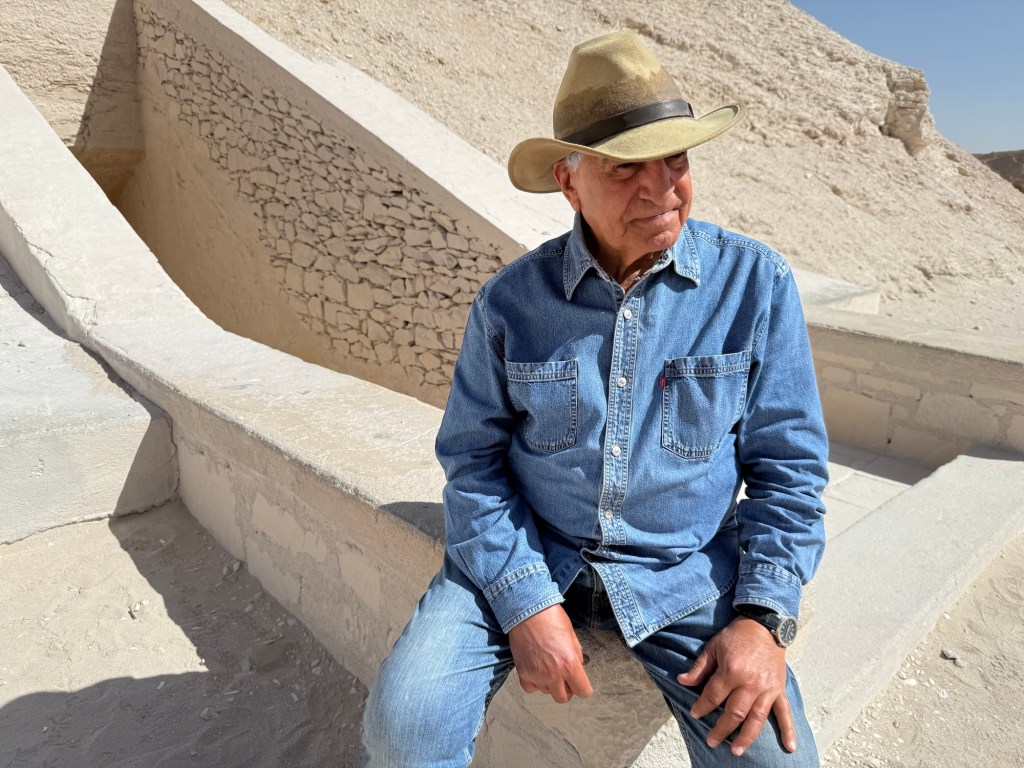
Hawass’ documentary comes out at the end of this month, but the archaeologist appears eager to keep going. When we meet, he has just completed press in Los Angeles for the film and is planning several lectures on unrelated archaeological projects he is working on. There is, for example, the Egyptian Genome Project, a national initiative to create a genomic map of modern and ancient Egyptians, and continued DNA research into the royal mummies. Hawass is currently hoping new techniques might confirm the mummy of Nefertiti of the 18th Dynasty, and reveal if the famed “King Tut” had an infection when he died (which would disprove the popular theory he was murdered).
Hawass also seems pleased to still be walking through the monuments and sites he’s studied all his life, both for this film and otherwise. His favorite unsurprisingly is Giza.
“I spent most of my life excavating every piece of sand at Giza,” Hawass says, reminiscing particularly about the time they were able to learn the Sphinx is carved from one “living” rock.
“I lived two years of my life in front of the Great Pyramid in the Guest House. The Giza Pyramids became a part of me, and it’s still a part of me,” says Hawass.
And while he remains hesitant to imagine what his legacy will be, the man who’s spent his life trying to spread enthusiasm for Egyptology among the public—including with a foundation that now teaches courses in learning hieroglyphs and the fundamentals of archaeology—seems keen on wanting to pass that passion down to the next generation.
“The most important thing that I would love people to remember me by is the teaching and the training of the younger people that I did,” Hawass says. “That really can continue my legacy by doing good work preserving the Egyptian history.”
The Man with the Hat is available on Apple, Amazon, and other apps on Jan. 20.