The Secret History of Marvel Movie Adaptation Comics
Let's look back at a time when Hollywood came to the Marvel Universe.

These days, the words “Marvel” and “movies” are synonymous. Even in this era of superhero fatigue, the re-release Avengers: Endgame Encore can top the box office. But for decades, despite Stan Lee‘s attempts to bring his heroes into other media, Marvel Comics only made it to the big screen in the form of the disastrous Howard the Duck, or a young Vincent D’Onofrio as a construction worker mistaken for Thor in Adventures in Babysitting.
But that doesn’t mean that the House of Ideas missed out on Hollywood altogether. Rather, movies regularly intersected with Marvel in the form of comic book adaptations of genre films, not unlike the official novelizations that used to line bookstores and grocery aisles. More than mere four-color reproductions of hit films, these comics sometimes brought Hollywood heroes into the Marvel Universe, changing both our perception of the movie and comic book history.
Stan Goes Hollywood
To understand the genesis of Marvel’s comic book adaptations, it’s important to remember Stan Lee’s true role at the company. As most comic fans know, Lee’s creative work tended to go no further than pitching ideas and writing dialogue over pages plotted by artists, despite the credit he would claim for himself. Rather, Lee functioned most as a figurehead, a pitchman who sold the idea of Marvel Comics. Thus, Lee became a recognizable character long before his first movie cameo, going on talk shows and delivering college lectures about the artistic or cultural value of comic book heroes.
In particular, Lee loved popular culture and longed to make the jump from comics to other media, specifically movies. Thus, he often made plans to make movies with everyone from French auteur Alain Resnais to Troma founder Lloyd Kauffman, and palled around with public figures like Hugh Hefner. Part of that plan involved bringing pop cultural figures into comics, which resulted in oddities such as stories in which the Avengers visit David Letterman and Saturday Night Live, or a special issue about the rock band Kiss.
The latter came in the form of 1977’s Marvel Comics Super Special #1, a magazine-format series that sought to expand the company’s appeal. The magazine format allowed for more mature storytelling, and it was sold off of the comics rack, alongside other, more “respectable” fair. As such, Marvel Comics Super Special proved to be the perfect place for the company to welcome Hollywood to the comics page.
Very Super, Very Special
The credits to 1978’s Marvel Comics Super Special #3 are familiar to any comic book reader. The lead story is written by Archie Goodwin, who also co-created Luke Cage. The pencils come from Thor and Fantastic Four great Walter Simonson, inked by Frank Miller‘s frequent collaborator Klaus Janson. Even the images on the cover feel like classic Marvel, with a man and a woman running toward a flying saucer flying from a desert butte.
The surprising part comes when readers notice the subtitle of the book: Close Encounters of the Fourth Kind. “All new! The illustrated collector’s edition of the Steven Spielberg film!” That’s right, this issue features Simonson’s renditions of Richard Dreyfus’s Roy Neary and Melinda Dillon’s Jillian Guiler, two people inexplicably drawn toward the arrival of aliens.
Close Encounters would hardly be the only instance of the series adapting a movie. Issue #6 offers its take on Jaws 2, complete with a cover showing a bikini-clad snorkeler swimming toward the reader and away from a shark’s maw. William Shatner and Leonard Nimoy grace the cover of issue #15 for a version of Star Trek: The Motion Picture, while Harrison Ford does double-duty, appearing in #16, Star Wars: The Empire Strikes Back, and number #18, Raiders of the Lost Ark. What interrupts the George Lucas double-feature? An adaptation of Xanadu, Olivia Newton-John’s bloated disco musical.
As that last point indicates, the Super Specials did not limit themselves to obvious genre fair. Yes, the series offered comic book renditions of the James Bond flicks For Your Eyes Only and Octopussy, the David Lynch version of Dune, and even the gonzo The Adventures of Buckaroo Banzai Across the 8th Dimension. But it also dipped into surprising territory. The musical Annie, The Muppets Take Manhattan, Labyrinth, and Santa Claus: The Movie all get adapted.
Marvel often put some of its top creators on these projects. John Buscema, Bill Sienkiewicz, Marv Wolfman, and Dave Cockrum—people who would define some of the company’s most legendary characters—all worked on the books. However, they were treated very much like gimmicks, collector’s objects meant to supplement or advertise the movie rather than tell full stories themselves. But that wasn’t the case for all of Marvel’s movie adaptations.
Unlimited Series
If one were to go to a convention and ask about Marvel’s Dune, Raiders of the Lost Ark, or Empire Strikes Back comics, they may indeed be given issues of Marvel Comics Super Special. Or, they may be given issues of the series that Marvel made adapting these films, sometimes in three- or four-issue runs, sometimes as part of an ongoing.
Unlike the Super Specials, these comics were indeed comics, through and through. They came adorned with the standard Marvel logo, they were interrupted by house ads for Spider-Man and the Hulk, and they usually featured at least one bit of grandstanding by Stan Lee. Sometimes, these miniseries were merely reprints of the Super Special, just resized and broken up into several issues.
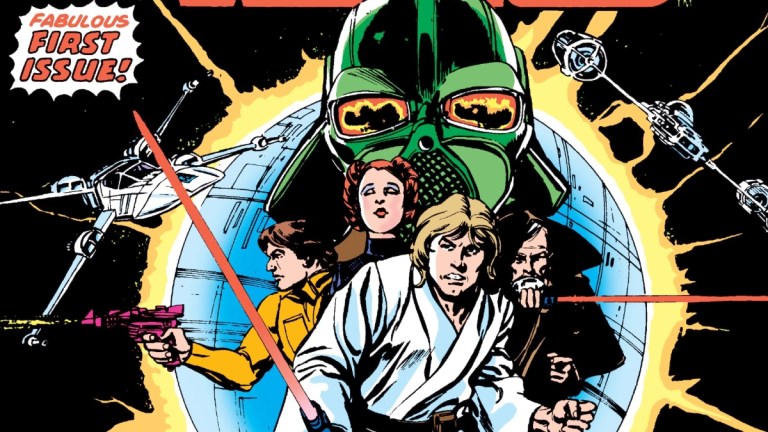
But other times, they were created to be read as monthly comics within the Marvel Universe, and here’s where things get weird. One of the most infamous examples was the Star Wars ongoing, which actually hit stores before the movie arrived in theaters. The first few issues more or less follow the script of the film (with some elements that were cut from the movie, including Darth Vader uttering the word “Sith” long before anyone does so on screen). But from there, things get weird, as creators Roy Thomas and Howard Chaykin get to play around with the characters after the events of the film, adding their own weird creations, like the green-furred rabbit Jaxxon.
Jack Kirby‘s adaptation of 2001: A Space Odyssey, which began a year earlier in 1976 goes even further. While Kirby more or less follows the same basic plot of the Stanley Kubrick film, along with additional material from the Arthur C. Clarke novel and an earlier script, he adds his own elements, tracing interactions with the monolith through time. From these stories comes X-51, a self-aware android who eventually takes the name Machine Man and fights alongside the Avengers.
Marvel’s Godzilla comics were even more brazen. Instead of copying any of the movies, the series immediately placed the King of the Monsters into the Marvel Universe, and created a unit of SHIELD called the Godzilla Squad. As soon as issue #3, Thor and Hercules appeared on the front cover, duking it out with Godzilla.
Forgetting How to Adapt
Fun as these interjections are, they do create problems for people concerned with continuity. Now that Marvel and Star Wars are both owned by Disney, guys like Jaxxon can appear again, and Marvel’s deals with Toho and IDW (who has the main licensing rights for Godzilla) allow them to reform the Godzilla Squad again. But Machine Man can only gesture toward to that time he was brought to life by a towering black object, and he certainly can’t mention his cousin, HAL 9000.
Perhaps it’s just as well. Marvel has had fun with characters like Death’s Head, who emerged out of Doctor Who and Transformers comics that it can no longer print but continues to make appearances, and with spin-offs of the Micronauts toy line. Comic book readers almost instinctively know how to make allowances for gaps in canon.
Rather, the real loss is the absence of comic book adaptations themselves. Sure, this age of streaming and short theatrical windows means we can see the latest blockbuster more readily than could anyone hoping to check out Santa Claus: The Movie. But these adaptations had an art all their own, at once works of interpretation and homage that the current pop culture landscape lacks, no matter how popular the MCU gets.