Beyond The Avengers: Marvel’s Forgotten Other Superhero Teams
The Marvel Universe is deeper and weirder than Earth's Mightiest Heroes, as demonstrated by these other gatherings of the cape and cowl set.

Even those most excited for Avengers: Doomsday have to admit that this upcoming Avengers film isn’t really an Avengers film. In fact, none of the Avengers movies past Age of Ultron have really been about a discrete team of Earth’s mightiest heroes. And that’s okay, because the Marvel Universe is vast and rich, but the Avengers have name recognition. So if the MCU wants to capture the feel of a major crossover event, they’re going to have to shove everyone under the Avengers banner, even if not everyone’s a member.
The comics don’t have that problem, which means that there’s much more room for variety on the page. In the more than 85 years since Marvel Comics #1 hit shelves, countless combinations of superheroes have gotten together under various names. None match the grandeur of the Avengers or the popularity of the X-Men, but these 10 all deserve more attention, even if the average moviegoer didn’t know they exist.

Agents of Atlas
We all know about SHIELD, the high-tech espionage agency originally fronted by Nick Fury. Ever since Samuel L. Jackson appeared at the end of 2008’s Iron Man as Fury, SHIELD has been at the center of the superhero universe. But in the comics, things are a little different, and SHIELD had a predecessor in the form of the Agents of Atlas.
First properly introduced in the 2006 miniseries Agents of Atlas, by Jeff Parker and Leonard Kirk, the team was an early group of superheroes brought together in the 1950s to deal with extraordinary threats. Under the guidance of FBI Agent Jimmy Woo, the team consists of heroes from the early days of Marvel Comics, back when they were called Atlas Comics. There’s the goddess Venus and Namor’s cousin Namora, adventurer Jann of the Jungle, intelligent simian Gorilla-Man, and spaceman Marvel Boy. Together, the group went on pulp adventures that brought the early days of superheroes into the modern era.

Champions
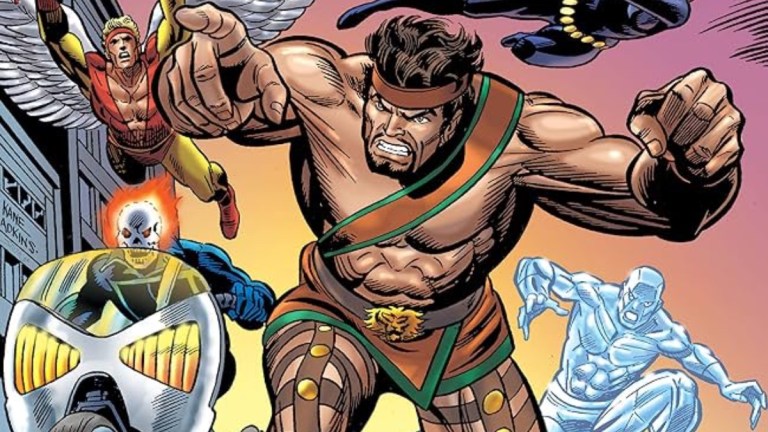
Strange as it might seem now, the first two Avenges line-ups didn’t make much sense. The first was just a collection of Marvel’s most popular heroes, and the second was a batch of also-rans who just got recruited into the big leagues. But by 1975, the Avengers were solidified as Marvel’s flagship team, so the company tried to put together another grab back of characters. Enter, the Champions, who debuted in 1975’s The Champions #1, by Jenny Blake Isabella and Don Heck.
The original line-up was led by Hercules, who gathered together the most obvious group of LA-based heroes to fight Pluto, god of the underworld. Obviously, you need Ghost Rider, a supernatural character. But then Herc also grabs the super spy Black Widow, and former X-Men Angel and Iceman. Somehow, the team won and managed to hold a series for three more years, only to fall into obscurity, until a new, young set of Champions—led by Ms. Marvel Kamala Khan and Miles Morales—formed in the 2010s.

Defenders
Like the Champions, the Defenders were a grab bag team. Unlike the Champions, that inconsistency was a feature, not a bug. The group who started in 1971’s Marvel Feature #1, by Roy Thomas and Ross Andru, consisted of Doctor Strange, Hulk, and Namor, three guys who had nothing in common and didn’t want to be around each other. Yet, they recognized that their powers actually worked well together, and thus a “non-team” was born.
The non-team concept never made much sense, but it did allow the Defenders to keep taking on more and more unlikely members. Characters rotated in and out, welcoming Silver Surfer and Doctor Strange’s partner Clea, and eventually being led by Nighthawk of all people. The rotating cast makes for some fun deep dives, but it also makes it hard for the book to hold an audience, forever resigning the Defenders to the c-tier of superhero teams.

Alpha Flight
In the movies, the Avengers are presented as an international team, under the guidance the shadowy faces from around the world who run SHIELD. In the comics, the Avengers tend to work for the American government, despite counting non-Americans such as Black Panther and Thor as members. Thus, various other countries have their own super-teams in the Marvel Universe, including Russia’s Winter Guard and Canada’s Alpha Flight.
But Alpha Flight is more than a collection of the mightiest heroes of the Great White North. They’re inextricably tied to Department H, the government agency that participated in the Weapon X program that turned Logan into the killing machine known as Wolverine. Thus, Alpha Flight not only often has something sinister about it, but the team often intersects with mutants, having first appeared in 1979’s Uncanny X-Men #179, by Chris Claremont and John Byrne. Yet, despite the sometimes nefarious nature of their bosses, Alpha Flight often makes for thrilling stories, thanks to its unusual line-up, which includes the jovial Puck, the gamma-irradiated Sasquatch, and the arrogant mutant Northstar.

Guardians of the Galaxy
Before rushing to the comments to point out that everybody knows about the Guardians of the Galaxy, note that I’m not talking about Starlord and his band of 21st century adventurers. That line-up of the team didn’t exist until 2006, when Marvel relaunched all of its cosmic characters. No, I’m referring to the original Guardians of the Galaxy from 1968’s Marvel Super-Heroes #18 by Arnold Drake and Gene Colan. That story took place in they 3007, when Charlie-27 returns home to his planet Jupiter to find it conquered by the reptilian Badoon. Together with Vance Astro, Martinex, and Yondu—all survivors of other conquered planets—Charlie-27 forms a resistance group called the Guardians of the Galaxy.
For the next few decades, the Guardians were mostly a curio, showing up to join the Thing in Marvel Two-in-One or fighting alongside the Defenders whenever time-travel shenanigans occurred. In 1990, the team finally got its own book, written and penciled by superstar artist Jim Valentino. Valentino’s book framed the Guardians as the Avengers of the future, and turned the resistance tale central to the concept into something more hopeful and superheroic… at least until Star-Lord showed up to hog all the fun.

Heroes for Hire
MCU fans might be a little miffed that the description of the Defenders above made no mention of Luke Cage or Iron Fist. That’s because those guys were never members of the Defenders in the world of the comics. Instead, they had their own team called the Heroes for Hire, something very different than what we saw on screen. As their name suggests, the Heroes for Hire were working-class superheroes, people who did good deeds but needed to earn a living, and thus charged for their services.
The first incarnation of the Heroes for Hire were less a team and more of a duo, a business venture that Luke Cage and Danny Rand put together in 1978’s Power Man and Iron Fist #54, by Ed Hannigan and Lee Elias. In the fallout of the Onslaught event that killed the Fantastic Four and the Avengers, Danny and the Golden Age Human Torch (more on him in a minute) launch a new Heroes for Hire, one that eventually includes Ant-Man, She-Hulk, Deadpool, and, yes, Luke Cage. That incarnation remains in place today, albeit with a rotating crowd, reminding us that even the good guys need a pay day.

Invaders
Speaking of Golden Age heroes, the very first superhero team in the Marvel Universe came long before Marvel Comics existed… sort of. Timely Comics, Marvel’s predecessor, first gathered together its most popular characters in 1946’s All-Winners Comics #19, written by Batman co-creator Bill Finger and penciled by various artists. That team included Captain America and Bucky, the Human Torch (originally an android, not Johnny Storm) and his sidekick Toro, Namor, the patriotic Miss America, and a yellow-clad speedster called… the Whizzer. No, this isn’t a Garth Ennis comic.
Dubbed “the All-Winners Squad,” that team only had one further appearance before the collapse of the superhero market meant that Timely would focus on teen romance and sci-fi comics instead. But after superheroes were a hit again, writer Roy Thomas and artist Sal Buscema revisited the idea in 1969’s Avengers #71. There, the All-Winners Squad were retconned into the Invaders, a superhero team devoted to fighting the Axis Powers (with none of the racism that marked the comics actually published in World War II). Since then, modern versions of the Invaders have come and gone, with the now-grown Winter Soldier or one-time Captain America John Walker a.k.a. U.S. Agent on the team. But they’ll always be in the shadow of the original All-Winners.

New Warriors
Stan Lee famously hated teen sidekicks, which is why he resurrected Captain America without poor Bucky in the 1960s. But he did see the value of teen superheroes like Spider-Man, and soon the Marvel Universe had a handful of super-powered adolescents running around, but no equivalent to the Teen Titans to gather them together. But the X-Men did have the New Mutants, the next generation studying at Xavier’s school, so Marvel decided to give the Avengers their own analogue in the New Warriors.
Debuting in 1989’s The Mighty Thor #411, by Tom DeFalco and Ron Frenz, the New Warriors were bunch of superpowered teams assembled by skate-boarding hero Night Stalker to wage a war on crime. The first group included the mutants Firestar and Marvel Boy, the Green Lantern analogue Nova, Namor’s relative Namorita, and the upbeat Speedball. Eventually, the team would be defined by ‘90s edge, particularly as it gains members such as the angry and aptly-named Rage, and as Nova runs around in a red muscle shirt as a costume. For fans of the team, the silliness is part of the appeal of the New Warriors, which is why the concept gets updated (and becomes immediately dated) every decade or so.

Power Pack
For those who like young heroes, but don’t want to deal with adolescent angst, there’s the Power Pack, the cutest bunch of moppets in the Marvel U. Created in 1984 by legendary X-Men editor and writer Louise Simonson and artist June Brigman, the Power Pack brought some much-needed whimsy to the Bronze Age. The Power Pack generally consists of four siblings in the Powers family. Eldest Alex a.k.a. Gee can control gravity. Julie a.k.a. Lightspeed leaves a rainbow trail when she flies. Jack the Mass Master can change the size and density of things, while Katie a.k.a. Energizer can shoot power balls.
The kids gained their abilities when the horse-like alien Aelfyre Whitemane learns that their father has discovered an anti-matter converter. To protect Dr. Power from the evil Snarks, Whitemane (or “Whitey”) imbues the children with special abilities, setting off a series of fun adventures. Throughout the years, the Power Pack has gained new members, most notably Franklin Richards of the Fantastic Four, and have taken on new names. But the team always works best when it’s just a family, defending the Earth together.

X-Statx
If the New Warriors were too edgy for some, just wait until you get a load of the X-Statix. Created by Peter Milligan and Mike Allred and introduced in 2001’s X-Force #116 as, yes, a new version of X-Force, the X-Statix applied early 2000s cynicism and media savvy to the world of mutants. This team were not feared and hated; they were loved and admired, at least from afar. The team was put together by the mysterious Coach, who worked with the government and media conglomerates to create a sexy group of doomed heroes who would become ratings gold.
Even after changing their name to the X-Statix, the team embraced that ethos. Random and shocking deaths could happen at any time, which could make the book feel cynical were the characters not so well-drawn. Team leader Mister Sensitive, whose mutant ability gave him senses heightened to an almost debilitating degree, and the teleport U-Go Girl prove to be among the most complex characters in the Marvel Universe at the time. As befits the central concept, X-Statix had trouble sustaining the mixture of strong character work and a death drive, so the team rarely lives on past its initial run (save for inexplicable breakout character Doop). But those first issues are enough to establish the X-Statix as one of Marvel’s best, most underrated teams.