Thirty Years Later, Fargo Remains the Best and Most Beguiling Coen Bros Movie
Thirty years ago, Joel and Ethan Coen proved that they do care about their characters with Fargo.

In 2013, former Village Voice film critic J. Hoberman began his review of Inside Llewyn Davis by declaring Joel and Ethan Coen as masters of the “art of contempt.” Where forerunners such as Marcel Duchamp or Johnny Rotten only dabbled in the medium, the Coens perfected it. “An undeniably talented two-man band of brothers, the Coens take pleasure less in confronting their audience or authority in general, than in bullying the characters they invent for their own amusement,” Hoberman wrote. “Theirs is a comic theater of cruelty populated by a battered cast of action figures and a worldview that might have been formulated not from a Buick 6, à la Dylan but the Olympian heights of a bunk bed in suburbia.”
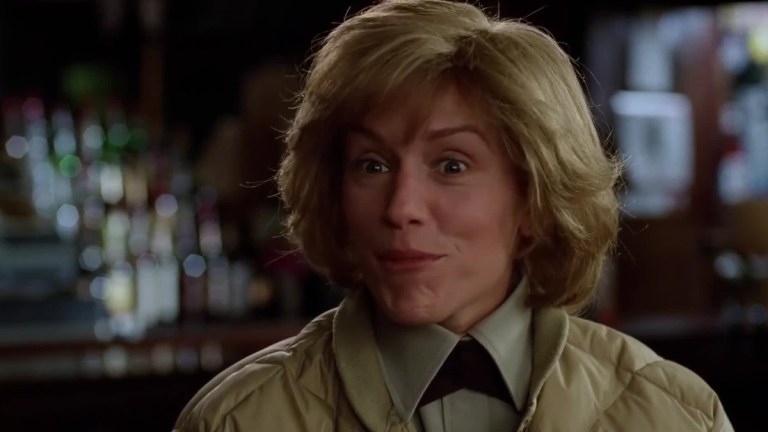
Hoberman is hardly alone in his assessment of the Coens’ talent and taste for condescension. Jonathan Rosenbaum, Roger Ebert, and other stalwarts of film criticism have heard a condescending giggle behind the travails of self-destructive folk singer Llewyn Davis, would-be parents H.I. and Ed McDonnough, and even the laid back Dude. Strong as the arguments are, they all dissolve at the sound of one short monologue, delivered by Frances McDormand as police chief Marge Gunderson at the end of Fargo. Released thirty years ago today, Fargo remains the Coens’ best movie and, because of that sweet and sincere speech, their most beguiling film.
Minnesota Nice and Minnesota Nightmares
By the end of Fargo‘s climax, several people have died, some in horrific ways. Carl Showalter (Steve Buscemi) gets shot in the face and shoved into a wood chipper. A traffic cop gets shot in the head for pulling over Carl and his partner Gaear Grimsrud (Peter Stormare). Gaear kills two more passers-by because they saw the two with the cop’s body, while Carl murders businessman Wade Gustafson (Harve Presnell) and a parking lot attendant (Bix Skahill) for getting in his way. And Jean Lundegaard (Kristin Rudrüd), the housewife whose husband Jerry (William H. Macy) came up with the whole fake ransom plot to bulk his father-in-law Wade, dies off screen.
That’s a lot of death for a movie that immediately entered the zeitgeist, in part because of the thick Minnesota accents the main characters use. If one only knows Fargo from Saturday Night Live or The Simpsons, then they would reasonably expect the film to be a bit of folksy comedy, celebrating the weird and wonderful antics of people in a unique community.
That’s not a completely wrong reading of Fargo. Minnesota natives themselves, Joel and Ethan Coen do clearly take pleasure in putting their home state on the big screen. The rhythms of the accent and especially the practice of “Minnesota Nice”—a cultural emphasis on superficial politeness even over deep despair—drive much of the film’s dialogue. A scene in which Marge interviews two local sex workers about Carl and Gaear ends with the former asking, “Oh yah?” and the latter responding, “Yah!” with the camera holding for to give the audience place to laugh.
The movie knows that there’s something offbeat about the way the people of Brainerd, Minnesota, and the nearby metropolis Fargo, North Dakota. But the film never forgets their rich inner lives, as demonstrated in Marge’s standout moment.
A Beautiful Day in an Ugly World
After the climax of Fargo, with all the dead bodies discovered and Gaear Grimsrud in her custody, Marge tallies up the count and drives him to the police station. “And for what? For a little bit of money?” she asks, disbelieving. “There’s more to life than a little money, you know. Don’tcha know that? And here ya are, and it’s a beautiful day. Well. I just don’t understand it.”
Read on the page, Marge’s response falls in line with both the cultural understanding of Fargo and with the critical consensus of the Coens. Marge seems hilariously out of touch with the bleakness of a world in which so much murder could happen. Her declaration that there’s more to life than money, delivered to a man as cold and uncaring as Gaear Grimsrud, seems at once obvious and useless. To those who insist that the Coen Brothers hate their characters and want us to laugh at their suffering, “I just don’t understand it” is the truest line that Marge speaks in the movie.
And that’s the point: Marge doesn’t understand it. She doesn’t misunderstand because of naiveté. Throughout the movie, she demonstrates her understanding of the evil that people can do, as demonstrated by her clear-eyed analysis of the murder scene that Carl and Graear left after shooting the traffic cop. Nor does she trust people blindly, as shown by her handling of former classmate Mike Yanagita (Stephen Park), who makes an unwelcome pass at her. She’s a good enough detective to keep putting pressure on Jerry Lundegaard and to not back down when he gets defensive, even if she’s a bit too slow to realize that he’d rather run than give her the information she needs.
Rather, Marge doesn’t understand how Carl and Graeer and Jerry can cause so much destruction because she chooses to not understand. When she finishes the death tally in her monologue and looks in the mirror to see that Graear refuses to acknowledge her point, she chooses to look away from him and up at the sky. She pronounces the day beautiful because she chooses to believe that it’s beautiful, because that’s the type of world she’s trying to create, no matter what people like Carl and Graear and Jerry do.
Choosing a Good Life
The very last scene in Fargo could be its most laughable. Throughout the movie, Marge’s husband Norm (John Carroll Lynch) submits a nature painting to a state contest. At the end, he announces that he lost to the Hauffman brothers, that their work would adorn the new 29-cent stamp while his would be relegated to the 3-cent stamp.
Compared to the pile of bodies accumulated throughout the movie, the stakes are so low and quotidian that they make the moment laughable. But Marge isn’t laughing. Instead, she snuggles closer to Norm and reminds him that people will need the 3-cent stamp to supplement the 26-cent stamps they already have, a point that Norm accepts. The two snuggle together, warm in their bed, and instead of looking at the evil around them or even their small embarrassment, they look to the future, reminding each other that Marge will give birth in two months.
The need for 3-cent stamps does not negate the fact that Norm lost to the Hautman Brothers. The birth of the Gundersons’ child does not undo the many deaths throughout the film. The warmth of their bed doesn’t stop the Minnesota cold outside.
But the decision that Marge and Norm make to choose that small bit of sweetness has value, not only within Fargo, but also within the larger Coen oeuvre. The Gundersons’ decisions reveal the Coens’ characters to be more than bumpkins to whom bad things happen. Rather, they are people who try to make a life in a cruel and uncaring world. Sometimes, those decisions are inexplicably self-destructive, as seen by every selfish thing that Llewyn Davis does. Sometimes, those decisions are as unlikely as they are hopeful, as when H.I. takes one of Nathan Arizona’s many kids. Sometimes, the Dude just chooses to abide.
Obviously, these decisions rarely work out for the characters, and we can laugh at them as much as we can feel sympathy or horror at their outcomes. But any viewer who feels contempt for the characters and their decisions cannot blame the Coens. They’re missing the sympathy and dignity the Coen Brothers give their characters, none more so than Marge Gunderson.