A Knight of the Seven Kingdoms Just Teased a Major Event in Westeros History
A Knight of the Seven Kingdoms hints at Egg’s heartbreaking future with its reference to the Tragedy at Summerhall.

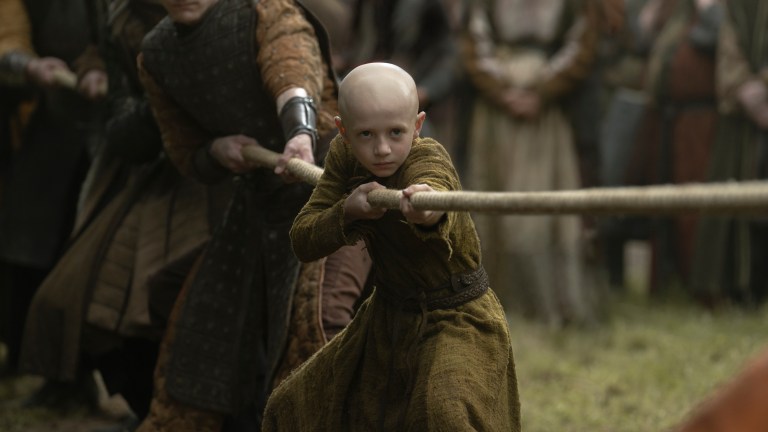
The following article contains spoilers for A Knight of the Seven Kingdoms episode 3 as well as details from the larger Targaryen family history in George R.R. Marin’s A Song of Ice and Fire canon.
The third episode of A Knight of the Seven Kingdoms is full of revelations. We learn that Aerion Targaryen is definitely the monster everyone says he is and that Ser Duncan the Tall is every inch the hero we all hoped. Most importantly, however, we learn the true identity of Dunk’s squire, Egg, who isn’t exactly the runaway stable boy he’s led everyone to believe.
No, he’s actually a Targaryen prince, the fifth child (and fourth son) of Prince Maekar, who will one day sit the Iron Throne as King Aegon V. And while his experiences with Dunk among the smallfolk help shape the ruler he’ll one day turn into, it appears that even the young Egg can’t escape the dark fortune that seems to haunt most of his family — or the hereditary madness that so often goes hand in hand with the Targaryen name. “The Squire” openly hints at the fairly tragic end awaiting young Aegon, though you likely won’t catch it if you’re not already fairly well versed in the horrors of his future.
On a walk through the jousting village, Dunk and Egg run into a fortune teller. She promises Ser Duncan the sort of generally bright fate you expect to hear from someone working the tournament grounds and hoping for tips — great success and more riches than a Lannister! But Egg’s fortune is something altogether different. “You shall be king and die in a hot fire, and worms shall feed upon your ashes,” she says. “And all who know you shall rejoice in your dying.”
Look, let’s just start by saying this is a whole lot to put on a ten-year-old kid, even for a fortune teller out to make a quick buck. But the unfortunate thing is… she’s also not wrong. At least where Egg is concerned. (You can argue about whether Dunk technically ends up being more wealthy than a Lannister, financially speaking, or just richer in terms of prestige.) Because Egg will die horribly, alongside many of the people he cares about most.
To compound the tragedy of his death further, King Aegon V actually turns out to be a pretty great ruler, as Targaryens go. Benevolent and approachable, he devotes a huge part of his reign to trying to improve the lives of the smallfolk he comes to know through squiring for Dunk, granting them new rights and protections they’ve never had before. (He spends the other half of his reign dealing with continued rebellions and his stubborn, intransigent children. Even Targaryens can’t have it all.)
But no matter how unconventional Aegon’s approach to the idea of kingship might be, he turns out to be very much like the rest of his family in one specific and very unfortunate way. Like so many Targaryens before (and after) him, he is obsessed with dragons. Aegon’s fascination with the creatures that once defined his family’s legacy doesn’t go so far as his brother Aerion’s — who literally believes he is a dragon in human form — but it’s still enough to ultimately bring about the end of his life.
The fortune teller’s prophecy in “The Squire” refers to an event that will come to be known as the Tragedy at Summerhall. The former seat of Aegon’s father, Summerhall is a castle in the Stormlands that the Targaryens often use as a vacation retreat. But in 259 AC, a catastrophic fire breaks out during a celebration to mark the birth of the king’s first great grandchild (Rhaegar, future father of Jon Snow according to the Game of Thrones TV series), leading to the deaths of, among others, King Aegon, his eldest son Prince Duncan Targaryen, and Ser Duncan the Tall, who is by this point Lord Commander of the Kingsguard.
The cause of the blaze remains unknown, though it is generally accepted that it was related to Aegon’s quest to restore dragons to the Seven Kingdoms and likely involved an attempt to hatch the last of the family’s dragon eggs by sorcery, wildfire, or a combination of both. (Some say blood sacrifice was also involved.) The tragedy drastically weakens the Targaryen line and marks the beginning of the final downward spiral for the family, leaving Viserys and Daenerys as essentially the only members of their House just a few short decades later.
No one knows for sure how many people died at Summerhall, and the survivors all refuse to speak of what happened, meaning the circumstances surrounding the blaze and its aftermath are a particularly intriguing mystery that A Knight of the Seven Kingdoms could provide some answers to, should the show continue long enough to include information about the horrific end of its leads’ lives. Of course, everything to do with this tragedy and Dunk and Egg’s ultimate fates is a real downer for a show that seems to be priding itself on its light touch and low-stakes plots, but this is Westeros, after all. No one gets a happy ending.