Minus Zero Director Reveals Why He Brought Back Godzilla’s Greatest Enemy (Exclusive)
Godzilla Minus Zero director Takashi Yamazaki follows up Godzilla Minus One by doubling the kaiju fun...

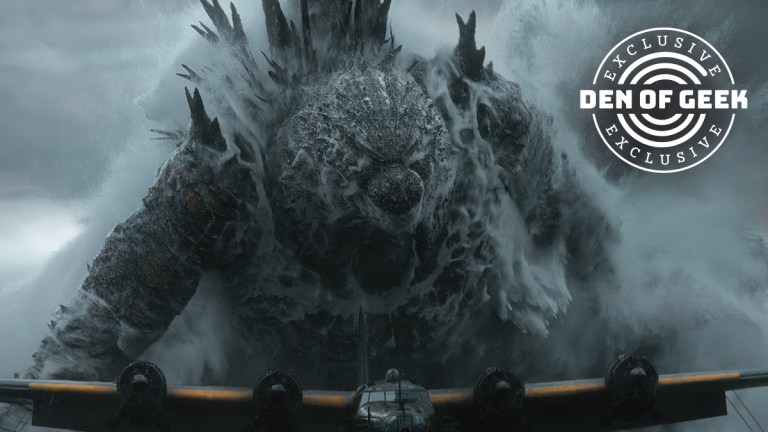
This article appears in the new issue of DEN OF GEEK magazine. Find out how you can subscribe to get the full physical copy right here!
The release of Godzilla Minus One in 2023 marked a watershed moment for the legendary giant monster, whose screen exploits began nearly seven decades earlier with the original Japanese release of Ishirō Honda’s Gojira (1954). Written and directed by Takashi Yamazaki, Minus One was the first Godzilla movie since the original to be set in the immediate aftermath of World War II, when a defeated and traumatized Japan was left with nothing and forced to rebuild in the wake of the devastating atomic attacks on Hiroshima and Nagasaki.
Perhaps even more explicitly than any other Gojira follow-up, the monster was once again positioned as a metaphor for the emergence of nuclear weapons and their devastating physical and psychological toll. Yamazaki also added not just fully fleshed-out human characters to the mix, but also approached Godzilla’s attacks on the populace with an intensity and realism previously unseen in the franchise. Audiences around the world responded, with Minus One becoming the highest-grossing Japanese Godzilla film ever made and the Academy awarding it Best Visual Effects, a first for both the Oscars and the Big G.
Now the King of the Monsters is back, and Yamazaki has returned to write and direct Godzilla Minus Zero, picking up the story of the found family comprised of former kamikaze pilot Koichi Shikishima (Ryunosuke Kamiki), his partner Noriko (Minami Hamabe), and their adopted daughter Akiko (Sae Nagatani).
“I’m very attached to the family,” Yamazaki explains, even as he acknowledges revisiting human characters in this franchise is rare. “I wanted to see what was going to become of this family going forward… I also wanted to see how people would try to deal with a situation where an even fiercer catastrophe befalls them.”
Not that it should be a surprise, but just as the Shikishima family and their compatriots attempt to return to a normal life after the events of the first film, a still-recovering Japan is threatened once again—but not by a re-emergent Godzilla. At least not initially.
In the opening moments of Godzilla Minus Zero, Yamazaki boldly introduces his version of another reigning kaiju from the Shōwa era of Toho Studios: King Ghidorah, the gigantic, three-headed, dragon-like beast from space whose history with the franchise goes back more than 60 years.
“I have a special sentiment toward this kaiju, because Ghidorah first appeared on the screen in 1964, and I myself was born in 1964,” says Yamazaki, who notes that Ghidorah was his first and only choice for the film out of Godzilla’s long list of monstrous enemies. “It was also the first time a kaiju came [on-screen] to my hometown of Matsumoto. So I have particular memories about this, and a sense of nostalgia for the kaiju. It had always been in my mind to have Ghidorah appear if I were to make a second film, and I never really strayed from that idea.”
While Godzilla has been and continues to be a metaphor for human-made nuclear horrors, Ghidorah represents something different for Yamazaki. “The way in which he interacts with or affects the weather is a metaphor for a natural disaster … which Japan suffered a lot,” the director explains. “There were a lot of disastrous typhoons that we had to survive through in our postwar era, which is also a reason that our postwar recovery was a bit delayed as well. So it does symbolize the turmoil and catastrophe that we had to survive in that era in Japan.”
A towering monster capable of flattening cities with its sheer size, lightning breath, and massive disruption of the skies themselves, Ghidorah seems unstoppable until a regenerated Godzilla rises from the ocean. The question thus becomes: can human beings somehow point Godzilla toward Ghidorah and force him into battle on Japan’s behalf?
The answer to that question is far from straightforward in Godzilla Minus Zero. Without spoiling too much, it involves direct references to the tragedies at Hiroshima and Nagasaki, certain plot strands left unresolved at the end of Minus One, and even ideas first hatched all the way back in the original 1954 film. It also reexamines a concept that Yamazaki touched on in Minus One: Godzilla is not just a monster, but in some ways, a god. A coldly indifferent one.
“I didn’t want to depict Godzilla as a being that is on the side of humanity,” Yamazaki says. “He is not our friend. Here he is depicted not as a complete god, but as a presence somewhere between beast and god. Therefore the human beings who are left to battle against him have to resort to certain methods and means that are absolutely taboo for human beings… That we as humankind should not step into this taboo is the idea that I’m depicting here, and I wanted to portray the internal conflict that comes with that.”
It’s this rich brew of metaphor, subtext, character study, and, of course, giant monster battles that has allowed Yamazaki to reach a whole new audience with his vision of Godzilla, and should he have the opportunity to direct a third film—for which he muses he might create his own original kaiju to battle the title character—he’s more than ready to move forward and carry Godzilla and his legacy into an astounding eighth decade on screen.
“As a filmmaker and a Godzilla fan myself, given that Godzilla has had a very long history of 70 years, to be part of the continuation of this tradition and this history gives me a sense of immense responsibility,” Yamazaki says with reverence. “I want to make Godzilla a very spiritual and sublime figure. And because of my absolute love for this kaiju, going forward, it makes me very happy to have so much support, and I’m very thankful for that.”
Godzilla Minus Zero opens in U.S. cinemas on Nov. 3.