Bucking Fastard Review: Kate Mara and Rooney Mara as The Shining Twins (But Funny!)
Werner Herzog returns to narrative films with an irresistible joke that casts Kate and Rooney Mara as sisters who do everything together. Everything.

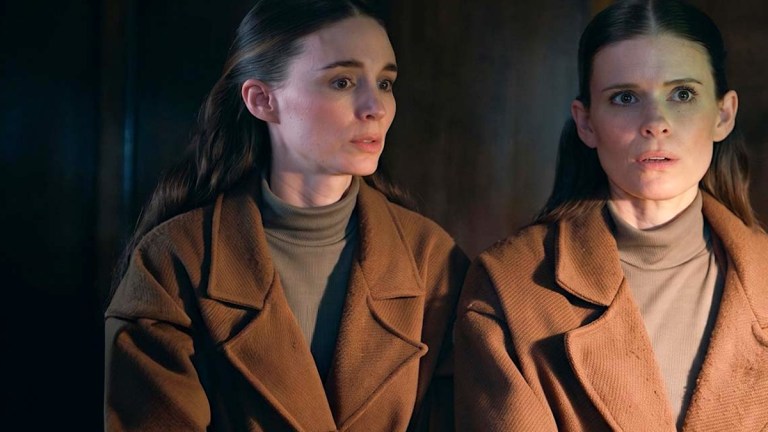
Kate and Rooney Mara are not twins, nor are their characters Jeanie and Joanie Holbrook in the new, odd Werner Herzog movie Bucking Fastard. Joan and Jean, in fact, get aggressively perturbed when they’re mistaken as identical siblings, or otherwise described in any terms as a double act. That’s because they’re so singularly one person; one characterization; a single performance told via two Maras. To suggest a differentiation is akin to effrontery.
And yet, the symmetry of both real-life Mara sisters’ performances and the way that Herzog almost always frames them, with Rooney to the left and Kate to the right, suggests an undeniable achievement in performance. The Sisters Mara are like a winking inversion in this movie of the spooky Grady girls and their matching dresses seen in Stanley Kubrick’s The Shining, and a reversal of old-timey Irish fairy tales about doppelgänger changelings.
There’s something uncannily unnerving at play, but also unexpectedly wholesome and jejune. As befits Herzog’s naturalist and documentarian instincts, it is when Kate and Rooney are allowed into the literal Irish wilderness of County Kildare (doubling for Wessex) during the third act, and away from the prying, voyeuristic eyes of society, that the performances seem the most at ease. Like a certain literary metaphor about mockingbirds and the morality of killing them, theirs is a wild thing energy that is best left to follow its own sisterly muses.
Nonetheless on a certain level, I cannot help but think Herzog was just tickled by the idea of seeing real-life sisters recite every line of dialogue in either unison or a shared back-and-forth that sees them effortlessly finish the other’s sentences. It is a joke, and a film, that lives in an eerie dreamlike space. And the picture is at its most bemusing when we just revel in the weirdness of, say, an opening courtroom sequence where Joanie and Jeanie insist on taking the stand together before His Majesty’s Tribunal Services. They’re apparently facing legal jeopardy after they fell in love with, and then became violently obsessed over, their limousine-driving neighbor (Orlando Bloom). That he went to bed with both of them at the same time probably wasn’t the wisest choice on his part either.
One can almost hear Herzog chuckle as Kate and Rooney’s faces flicker between sweet reverie while recalling meeting this cad in church to, not so convincingly, saying they had nothing to do with the fire that nearly immolated his house. When Bloom insists they’re crazy, the Maras scream “Bucking Fastard” with such synchronized fury, it creates a natural reverb echo in the ear.
For the first hour or so, the movie delights on this wavelength, even as it dutifully and almost obligatorily scaffolds a more bittersweet allegory atop the joke. There is, indeed, a method to Herzog’s madness, as revealed in an unexpectedly melancholic third act, but sometimes the matching clothes and four-pupiled wide-eyed stare is really all we needed.
Loosely based on a real pair of English sisters (who were, in fact, twins), Herzog’s Rooney and Kate deliberately occupy a kind of ethereal alternative reality. Theirs is a magical existence where Bloom can kick open the doors of church and storm through with a pint of beer in his hand like the Second Coming landed on Oktoberfest morning. Notably the story is also set in the UK, and yet both Maras make no attempt to hide their natural American accents. Increasingly a documentarian in his advancing age, Herzog returns to narrative storytelling in order to find the surreality of actual events.
It’s easy to see why the story of real-life Freda and Greta Chaplin appealed to the director of Aguirre and the most tender-hearted and weeping twist on Nosferatu we ever got. The Chaplins’ life reads like a bittersweet fever dream that was preserved in several docs I’m sure Herzog sought out. In his own peculiar manner, the filmmaker wants to use that truth to imagine a fiction interrogating the cost of being different. The filmmaker, Kate, and Rooney seek to celebrate the thinly-fictionalized Holbrook sisters’ iconoclastic singularity (times two), but Bucking Fastard ultimately becomes about the cost of going by the beat of a different drum.
In the film’s back half, the Holbrook girls are dispossessed by the culture around them. Their parents, whom we never see, want nothing to do with their now nationally notorious daughters; the only friends in their lives are intriguingly a rotating chorus of men, some of whom pity the poor things, and others like Bloom have obviously more lascivious things on their minds. None of them really get through to either Joanie or Jeanie about becoming their own person. There are occasional flashes of discordance, and curiously Herzog tends to foreshadow that danger whenever he has Kate move to the left of frame, and Rooney to the right. But these are less epiphanies than moments of disharmony, like the string of a fine violin snapping mid-concerto.
Soon enough, the sisters are always back where they’re happiest, which in the third act involves living out in the country with a kindly aunt, a fox they befriend, and a cave that becomes a not-so-subtle visual metaphor for the social destiny they built for themselves.
As an allegory, there is something wistful about the longview cost of being different. As a narrative, it becomes a lot like the sisters’ lives: unsatisfying and without the happy ascent you hope for in the glory days of youth—or Bucking Fastard’s much stronger first half. Rooney and Kate’s performances are too good of a gag to ignore, but the movie struggles to be worthy of their sis bliss.
Bucking Fastard premiered at the New York Film Festival on Sept. 30.