Club Kid Review: The Feel-Good A24 Gay Nightclub Movie You’ve Been Waiting For
Jordan Firstman’s Club Kid is the rarest of things in modern indie cinema: a feel-good crowdpleaser that will charm all awards season, even if it is a bit like queer arthouse Big Daddy.

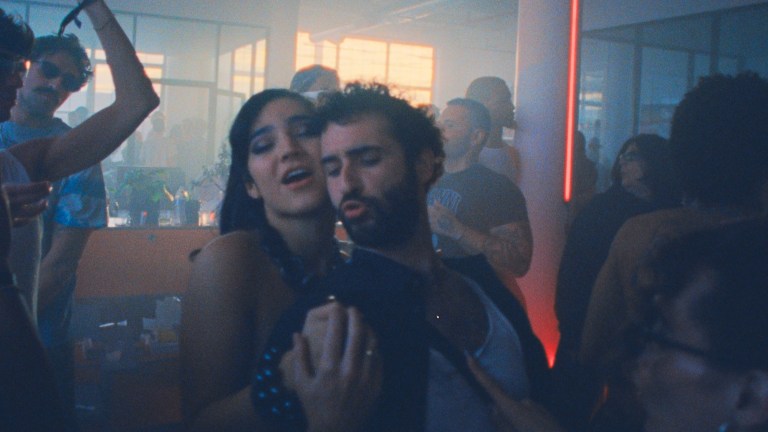
There are few people who do not at some point want to be the life of the party. There are even fewer who want to be the final dregs hanging on after last call is announced, “Closing Time” played, and the lights flipped on. Peter, Jordan Firstman’s hard-living and self-styled party promoter, is well past both points in a debut feature that the actor also wrote and directed. During an absolutely delirious opening sequence set in 2016, Peter is seen dancing by himself, unaware when things need to wind down… particularly following a threesome in the back of the club.
There’s, perhaps, a metaphor in this about a generation who can relate all too well when an insert card says, “A Deacde-ish Later,” and Peter is depicted still hitting the clubs as the oldest guy in the room, wondering aloud if anyone else feels like they lost grip on the last 10 years sometime yesterday. And there certainly could’ve been another, sobering A24 drama about millennial ennui and the despair of arrested-development malaise .
Fortunately, Club Kid is not that movie. It is, in fact, a simpler and therefore altogether rarer magic trick in the world of modern indie cinema: here is a pure, unapologetic crowdpleaser, a happy-go-lucky dramedy that is as charming as anything you will see this fall, and a movie that could not unfairly be called queer arthouse Big Daddy. That is to say while leaning in some degree of formula and feel-good (read: Hollywood) storytelling, Firstman has crafted an irresistibly sweet and sincere character study about a middle-aged man forced to finally grow up when a son he didn’t know about shows up at the door of his SoHo loft. (Recall that threesome I mentioned earlier? It turns out the otherwise gay Peter partied a little too hard that night.)
This is how Arlo (a precious and natural Reggie Absolom) enters the picture. Quiet, awkward, and angel-faced behind a polite English accent, Arlo is actually in the care of Edison (Kirby Howell-Baptiste, stealing scenes). In the same sequence Arlo and Edison enter the picture, the latter reveals she’s a friend of the boy’s mother, who died by suicide a few weeks ago. Apparently his stepfather is a piece of work, and Edison has the birth certificate to prove the paternity, which she’ll get around to showing Peter, but first can he offer her a bump of coke? For the jitters, y’know? Also if he doesn’t want to be a father, she totally gets it, and she’ll take Arlo back to the UK momentarily. Just let her go out and run a few errands this afternoon and….
So yeah, she never reenters the movie.
But that’s when the real story begins when a guy who went straight from an all-night party to a 10 a.m. business meeting the next day (it didn’t go well) is suddenly forced to figure out what it means to have a son, or even talk to a child. He also discovers another dimension to his life that has more to do with afternoon playgrounds instead of nocturnal Alphabet City rendezvouses—although, in a curious turn of events, young Arlo gets a bit of a crash course on that side of big city living too when he discovers Peter’s DJ mix tracks.
Stories about unexpected parenthood, responsibility, or basic “adulting” go back to as long as there have been stories, yet Firstman’s approach to the material comes with such vivid specificity that it makes the universal emotions of love and newfound maturity something altogether grander, if even still somewhat elegiac. By its very title, Club Kid is set deeply within the gay nightclub scene of the five boroughs—although Firstman’s real inspiration was apparently a summer spent in Berlin. This world is showcased in all its hedonism but also joy. We view it with the affection of a fellow traveler but the distance and melancholy of an introvert trying to fit in.
As the fictional Peter tells his remarkably well-adjusted, newfound son, “I’ve spent my whole life working to be cool, and I’ve succeeded at times.” But the epiphany for the character is that this kid simply is cool, or at least it puts him in touch with a side of himself that doesn’t need to front.
This dynamic for our protagonist makes for a layered showcase of Firstman’s talents as an actor and his perhaps even more remarkable fortitude as a director who can build a tone of bittersweet happiness and the quieter pleasures learned in found family. Let’s just say Arlo meets all varieties of adopted uncles and aunts. The film is also frank about the dangers and excesses of what some would consider an extreme lifestyle, and certainly of how it can be both celebrated and chided in the same breath by mainstream, even desperately supportive voices. There are sequences where Peter is judged by those who claim to have Arlo’s best interests at heart, but also supported by unlikely cheerleaders in social services (personified by a gentle and hunky Diego Calva). At heart, though, it remains a simple father-and-son story told with confident authenticity.
The son element is where Firstman reveals the hiccups that can occur in first-time filmmaking. Young Abolsom is sublime as a child struggling to adjust behind a serene, stoic exterior, yet the film and Firstman are so wrapped up in Peter’s baggage that the boy’s own grief over losing a mother—or the culture shock of going from the UK to NYC—is left underwritten and unexplored. At one point Arlo gets in a fight on the playground, and the film and Peter both reveal curiosity at what might be going on, but neither have the time to dig deeper; they’re too distracted in what this cool kid means for all the other messy furniture in his father’s life.
But from the retro DJ gear piled in Peter’s apartment to the old-timey piano Arlo convinces his father to lug up three flights of stairs for the same one-bedroom, Club Kid finds such warmth and undeniable good cheer from these knicknacks that it’s impossible to not want to join the revelry. And when Arlo can finally refer to Peter as “Dad,” there will be few dry eyes in the auditorium. It’s a song you’ve heard before, but it is sung with so much grace that it can still feel like an epiphany.
Club Kid releases in the U.S. on Nov. 6.