Let Dinosaurs Rule Hollywood Movies Again
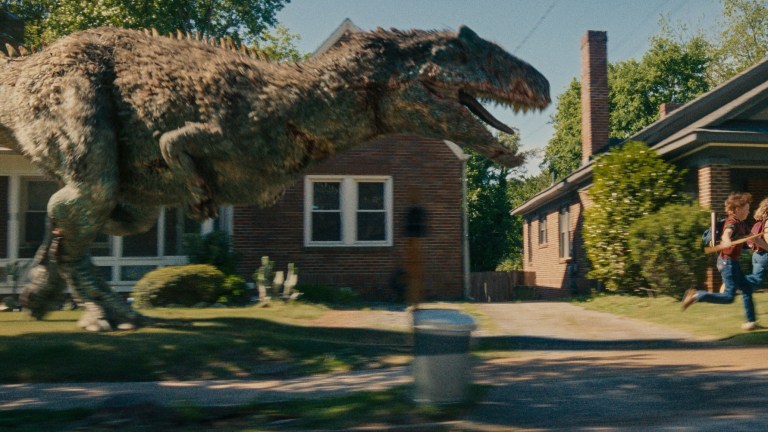
The End of Oak Street is the rare thing: a dinosaurs-attack movie not attached to the Jurassic Park franchise. And its studio seems almost scared of it.

A few years ago, I had the chance to speak with Scott Beck and Bryan Woods, the screenwriters who first came up with the idea of A Quiet Place and who wrote and directed the deliciously elevated B-thriller, Heretic. In between those pictures, they also wrote and directed a dinosaur movie that didn’t quite work, the Adam Driver-led 65. It’s a movie with a hell of an elevator pitch—what if a guy who looks like Kylo Ren crash-landed on Earth 65 million years ago when dinosaurs ruled the Earth?—but suffered in execution. Even so, I admired the ambition, especially because multiple studios refused to consider making a dinosaur movie on principle.
“Jurassic Park is such a towering achievement that it’s almost scared off anyone in Hollywood from ever doing a dinosaur movie,” Woods told me at the time, “which is a totally valid reaction to that movie. But at the same time, as fans of dinosaurs and as fans of the subgenre of dinosaur movies, we kind of felt like there was a little something missing from the landscape.” It’s an anecdote that lines up with Luke Sparke’s experience as a young filmmaker with a pitch for what became Primitive War, a movie he sold around town before settling on making it as an indie that was released on VOD last year. According to the helmer (via Slashfilm), “Everyone said, ‘Well, Jurassic has the monopoly on dinosaurs, and you are not Steven Spielberg.’”
That’s very true. But then, very few of us are. Spielberg of course has a preternatural intuition about where to place a camera and how to utilize its movements for maximum awe and excitement, but the last time he personally directed a dinosaur movie was nearly 30 years ago via The Lost World: Jurassic Park. Meanwhile all the sequels he produced in that series since have generally been of a precipitous drop in quality—with the notable exception that no Jurassic movie before or since is worse than Jurassic World Dominion, a.k.a. the one that brought back Sam Neill and Laura Dern and then had them chase locusts.
But in spite of that franchise’s glaring problems, studios have treated dinosaurs as essentially copyrighted intellectual property belonging exclusively to Spielberg—so much so that outside of 65, the only other misbegotten attempt to do a Hollywood-backed dino-attack flick in the past three decades was Roland Emmerich’s poor choice to bastardize Godzilla into a Jurassic clone.
But that’s now changed.
Like a bolt of prehistoric lightning, David Robert Mitchell’s The End of Oak Street has ironically delivered the best Steven Spielberg dinosaur movie the Beard never made himself. This is not to say Oak Street is another Jurassic Park redo—the happily schlocky picture makes no bones about being a techno thriller, nor bothers to waste a minute lamenting the hubris of man. Instead it’s an older school riff on a different style of Spielbergian cinema; the type he’d produce under the Amblin banner and that would’ve been helmed by Richard Donner or a young Bob Zemeckis in the ‘80s. Mitchell even sets his popcorn in 1982, the same year the writer-director would’ve been eight, and the film’s core family ensemble includes a 13-year-old boy among its ranks.
Made in the vein of Gremlins or Back to the Future with a body count, Oak Street is also meaner than any of the modern Jurassic World flicks. It’s basically a Twilight Zone episode where, rather inexplicably, a whole neighborhood is transported back in time hundreds of millions of years. There’s no rhyme or reason, but there is a literal cast of dozens of American suburbanites who suddenly find themselves on the buffet table for a scaly party that includes Spinosauruses, winged demons, a feathery giant chicken with fangs, and of course a T-Rex. It’s madcap and delightful entertainment in the hands of a director who helped kickstart our current age of “elevated horror” with It Follows.
Mitchell even finds time to craft a simple, but effective, story about a family in crisis as led by Ewan McGregor and Anne Hathaway, two actors who give the material more gravitas than it needs, but look oh so awesome when swinging sledge hammers and shotguns at attacking dinos.
All of which makes the fact that the movie is being almost quietly jettisoned into theaters at the end of this summer a tad baffling. The thing rips and roars, but neither McGregor or Hathaway have done much press for the movie. Elsewhere the marketing team invested in a woeful AI video focused purely on the adorable dog in the movie doing “a podcast interview” with other AI canines.
Three decades later, Hollywood still seems sheepishly afraid to admit they’re playing in Spielberg’s ballpark. But the thing is Mitchell is only about the fourth guy to do so without Jurassic in the title, and he went ahead and made the best one since Spielberg’s dino-eye roamed Isla Nublar and he shouldn’t be the last.
Dinosaurs are one of the oldest daydreams of movie magic. They have been with us since Gertie the Dinosaur quietly walked across the animated screen in 1914 and wowed audiences when they attacked in “live action” the casts of The Lost World (1925), King Kong (1933), and the oh, so scientifically-minded One Million Years B.C. (1966) with Raquel Welch’s fur bikini.
Jurassic Park is wonderful, but there is an eternal itch that needs scratching, and if lousy Jurassic World sequels won’t get the job done, hand the boomstick and dino-repellent to the next generation.